Politics & Government
Newark Group Says NJ Should Have Done More After George Floyd's Death
A social justice group in Newark reflects on what police reforms have – and have not – been accomplished in NJ since George Floyd's murder.


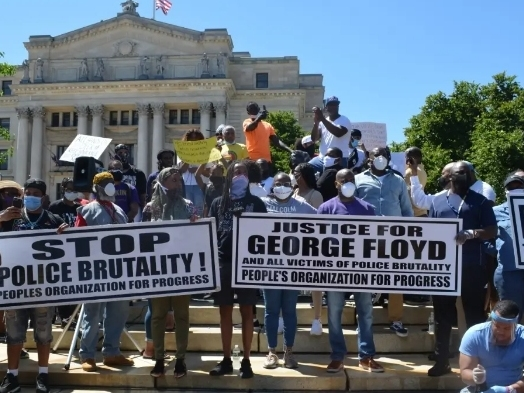
NEWARK, NJ — It's been two years since George Floyd was murdered under the knee of a police officer in Minnesota. Now, a social justice group in New Jersey is reflecting on what reforms have – and have not – been accomplished in the Garden State after Floyd’s death sparked a national “racial reckoning” in the summer of 2020.
After Floyd was killed, towns and cities across New Jersey saw rallies and protests against police brutality, with marchers demanding reforms on the local, state and national levels. The protests included a massive-but-peaceful rally in Newark, which was supported by the Newark Police Department.
“This moment marked a transformative opportunity for moving past rhetoric to ensure police are accountable to the communities they serve here in the Garden State and across the nation,” the New Jersey Institute for Social Justice (NJISJ) said Wednesday.
Find out what's happening in Newarkfor free with the latest updates from Patch.
“New Jersey has failed to meet this moment,” the Newark-based group added.
According to the NJISJ, it’s not all bad news – there have been some significant victories when it comes to police reform in the past two years. They include three new police directives rolled out on the state level last year, including an update about filming law enforcement officers on the job.
Find out what's happening in Newarkfor free with the latest updates from Patch.
“None of us can forget the role that a young Darnella Frazier played in recording George Floyd's murder, resulting in the conviction of Derek Chauvin – one of many cases where recordings have led to police accountability,” said the NJISJ, which worked with the New Jersey attorney general’s office and the ACLU of New Jersey to craft the directive.
“We also succeeded in getting legislation passed to keep police at least 100 feet away from polling places during elections, a good law but a sad acknowledgement that due to generations of trauma with law enforcement, Black voters justifiably may find police presence to be intimidating,” the group said.
“Unfortunately, however, New Jersey has let languish bills that would create meaningful police accountability, like completely banning chokeholds and establishing civilian review boards,” the NJISJ continued.
“If anything, it appears that legislators are moving toward avoiding true transformation in favor of politically driven moderation – and have shown little appetite for also focusing on building up alternatives to policing to create deeper community safety,” the nonprofit charged.
RACIAL JUSTICE IN NJ: BEYOND POLICE BRUTALITY
Policing isn’t the only racial justice issue that needs to see action in New Jersey, according to the NJISJ.
“Whether it’s the recent massacre in Buffalo, or the disparate treatment of Black and white teens at a New Jersey mall, we face reminders every day that white supremacy is alive across America and that it impacts not only policing, but every part of life for Black people through criminal, economic, environmental and democratic injustice,” the group said.
- See related article: Racial Gaps Still Plague New Jersey, Advocates Say
Last year, the NJISJ released a report with a list of ways to “make Black lives really matter in New Jersey” for 2021 and 2022.
Here are some of the longstanding racial issues the state needs to face, the NJISJ said – and some possible solutions, too.
TRANSFORM THE YOUTH JUSTICE SYSTEM
Close Youth Prisons, Invest in Kids – Close New Jersey's three youth prisons and invest $100 million into creating a lockbox fund for front-end youth services and programs.
Implementation of a Community-Based System of Care for Youth – Pass and sign the Restorative and Transformative Justice for Youths and Communities Pilot Program bill (A4663/S2924) to develop restorative justice hubs and enhanced reentry services for the young people being released from New Jersey's youth prisons in response to the COVID-19 crisis (Signed into law on August 11, 2021).
KEEP COMMUNITIES SAFE
Build a Culture of Accountable Policing – Ensure that law enforcement is guided by policies and systems designed to build a culture of accountability that are created and implemented through engagement with community members by:
- First Amendment Directive to protect civilians' rights during police interactions (Issued by the Attorney General on December 7, 2021)
- Limiting military-grade equipment available to local law enforcement agencies through the federal 1033 program
- Banning and criminalizing police use of chokeholds (A1370/S265)
- Ending law enforcement qualified immunity
- Creating municipal civilian complaint review boards (A1515)
- Reducing police enforcement of non-serious offenses, particularly for youth
Invest in Community-Based Public Safety Options - Rethink policing by investing in community-based approaches to public safety that will decrease law enforcement's footprint by:
- Developing mental health first responder and crisis intervention systems that rely on highly trained professionals other than police to address certain crises
- Reinvesting dollars into community-based services that empower communities—like schools, hospitals, libraries and parks
- Funding restorative justice programs and services
ENSURE DEMOCRACY FOR ALL
- Free the Vote for People in Prison - Restore the right to vote to incarcerated people.
- Same-Day Voter Registration - Enact same-day voter registration, including on Election Day (A1966/S247).
- Early Voting - Enact comprehensive early voting using e-poll books (A4830/S3203) (Signed into law on March 30, 2021).
- Racial Justice in Redistricting - Guarantee that New Jersey's racial makeup is effectively represented in the redistricting process.
- Right to Jury Service for People with Criminal Convictions - Restore the right to serve on a jury for people with criminal convictions.
- Limited Police Presence at Voting Locations - Ensure voters can cast their ballot without fear by limiting police presence at voting locations except for emergency response (A4655/S2923) (Signed into law on January 18, 2022).
REPAIR THE HARM OF DIVESTMENT
Produce COVID-19 Racial Data - Ensure the Department of Health maintains and regularly updates COVID-19 impact data by race, ethnicity and other key demographics at the municipal and county levels (in compliance with P.L.2020, c.28) (Municipal data released and updated in 2021 to ensure compliance).
Establish Reparative Justice - Create the New Jersey Reparations Task Force (A938/S386).
“From the ravaging of the coronavirus pandemic, to persistent violence by police against Black people, to disparities in wealth, health and criminal justice, we are seeing deeply embedded cracks of structural racism in our foundation erupt into earthquakes in Black communities,” the NJISJ wrote.
“This is true right here in New Jersey, where Black people face some of the worst racial disparities in the nation,” the group added.
- See related article: Systemic Racism In NJ Added To Pandemic Deaths, Advocates Say
- See related article: NJ Has One Of America's Worst Racial Wealth Gaps, Study Says
- See related article: See The Plan To Fix New Jersey's 'Racist' Infant Mortality Gap
Send local news tips and correction requests to eric.kiefer@patch.com
Sign up for Patch email newsletters. Learn more about posting announcements or events to your local Patch site. Don’t forget to visit the Patch Newark Facebook page.
Get more local news delivered straight to your inbox. Sign up for free Patch newsletters and alerts.