Community Corner
NJ Sewerage Agency Rehabs Its Network Of Sludge Tanks In Newark
The Passaic Valley Sewerage Commission usually gets "extremely high volumes of sludge" from a barge and 8 ships per week, its chair says.


NEWARK, NJ — Every week, the Passaic Valley Sewerage Commission (PVSC) gets a visit from a barge and about eight large ships, including some from the New York City Department of Environmental Protection and the Bergen County Utilities Authority, among other customers. Each carries an extremely high volume of “sludge” – an industry term for wastewater treatment byproducts.
And it’s all got to go somewhere.
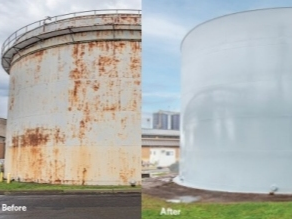
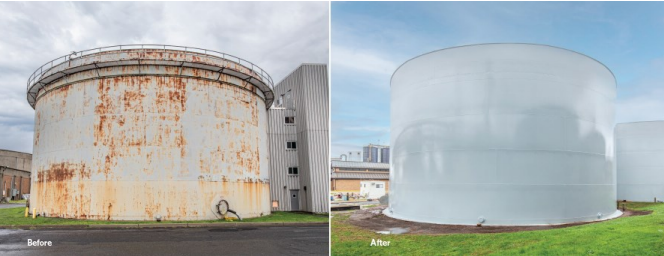
As part of the treatment process, the payload of sludge will eventually be sent to the PVSC’s 1.6-million-gallon Old Sludge Storage Tank network in Newark, which was originally constructed in the 1960s. Since then, the tanks have seen bad weather, constant usage and the passage of time, all of which have contributed to their corrosion.
Find out what's happening in Newarkfor free with the latest updates from Patch.
Recently, the sewage agency embarked on a project to rehabilitate its giant sludge tanks. The effort included restoring the tanks with a corrosion-resistant liner, repairing the stair tower and pumping station, and designing a new force main to allow for the transmission of contents from the Old Sludge Storage Tanks to PVSC’s Primary Clarifier influent channel.
The project also included rehabilitating concrete floors and metal walls, removing hazardous coatings, and demolishing catwalks, a water cannon system and old sample ports.
Find out what's happening in Newarkfor free with the latest updates from Patch.
“The PVSC receives extremely high volumes of sludge from approximately one barge and eight ships per week,” said Thomas Tucci Jr., the agency’s recently re-elected chair.
“These tanks are vital in enabling us to treat that sludge efficiently and at full capacity,” Tucci said, adding that by rehabilitating the tanks, the PVSC is “ensuring our future ability to consistently receive and treat large amounts of sludge.”
The agency’s efforts earned it recognition from the American Council of Engineering Companies, which gave the project a “Distinguished Award” in May at its annual awards banquet.
HDR Inc., the engineering, architecture, environmental and construction services firm that is the designer on the OSS tanks project, also earned an award from the American Council of Engineering Companies for its work.
HDR offers more details about the PVSC’s Old Sludge Storage Tank network and its importance on its website:
“Nearly 100 years ago, the Passaic Valley Sewerage Commission constructed a wastewater treatment plant near the banks of the Passaic River and Newark Bay. Over the subsequent century, it has become one of the East Coast’s largest wastewater facilities. It serves 1.5 million residents, 225 significant industrial users, and 5,000 commercial users across 48 municipalities and 5 counties and is designed to treat an annual average flow of 226 million gallons per day and wet weather capacity of 400 MGD.
“The PVSC’s treatment facility operates a pure oxygen active sludge plant and treats its sludge using gravity thickeners, thickening centrifuges, Zimpro wet air oxidation, decant tanks, and frame and plate sludge filter presses. In addition to PVSC’s own sludge production of approximately 20 MGD (peak), PVSC accepts and processes merchant sludge from the New York City Department of Environmental Protection, Bergen County Utilities Authority and others. PVSC can receive such visitor sludges delivered via overland trucks or marine vessels such as ships and barges. The marine vessels discharge into a combination of four existing open air storage tanks, two “new sludge storage” tanks and two “old sludge storage” tanks.
“In 2016, the PVSC commissioned an existing conditions assessment of several facilities, including the old sludge storage facilities constructed in the 1960s, to determine the need for repairs and replacements of the WWTP’s aging solids handling infrastructure. The OSS tanks showed signs of corrosion and needed to be rehabilitated to ensure future ability to receive sludge.
“The Old Sludge Storage Rehabilitation project restores the 1.6-million-gallon OSS tanks’ use and supports the overall operation of the Zimpro biosolids handling process. Additionally, the project included repairs and upgrades to the OSS stair tower that connects the two OSS tanks and the associated OSPS pumping station. Lastly, the project included the design of a new below-ground force main to interconnect the OSS tanks to an existing interceptor to convey OSPS pump discharge to the primary clarifier influent channel.
“We supported PVSC with obtaining funding through the New Jersey Infrastructure Bank,” HDR notes on its website. “This included preparing an environmental planning document, which the New Jersey Department of Environmental Protection accepted. They also assisted PVSC with obtaining NJDEP approval for the new force main and vault.”
Send local news tips and correction requests to eric.kiefer@patch.com. Learn more about advertising on Patch here. Find out how to post announcements or events to your local Patch site. Don’t forget to visit the Patch Newark Facebook page.
Get more local news delivered straight to your inbox. Sign up for free Patch newsletters and alerts.