Politics & Government
NJ Watchdog Continues To Monitor State Police: See Latest Report
Comptroller: NJ State Police "generally complied" when it came to investigating complaints and disciplining troopers – with some exceptions.


NEW JERSEY — A state watchdog agency has completed its mandatory, bi-annual review of the New Jersey State Police, finding that the department “generally complied” with internal investigation requirements – with some exceptions.
The New Jersey Office of the State Comptroller (OSC) is required to conduct performance reviews of the New Jersey State Police (NJSP) under a 2009 state law. The goal? To see if the NJSP is “maintaining its commitment to non-discrimination, professionalism and accountability.”
The law was rolled out to continue the work of a 1999 consent decree, which was reached after the U.S. Department of Justice sued the NJSP and the state of New Jersey for allegedly discriminating against Black drivers traveling on highways throughout the state, including the New Jersey Turnpike.
Find out what's happening in Newarkfor free with the latest updates from Patch.
For the most recent report, the OSC focused on the NJSP’s Office of Professional Standards and its procedures for investigating complaints made against troopers – and meting out discipline when appropriate.
Read the full report and learn about its methodology here. Learn more about how to file a complaint against a NJSP trooper here.
Find out what's happening in Newarkfor free with the latest updates from Patch.
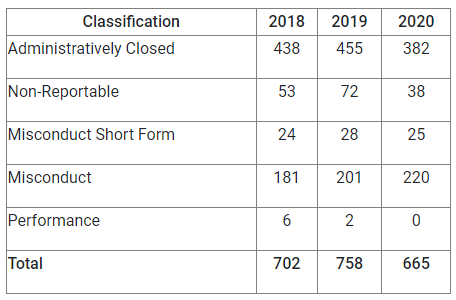
The comptroller’s office released data showing the number of complaints against troopers received and classified by the NJSP’s intake unit during the period of January 2018 through December 2020:
According to investigators with the comptroller’s office:
“To determine if OPS’s Intake Unit was properly classifying complaints against troopers, OSC sampled and reviewed 82 OPS cases closed during the review period. This sample included 37 cases that the Intake Unit had classified as administratively closed, 39 that had been classified as misconduct, two that had been classified as misconduct short form, and four classified as non-reportable. Of the sampled files reviewed, OSC found that, with the exception of five cases … the Intake Unit had properly processed and documented those complaints. OSC also observed operations at the Hotline call center and listened to recorded conversations between complainants and Intake Unit personnel. OSC’s review found that the Intake Unit dealt with callers in a professional and courteous manner and obtained pertinent information from them.”
As for misconduct probes and discipline in the NJSP, here’s what the comptroller’s office had to say:
“To establish whether the Internal Affairs Investigation Bureau (IAIB) is conducting thorough misconduct investigations, OSC reviewed the 39 misconduct cases to ensure they contained all the required investigative documents and evidentiary material. OSC also examined whether IAIB’s determinations that allegations were either substantiated, unfounded, exonerated, or had insufficient evidence were supported. OSC reviewed all relevant documentation and evidence contained in each of those files, including audiotaped statements of the complainant(s), the trooper that was the subject of the complaint, and any witnesses; MVR and body worn camera videos of the incident; any prior disciplinary history of the trooper; and any references to discipline imposed in similar cases. OSC’s review of the 39 completed misconduct investigations found that the evidence supported the findings and conclusions in each of the cases. Based upon available documents, it also appeared to OSC that discipline imposed was consistently meted out. OSC, however, was not able to review details of the prior offenses captured in the disciplinary lookback for the charged offenses.”
While the NJSP was “generally compliant” as far as classification and discipline, there were some “deviations from established policy” that should be corrected, investigators pointed out.
According to the comptroller’s office:
“Among other findings, the OSC determined that the NJSP’s Office of Professional Standards (OPS) departed from governing NJSP policy by administratively closing five cases that should have been classified as performance issues. The Office of Law Enforcement Professional Standards (OLEPS) was aware of this deviation from policy but did not take affirmative steps to correct it. Similarly, a process OPS used to administratively close some racial profiling and disparate treatments complaints ran counter to governing policy. The OSC also determined that OLEPS is not using existing data to analyze race, gender, or rank and their influence, if any, on the imposition of discipline.”
Investigators’ recommendations include:
- The NJSP should immediately reinstate the use of the performance classification, and further assess whether discontinuing its use is appropriate. Should a change in policy occur regarding the use of the performance classification, NJSP should receive approval of that change from both OLEPS and the Attorney General. Careful consideration should be given to whether the elimination or modification of this category would undermine effective supervision and documentation of trooper conduct.
- The NJSP, in consultation with the Attorney General, should continue to refrain from its practice of administratively closing racial profiling and disparate treatment complaints without further investigation when certain criteria are satisfied, and further assess whether such a practice is appropriate. Any changes to the current practices concerning the treatment of racial profiling and disparate treatment complaints should be formalized in SOP B10 after approval by the Attorney General. Careful consideration should be given to whether this proposed practice of administratively closing certain racial profiling complaints would undermine the Attorney General’s oversight of NJSP in the area of racial profiling.
- The IAIB investigative unit heads should ensure IAIB investigators request an extension of the 120-day requirement to complete an investigation when an investigation will exceed such time frame.
- The NJSP should provide an email address for OPS so members of the public can file online complaints.
- To avoid deterring the public from submitting complaints to OPS, NJSP should remove disclaimers from its complaint submission instructions that threaten criminal prosecution and/or civil proceedings against complainants.
- The OLEPS should ensure that NJSP does not implement changes to SOPs without prior approval in accordance with the mandates of the Act.
- The OLEPS should analyze existing data to assess any patterns regarding the influence of race, gender, or rank on the imposition and severity of discipline imposed by NJSP.
Send news tips and correction requests to eric.kiefer@patch.com
Sign up for Patch email newsletters. Learn more about posting announcements or events to your local Patch site.
Get more local news delivered straight to your inbox. Sign up for free Patch newsletters and alerts.