Politics & Government
One Of Nation’s Longest Pro-Palestine Protests Ends At Rutgers-Newark
"Raided" or "peacefully dismantled?" Protesters and authorities are giving clashing accounts of what happened at the Gaza solidarity camp.


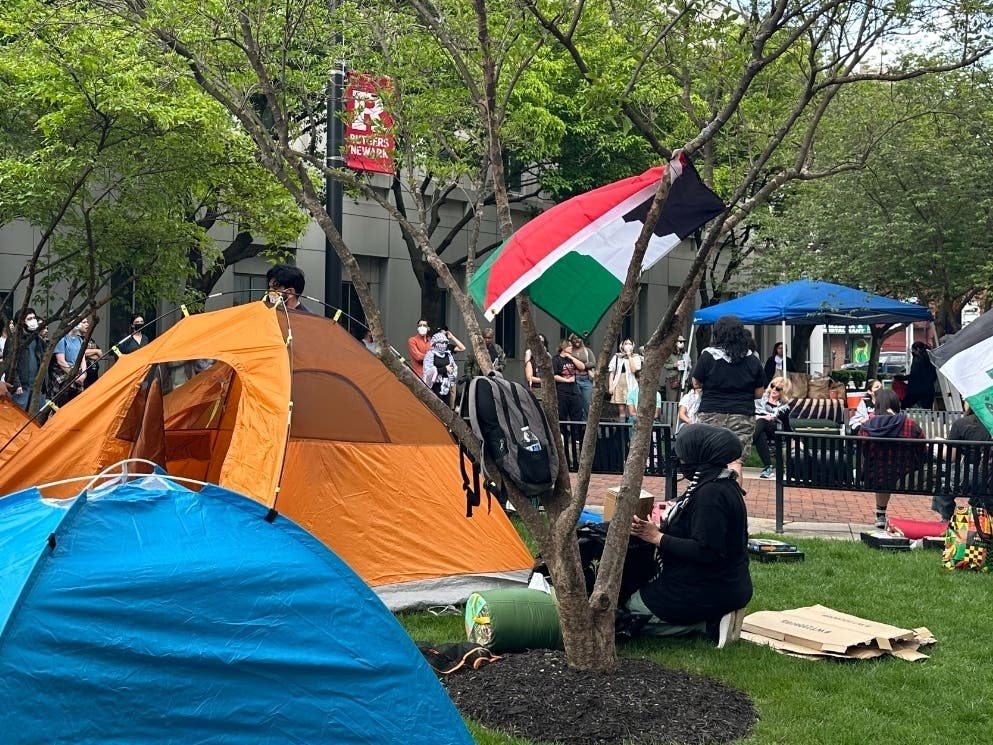
NEWARK, NJ — After an entrenched protest that lasted five-weeks – making it one of the longest-running such demonstrations in the nation – the pro-Palestine “Gaza solidarity camp” at Rutgers Law School in Newark is gone.
Protesters and authorities are giving clashing accounts of what happened on Sunday, with activists claiming their camp was “raided” and Rutgers administrators saying that it was peacefully “dismantled by the protesters.”
The Newark Solidarity Coalition, which has been helping to spearhead the protest, announced Sunday that the camp was being “cleared out in 30 minutes” in a social media post. “They are raiding the encampment!” the group wrote, adding that “they have all streets coming into the [university] blocked” and “they are not letting anyone near the campus.”
Find out what's happening in Newarkfor free with the latest updates from Patch.
The coalition also accused authorities of “pushing professors” and not allowing legal observers to access the area, sharing video footage filmed at the scene.
“We need a lawyer!” one activist yells.
Find out what's happening in Newarkfor free with the latest updates from Patch.
A statement from Rutgers-Newark paints a different picture of what happened Sunday, however.
“This morning, the small and sparsely occupied encampment at Rutgers-Newark was dismantled by the protestors shortly after they were informed by university officials that they needed to decamp, reflecting the university’s authority to regulate the time, place and manner of protest on university property while preserving the First Amendment rights of the students, faculty and staff to protest,” administrators wrote.
“Rutgers-Newark administrators, the Rutgers University Police Department in their regular uniforms and facilities staff were on site to oversee the decampment, which was orderly and peaceful,” administrators added.
Rutgers administrators claimed they have been attempting to meet with the protesters in good faith. However, over the past two weeks – while the protest has remained peaceful – activists have repeatedly violated the university’s fire code, running extension cords into nearby buildings and using open flames for cooking, they alleged.
University administrators are also accusing demonstrators of defacing buildings with graffiti, violating policies about accessing buildings and “degrading the campus environment.”
“Although the protestors have dismantled the encampment and work has begun to restore the site to its intended uses for the university community, we have offered to continue discussion with the protestors on how we may collaborate on local issues of mutual concern,” Rutgers administrators said.
Meanwhile, the Newark Police Department and Mayor Ras Baraka have issued their own statement about last weekend after Newark police officers became involved.
According to city officials, Rutgers police “made a decision to remove a student protesters’ encampment” and asked their peers at the NPD to help with traffic control during the “dismantling operation.”
Newark police didn’t participate in the dismantling of the encampment until three officers – who were conducting traffic control on the streets outside of Rutgers University – saw a crowd surrounding two Rutgers police officers, city officials said.
Here’s what happened next, they alleged:
“The university’s police officers had detained an adult male following a foot pursuit. Newark police officers provided mutual aid for crowd control. When the crowd was disbursed, Rutgers police detained the suspect, who was later released from the campus. Newark police returned to their traffic control locations.”
Newark police didn’t make any arrests during the encounter, authorities said.
Police acknowledged that one Newark officer was allegedly seen “flexing his muscles” during the encounter. A disciplinary investigation has been launched into a potential violation of Newark police policies and procedures, authorities said.
Baraka and Public Safety Director Fritz Fragé said they applaud the response of Rutgers University-Newark and thanked administrators for their “respectful approach to handling one of the longest-lasting protests in the country.”
“The City of Newark appreciates the university’s restraint and tolerance and its honorable upholding of students’ rights to peacefully assemble,” Baraka and Fragé said.
The Newark Solidarity Coalition posted the following message on social media about the encounter:
“On June 9, [Mayor Ras Baraka], who claims to stand for liberation, sent Newark police officers to remove peaceful protestors (80% of them were Black and Brown). Mayor Baraka then claimed that no police [were] sent. Please call Mayor Baraka and ask him why did he send Newark police to the encampment, and also why did he lie about it on the internet?”
@rasjbaraka https://t.co/zZnD1KLPuv pic.twitter.com/JNRedw6Ljj
— Newarksolidarity (@nwksolidarity) June 9, 2024
RUTGERS-NEWARK CAMP: A BRIEF HISTORY
On May 1, a coalition of students, faculty and community members set up camp in front of Rutgers Law School, pitching tents and raising Palestinian flags to protest the rising death toll and human suffering that is taking place in the Middle East.
Another pro-Palestine encampment protest recently took place at the Rutgers campus in New Brunswick. Those students agreed to voluntarily end their demonstration without police action or arrests, and Rutgers agreed to meet some of their demands – although tensions ran high at times. See Related: Rutgers Agrees To 8 Demands From Pro-Gaza Protesters
While the protest in New Brunswick ended within a week, the encampment in Newark endured much longer. See Related: Students Put Up Tents At Rutgers Newark, Protest Israel-Palestine War
Student organizers in Newark said that although Rutgers ultimately agreed to several of the demands in New Brunswick, two of their main requests – divestment from any company that supports the state of Israel’s war efforts in Palestine, and the termination of Rutgers’ relationship with Tel Aviv University – remained unheeded.
“An agreement to discuss divestment is not an agreement to divest,” organizers insisted, pledging not to disband the encampment until these two conditions are met.
In addition to the items put forth by their peers in New Brunswick, the protesters at Rutgers-Newark also made several other demands that are specific to the Brick City.
One demand? Offer free tuition and forgive all outstanding student loan debt for all Newark residents. Other demands included providing pro-bono legal services through Rutgers Law School to all Newark residents earning less than $50,000 as a single-family household, offering free health care services to local residents through the Rutgers Medical and Dental Schools, and “reinvesting” in the community by using three university-owned properties to provide free housing.
With administrators refusing to budge on the divestment and Tel Aviv University demands – an unacceptable response, according to organizers – the occupation of the campus continued. Organizers recently shared a view of the encampment from their perspective via social media (article continues below).
Rutgers-Newark administrators previously said they planned to "safeguard peaceful protest" when it comes to the pro-Gaza camp.
In a message to the community on May 2, Rutgers-Newark Chancellor Nancy Cantor advocated that “we need to speak our minds and advocate for our perspectives and it is essential that we do that with basic human empathy and respect for each other — in other words, peacefully.”
But with tensions rising, administrators wrote an email to protesters on May 21, telling them that they need to pack up their tents and leave.
“While we remain committed to continuing our conversations with you about these matters, we need you to leave now,” Senior Vice Chancellor for Public Affairs & Chief of Staff Peter Englot said.
“As we explained in our last written response to your concerns: the commitments we offer are contingent upon the peaceful and immediate conclusion of the encampment,” Englot added.
The message didn't land well with student demonstrators, who answered with a resounding “no.”
“We have responded to the [administration] and we have let them know that over 35,000 people have been killed in cold blood since October 7,” the Newark Solidarity Coalition charged. “This is why it is impossible for us to ‘leave now.’”
“The gravity and immediacy of the issues we are trying to address by remaining encamped are escaping you,” organizers added.
“Like you, we look forward to the peaceful conclusion of our encampment,” the coalition continued. “We have been sleeping outside in tents for weeks as you have had the privilege of returning to the comfort of your own homes. We miss our family and friends and the lives we hope to get back to at the successful conclusion of these negotiations.”
In their statement about the camp's dismantling, Rutgers-Newark administrators gave an update on negotiations with the organizers of the protest.
According to university spokespeople, work has already begun on the commitments made regarding the agreement in New Brunswick. In addition, the university already contributes to the Newark community in several ways, administrators said.
They include:
HOUSING - "Rutgers-Newark has a well-established track record of investing significant resources in collaboration with the City of Newark and grassroots Newark nonprofits on housing insecurity in our city, working with community partners across the public, private, and nonprofit sectors to advocate and organize community support for innovative public policy and actual affordable housing solutions for Newarkers. The work of our Center on Law, Inequality and Metropolitan Equity (CLiME) has been foundational, literally, in the creation and ongoing work of the Mayor’s Equitable Growth Advisory Commission, for example, and in documenting the urgency of optimizing the use of city-owned land to address housing needs in Newark through the Newark Land Bank."
TUITION - "Since 2016, Rutgers-Newark has had a free-tuition program for Newarkers—the Rutgers University – Newark Talent & Opportunity Pathways (RU-N to the TOP) Program—that ensures no tuition or mandatory fees for students from families making up to $65,000 a year, with a sliding scale above that up to $100,000 that keeps college very affordable. Indeed, this model was adopted by the State of New Jersey, and we have expanded our own efforts to the point at which we now provide more than $7 million a year (on average over the past five years) to Newark residents to enable them to attend Rutgers-Newark."
LEGAL AID - "The legal clinics of Rutgers-Newark have been offering free legal services to Newark residents for more than 50 years. Today, there are eleven such clinics, providing free consultation to Newarkers in the following areas: child advocacy, community and transactional law, constitutional rights, criminal and youth justice, education and health law, entrepreneurship, federal taxation, housing justice and tenant solidarity, immigrant rights, intellectual property law, and international human rights."
But there are some demands that Rutgers-Newark doesn't have an "appropriate role" in playing, administrators added:
- Seeking to have Rutgers-Newark lobby the Newark Municipal Council on behalf of the Newark Solidarity Coalition for a Gaza ceasefire resolution
- Seeking free health care services for Newarkers from Rutgers Health, which is not a part of Rutgers-Newark, and which already provides such services through free clinics
- Seeking divestment by three other higher education institutions in the Newark area (NJIT, Essex County College, and Seton Hall University).
"As a public institution, Rutgers-Newark—administration, faculty, staff, and students—is publicly accountable for abiding by policies that apply across all of Rutgers," administrators wrote. "That includes the policy on investment, which clearly articulates the process for evaluating divestment requests—a process grounded in the democratic principles of consensus building among campus constituencies in order to consider collective action."
"It has become clear in recent days, unfortunately, that those in the encampment do not plan to abide by that," administrators added.
While it may be at an end, the longevity of the protest at Rutgers-Newark has managed to catch people's attention and raise awareness about the ongoing Israel-Palestine war.
"We have been getting asked and were wondering ourselves if we are the 'longest' running encampment in the United States within the student intifada movement," the Newark Solidarity Coalition wrote last week as it passed the 38-day mark.
That title should go to the people of Palestine, activists insisted.
"It is hard for us to call ourselves the longest encampment because the people of Gaza have been encamped now for 27,781 days while facing a genocide," the coalition said.
Send local news tips and correction requests to eric.kiefer@patch.com. Learn more about advertising on Patch here. Find out how to post announcements or events to your local Patch site. Don’t forget to visit the Patch Newark Facebook page.
Get more local news delivered straight to your inbox. Sign up for free Patch newsletters and alerts.