Community Corner
Two Worlds of Music in 'Perfect Harmony'
Newark Black Film Festival's Youth Cinema series closes with touching Disney movie
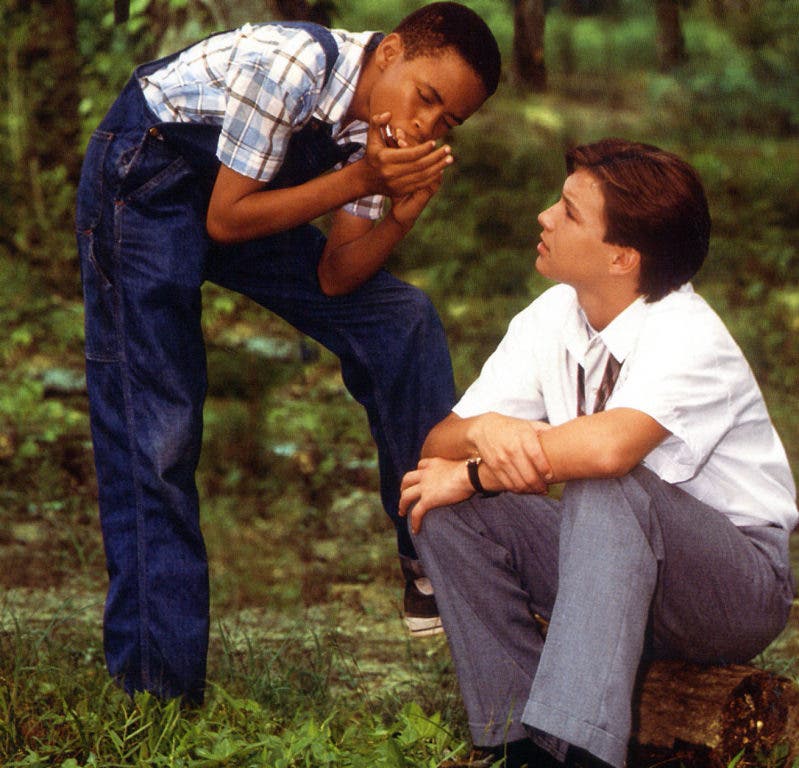
The child that enjoys a history lesson is a rarity. Even when that lesson arrives in the form of a film it can often end up being preachy, dull or didactic. But despite being a 20-year-old, made-for-TV movie about issues that took place over 50 years ago, "Perfect Harmony" managed to win over its audience of youngsters Wednesday at the Newark Museum.
"Perfect Harmony," produced by Disney in 1991, tells the story of three characters who are separated by race but bound by music against the background of a budding Civil Rights Movement.
The film opens in a South Carolina town in 1959 as Landy Allen (Eugene Byrd), a young African-American boy, comes to live with his grandfather following the deaths of his parents. At the same time, Derek Sanders (Peter Scolari), a white teacher, supposedly from Boston, arrives to take his position as the new choirmaster for the Blanton Academy for Boys. Then there is Taylor Bradshaw (Justin Whalin), a white choir member at the school and lead candidate for head boy, a position of honor and prestige.
Find out what's happening in Newarkfor free with the latest updates from Patch.
Sanders likely hails from Boston because among the flaws of the film are the enervated accents. With a setting in the South and one character coming from a state known for its distinct patois, this shortfall is especially hard to ignore. One character even chides Sanders about his barely audible accent. Twice.
Of course, that's better than the occasional over-acting by many of the adult actors in the film. You almost want to reach through the screen, pat them on the back and say, "It's okay. You already got the job."
Find out what's happening in Newarkfor free with the latest updates from Patch.
But for the children watching, a nondescript accent is not going to disturb the viewing experience. Although they were restless as the story established itself (as kids often are), whispers slowly died out over the course of the film.
With white student, Paul (David Faustino), threatening Landy and Taylor risking his reputation to befriend him, the tension is high. That strain is compounded by Sanders discovery of Landy's talent for music.
And this is the movie's real gift to the audience. It cleverly juxtaposes two worlds through their music: Blanton Academy and the black ghetto of Rivertown. Blanton Academy is all austere choirs and clean harmonies while Rivertown revels in the rhythms of gospel and the blues. But what makes the contrast clever is that neither is considered better or worse. There is an appreciation for and beauty in both forms of music.
The crowd Wednesday happily appreciated the filmmakers' efforts. Humming and clapping rumbled through the theater with every song. The uplifting - yet predictable - ending elicited applause, hoots, hollers and one lone little voice exclaiming, "Alright!"