Weather
Wildfire Smoke, Cigarettes And Climate Change: NJ Experts Crunch Data
Huffing air polluted by wildfires can be as hazardous to your health as breathing secondhand smoke, scientists at Rutgers University say.


NEWARK, NJ — Breathing air polluted by wildfire smoke can be as hazardous to your health as sitting in a bar that allows cigarette smoking, experts from Rutgers University say.
Rutgers scientists have been taking a look at “possible toxicological health effects” of the Canadian wildfires that sharply impacted air quality in New Jersey and the New York metropolitan area earlier this summer.
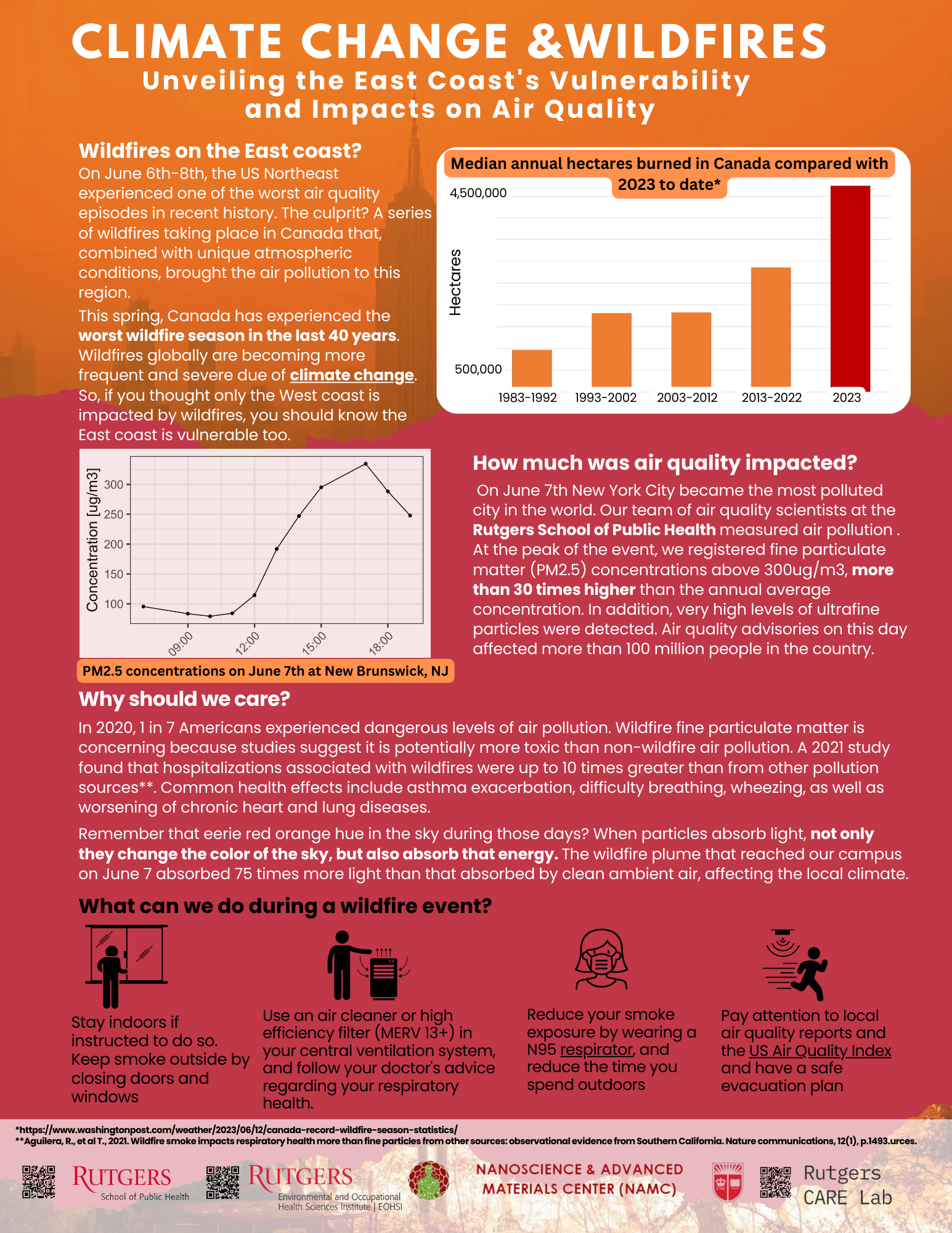
“On June 6 to June 8, the U.S. Northeast experienced one of the worst air quality episodes in recent history,” researchers said.
Find out what's happening in Newarkfor free with the latest updates from Patch.
The culprit? A series of wildfires taking place in Canada that – combined with unique atmospheric conditions – brought air pollution to the region. See Related: NJ Expert Answers Questions About Canada Wildfire Smoke (VIDEO)
Using state-of-the-art instruments, the Nanoscience and Advanced Materials Center (NAMC) at the Environmental and Occupational Health Sciences Institute (EOHSI) and the Rutgers School of Public Health collected samples of wildfire particulates throughout the wildfire event, also taking real-time measurements of air pollution levels for comparison.
Find out what's happening in Newarkfor free with the latest updates from Patch.
Their conclusion? The air seen in New Jersey and New York City could be compared to the secondhand smoke commonly found in bars before cigarettes were banned.
According to a statement from Rutgers:
“During the peak of the incident on June 7, the average concentration of fine particulate matter (PM2.5) from 3 p.m. to 7 p.m. was 330 micrograms per cubic meter (mg/m3), akin to the secondhand smoke in bars before smoking bans and way above the 35 mg/m3 24-hour limit of National Ambient Air Quality Standards.”
It was a level that was also noticed by local, county and state governments, including Newark, which issued health advisories for residents and handed out free N95 masks at senior buildings, the Newark Public Library and other key locations.
- See Related: Air Hits 'Unhealthy' Level In Newark Due To Wildfire Smoke (Update)
- See Related: Newark Hands Out Free Masks As Canada Wildfire Smoke Lingers
- See Related: Wildfire Smoke Delays Newark Airport Flights, FAA Says
The team plans to publish its full findings in several peer-reviewed scientific papers in the coming months, Rutgers administrators said.
CLIMATE CHANGE
According to Rutgers experts, Canada experienced the worst wildfire season it has seen for the last 40 years this spring. And Canada isn’t alone, they say: wildfires across the planet are becoming more frequent and severe due to climate change.
“Remember that eerie red-orange hue in the sky during those days?” researchers said. “When particles absorb light, not only do they change the color of the sky, but they also absorb that energy.”
For example, the wildfire plume that reached the Rutgers campus on June 7 absorbed 75 times more light than that absorbed by “clean, ambient air,” researchers said.
“Unfortunately, environmental issues have no boundaries, and we expect to see an increase in the frequency and intensity of wildfires in the northeast,” said Philip Demokritou, who is the Henry Rutgers Chair and Professor in Nanoscience and Environmental Engineering at the Rutgers School of Public Health, and director of the NAMC and the Division of Environment and Population Health Biosciences at EOHSI.
“The wildfires in Canada gave us a sobering demonstration of the climate change impacts on air quality,” said Memo Cedeño Laurent, assistant professor at the Rutgers School of Public Health, and director of the Rutgers Climate Adaptive and Restorative Environments (CARE) Lab.
Cedeño Laurent said the data unearthed so far underscores the potential health risks associated with wildfire incidents, “particularly for vulnerable populations such as the elderly and those with pre-existing respiratory conditions.”
Send local news tips and correction requests to eric.kiefer@patch.com. Learn more about advertising on Patch here. Find out how to post announcements or events to your local Patch site. Don’t forget to visit the Patch Newark Facebook page.
Get more local news delivered straight to your inbox. Sign up for free Patch newsletters and alerts.