Neighbor News
"Heaven, Hell, or Hoboken!" Exhibit at Rutgers University Commemorates 100th Anniversary of World War I
The experiences of New Jerseyans are on display through one-of-a-kind documents, photographs, and artifacts. Now open to the public.
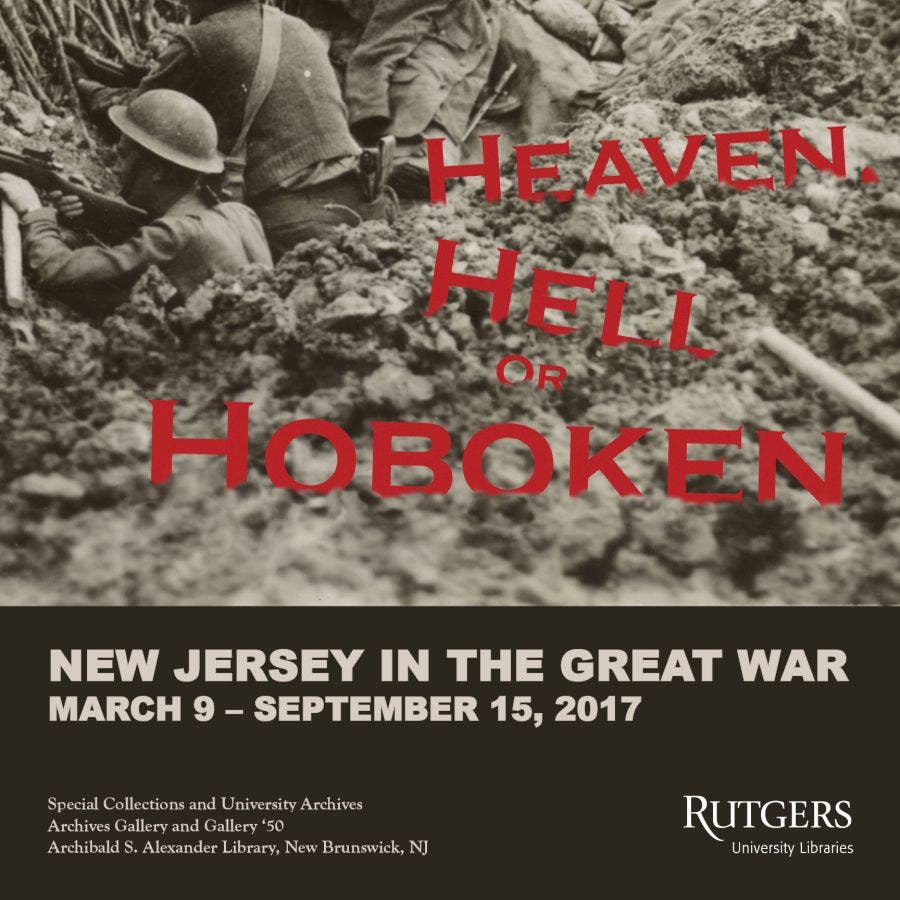
New Jersey played an important role in World War I. Not only did the Garden State make significant financial, industrial, military, and psychological contributions from the outset of the bloody conflict, but it would ultimately provide 72,946 recruits and 46,960 volunteers, with an additional over 20,000 serving by the War’s end. In total, 3,836 New Jerseyans were lost to combat, accident, or disease.
“Heaven, Hell, or Hoboken!”: New Jersey in the Great War (on display March 9 – September 15, 2017, Alexander Library, 169 College Avenue, New Brunswick, NJ) focuses on the individual experiences of these Jersey doughboys and servicewomen who bravely went “Over There,” and the families and neighbors who remained behind, “Over Here.”
The exhibit takes its name from Commander in Chief John J. Pershing who—predicting a swift resolution to the deadlocked Western Front—promised his men that they would be home by Christmas of 1917. His patented promise of “Heaven, Hell, or Hoboken!” became a national rallying cry for the nearly 1.8 million Americans that passed through Hoboken on their way to the European battlefront.
Find out what's happening in New Brunswickfor free with the latest updates from Patch.
Split into two parts, the exhibit begins with “Over There,” featuring rare watercolors by Swiss artist Gustave A. Wendt, artist Lute Pease’s political cartoons for the Newark Evening News, soldiers’ frontline diaries, letters from the Rutgers College War Service Bureau, trench newspapers, albums and scrapbooks from servicemen and servicewomen, and a complete French gas mask kit. Continuing with “Over Here,” the exhibit features a homemade service flag hung in a Branchburg family’s window, volunteer armbands, the John A. Roebling’s Sons’ patented torpedo nets, memorabilia from Camp Merritt, and posters from our Liberty Bond Poster Collection.
“We are grateful to share this important yet fairly unknown story,” said assistant curator of exhibitions Flora Boros. “Despite the fact that the Great War has slipped out of our living memory, we hope the exhibit will encourage visitors to feel some empathy for the Jerseyans who served both at home and abroad. We hope to reawaken those ties to the past—whether through a visitor realizing an ancestor or fellow Rutgers alum served, or by taking a moment to notice their hometown’s war memorial.”
Find out what's happening in New Brunswickfor free with the latest updates from Patch.
The exhibit includes loans of 29th “Blue and Gray” Division artifacts and souvenirs from the National Guard Militia Museum of New Jersey, wartime medical supplies from the Johnson & Johnson Archives, and postcards from the Special Collections of the George F. Smith Library of the Health Sciences at Rutgers Biomedical and Health Sciences.
Additional events will take place at the Libraries throughout the year including a WWI poetry reading during National Poetry month on April 18 and an additional exhibit titled Camden, World War I, and the New York Shipbuilding Corporation through March 31 at the Paul Robeson Library at Rutgers University–Camden.
# # #
ABOUT RUTGERS UNIVERSITY LIBRARIES
Rutgers University Libraries support and enrich the instructional, research, and public service missions of Rutgers, The State University of New Jersey through the stewardship of scholarly information and the delivery of information services. With more than five million volumes and thousands of digital resources located in 26 libraries, centers, and reading rooms in New Brunswick, Newark, and Camden, Rutgers University Libraries rank among the nation’s top research libraries.
ABOUT SPECIAL COLLECTIONS AND UNIVERSITY ARCHIVES
Special Collections and University Archives, located within the Archibald S. Alexander Library on the College Avenue Campus of Rutgers University–New Brunswick, collects, preserves, and makes available primary sources of a rare, unique, or specialized nature to support advanced research in the humanities and social sciences, including the largest and most comprehensive collections of materials relating to New Jersey and the region’s history and culture. Its four major divisions are the Sinclair New Jersey Collection, the Manuscript Collection, the Rare Book Collection, and the University Archives. The collections are available for use by Rutgers students and faculty, visiting scholars, and the general public. For more information, visit libraries.rutgers.edu/scua.