If the first week in August is unusually warm, the coming winter will be white and long.
If a cold August follows a hot July, it foretells a winter hard and dry.
Dry August and warm does harvest no harm.
Find out what's happening in New Milfordfor free with the latest updates from Patch.
Farmers and country folk learned to tell the weather, time of day and even compass points from Mother Nature by observing flowers that open and close like clockwork. Plants respond in obvious ways to weather conditions, affected predictably by sunshine, drought and rain. But those who make a living growing crops see subtle signs that may be more accurate than the Weather Channel.
A flower clock was originally conceived by naturalist Carolus Linnaeus who named itHorologium florae (“flower clock”) in the 1751 publication “Philosophia Botanica.” Linnaeus based his work on the concept that flowers, like humans, “responded strongly to an internal Circadian Rhythm.”
Find out what's happening in New Milfordfor free with the latest updates from Patch.
The Scarlet Pimpernel (Anagaltis arvensis) and wild indigo (Baptisa tinctoria) both close their petals and leaves before it rains. The Wind flower (Anenome neuorosa) folds up and droops, not from lack of water but to protect itself from rain, and heliotrope (Heliotropium arborescens) will not even open at the threat of a downpour. Daisies (Bellis spp.) also close up shop in anticipation of rain.
Lilacs (Syringa vulgaris) take the opposite tack, with blossoms opening in the morning when rain is on its way and more reluctantly when the air is dry. It is said that if a marigold (Tagetes erecta) hasn’t opened by 8 a.m., it will rain or thunder before noon. Some flowers, such as Crocus (Crocus supp.) and tulips (Tulipa spp.), open their blossoms as temperatures warm and close in the cooler air of evening.
Farmers predict rain when leaves “turn over” (and/or when cows lie down in the fields). Science validates the saying: “When leaves show their undersides, be very sure that rain betides,” as leaves appear to tremble more when the damp air that precedes a storm softens the leaf stalks.
Flowers that prefer full sun act like clocks as they turn their heads to follow its east-to-west path during the day. In addition to telling the time of day, the sunflower and other sun-worshipers, such as Silphium lactinianum (commonly known as the compass plant), provide fairly accurate clues to direction. Although the head or flower of these plants turns from east to west, its leaves radiate from the stem in northern and southern directions. (This only works with plants growing in full sun, not shade. In shade, plants are focused more on reaching out for any light.)
Wild Chicory announces a farmer’s work day by opening at 7 a.m. and closing at noon in time for lunch. The Star of Bethlehem signals naptime for the lady of the house by opening at 10 a.m. and closing by noon. Some flowers, like people, are late risers, opening late in the afternoon after a long evening. In their defense, these flowers avoid the brightest part of the day when planted in full sun, but behave slightly less dramatically in shade.
Scented plants also prefer the evening to day. Night-blooming Jasmine (Jasmine officianale) and flowering tobacco (Nicotiana alata) as well as annual stocks (Matthiola incana) give off their strongest fragrances in the evening to attract night-flying pollinators.
Home gardeners might enjoy making a cottage-style flower clock by creating a circular bed filled with flowers in sections that represent the day in hours. While not entirely accurate--a cloudy day may fool a late-afternoon bloomer into blooming in the morning; the lack of light tricks plants into thinking it is really late in the day. On sunny days, however, the flower clock can be amusingly predictable and certainly a conversation piece in the garden.
The following plants may be tried in our suburban gardens with a fair amount of success:
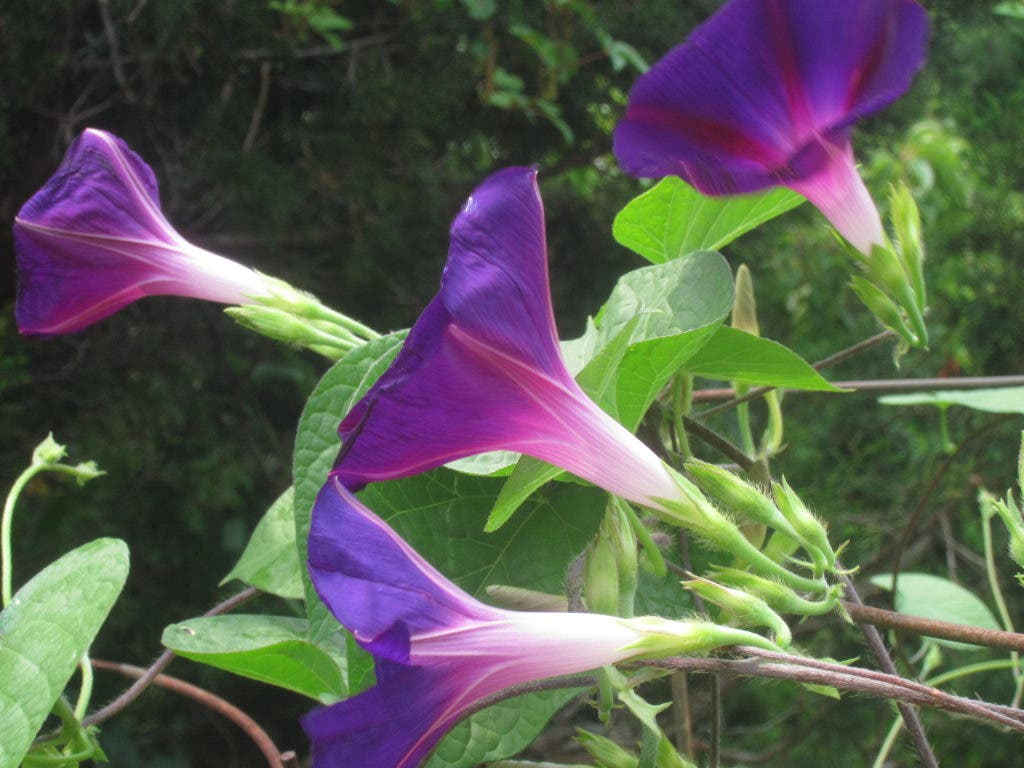
Morning Glories open at 6 a.m.
Wild Chicory opens at 7 a.m. and closes at noon.
Garden Lettuce opens at 7 a.m.
Scarlet Pimpernel opens at 8 a.m.
Malva opens at 9 a.m.
Star of Bethlehem opens at 10 a.m.
Passion flower opens at noon.
Goatsbeard closes at noon.
Childing Pink closes at 1 p.m.
Hawkbit closes at 2 p.m.
Morning Glory closes at 3 p.m.
Four o’clocks open at 4 p.m.
White Water lily closes at 5 p.m.
Evening Primrose opens at 6 p.m.
Day lilies close at 8 p.m.
Plant flowers densely in enriched soil, fertilizing every two weeks while blooming.
“How well the skillful gardener drew
Of flow’rs and herbs this dial new;
Where from above the milder sun
Does through a fragrant zodiac run:
And, as it works, th’ industrious bee
Computes its time as well we as we.
How could such sweet and wholesome hours
Be reckoned but with herbs and flowers."
Poem on the flower clock by Andrew Marvell in “The Garden” (1678)