Arts & Entertainment
Barbershop Quartets Compete for Global Honors in Parsippany
Harmony groups from New Jersey, Virginia, Pennsylvania, Maryland and New York brought the sound of music to the township.
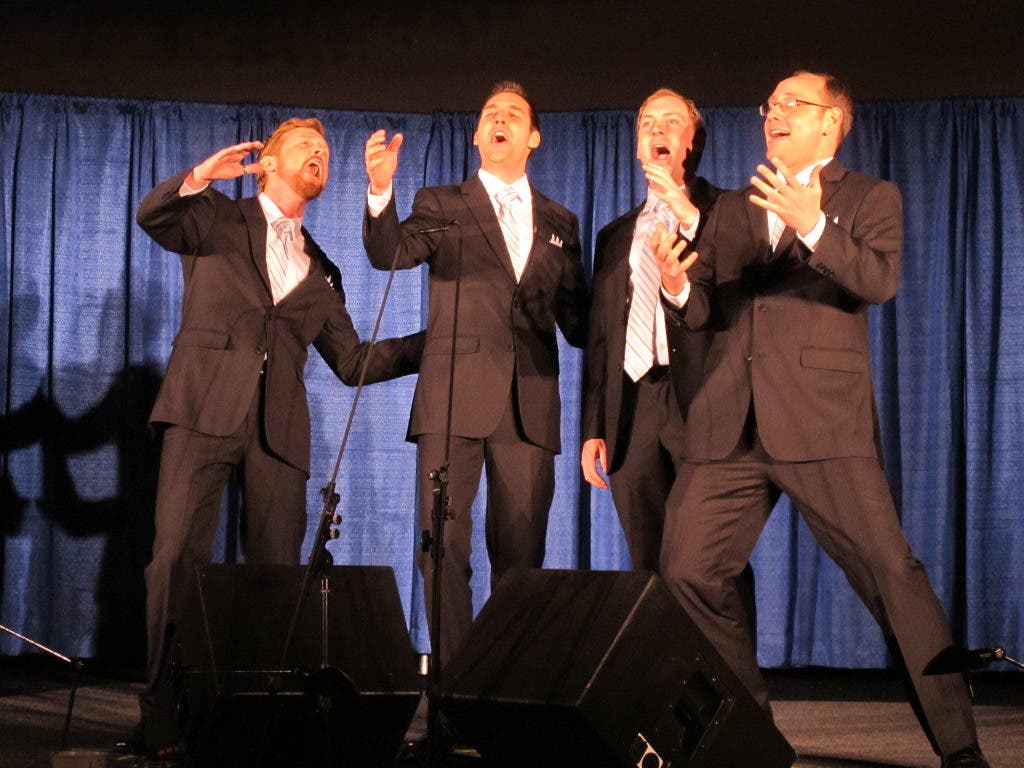


Those of you who think barbershop quartets faded into oblivion along with the Model-T automobile, the gramophone and other fond memories from a bygone era weren’t at the Sheraton Parsippany March 15 and 16.
The truth is, barbershop harmony singing, a distinctive four-part harmony art form popularized in the U.S. and Europe during the late 19th and early 20th centuries, is indeed very much alive and well.
Just ask nearly two dozen Barbershop Harmony Society quartets from Virginia, Pennsylvania, Maryland, New Jersey and New York, who squared off in the Mid-Atlantic District’s International Preliminary contest In Parsippany.
Find out what's happening in Parsippanyfor free with the latest updates from Patch.
Contestants vied for the right to compete at the Society’s international convention this summer in Toronto, Canada.
“Unbeknownst to many, The Barbershop Harmony Society is the largest men's singing organization in the world with nearly 25-thousand members, representing some 850 choruses and 1,200 registered quartets in 17 districts within the U.S., as well as representation in nine foreign countries,” points out Mid-Atlantic District President Bill Colosimo, adding that April 11 will mark the Society’s 75th anniversary.
According to Colosimo, contests like the one in Parsippany can be pretty intense, but the chance to compete on the international stage is an incentive most quartets find irresistible.
Find out what's happening in Parsippanyfor free with the latest updates from Patch.
“We evaluate and give numerical scores to each of the competing quartets in singing, music and presentation," explained certified contest judge Tony Sparks, one of six total BHS judges on the panel.
The judge emhasized that post-contest coaching sessions for all the quartets are just as important as the numerical scores, because making minor adjustments can often make a huge difference in the final tallies.
“Basically, singing category judges look for overall singing skills and execution, presentation judges evaluate entertainment and believability factors and the music judge is mostly concerned with the vocal dynamics of a quartet and how well the harmonies from each voice part are connected to create that wall of continuous sound,” Sparks said.
When all was said and done, Da Capo of Washington, D.C., and New York City's Round Midnight made the final cut and will be two of several quartets representing the district in Toronto.
A big part of the barbershop harmony phenomenon is the Society’s Youth in Harmony initiative. As part of this program, male and female quartets representing high schools, colleges and universities from the region were featured as part of the weekend festivities, in a separate adjudication.
Much like the regular contest, these young quartets were also evaluated by the same judges in the same three categories. But instead of numeric scores, they were ranked on a scale ranging from good to superior.
“We want to make every effort to give these young singers as much support and encouragement as possible because they all represent the future of this hobby,” Sparks noted.
Most quartets are quick to point out that music is just one part of the equation.
“The singing is always a lot of fun, but I’ve also made a lot of great friends,” said Rose Tohonou, a barbershopper who sings bass with Bring It On, a foursome from Maryland's Gaithersburg High School.