Schools
Par-Troy Teachers' 9/11 Curriculum Teaches Tolerance
Two Parsippany third-grade teachers say they want their work to inspire students to make a better world

In the years since the September 11, 2001 attacks on the U.S., which claimed over 3,000 loves, there has been a hotly-debated topic in education: How should teachers present the events that occurred on that day to students?
Two Parsippany teachers took the responsibility of teaching the events surrounding September 11 to the next level. They signed on to help develop a post-9/11 curriculum that is now used not only throughout the state, but across the nation and in parts of Europe.
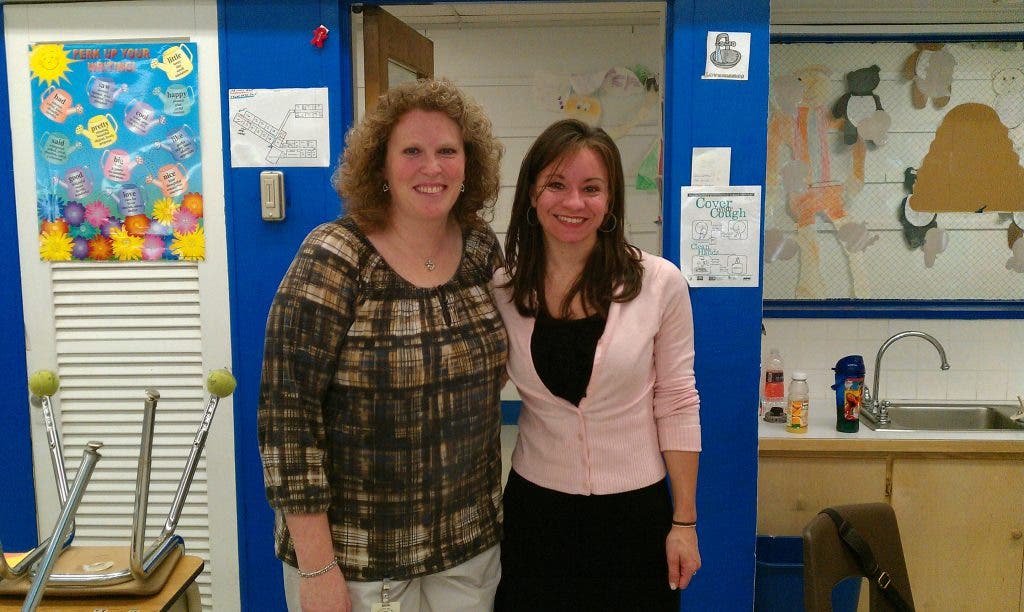
Third-grade teachers Dena Drobish of and Tina vonDohlen of worked with other New Jersey educators to create the 9/11 learning plans. Also involved were organizations such as the New Jersey Commission of Holocaust Education, Liberty Science Center and Families of September 11. Their task was to develop a curriculum that would present the tragedy of the attacks in a way that helps children learn positive lessons.
Find out what's happening in Parsippanyfor free with the latest updates from Patch.
Drobish and vonDohlen said the curriculum puts the facts of that day and the surrounding events in a presentable light that makes it comfortable for all students to learn and grow together in an accepting environment.
“We developed this so that kids have an idea of what happened, because it is history, but also not to judge people based on their skin color, ethnicity or their cultural background,” Drobish said. “I know that was a great fear, and that is why we start so young teaching them about being culturally sensitive and accepting others.”
Find out what's happening in Parsippanyfor free with the latest updates from Patch.
Additionally, the teachers said the curriculum can help ease the minds of parents who remember the September 11 attacks and still feel the impact on their own lives.
“We want too make sure that the parents know that we’re doing it in an appropriate manner, and that we’re not talking about it in a biased way and that we’re being very culturally-sensitive and keeping all of that in mind,” Drobish said. “I think it’s more the parents that get upset about it. The kids want to know; they’ll ask you very specific questions.”
Figuring out how to answer those questions presented several challenges, according to Drobish.
When developing the curriculum, educators were tasked with figuring out a way to properly educate children about the attacks in the first place.
“You had no idea how to talk to children about it,” Drobish said. “You felt like you were walking on eggshells, and basically, you tried to skip over it. You weren’t sure about what you should or shouldn’t say, so you were better off to just try to avoid it altogether.”
The developers of the curriculum also had to be conscious of the fact that children at different age levels—the curriculum exists for grades K-12—learn and interpret information differently. Drobish said this was especially tricky to handle when dealing with topics that could be considered controversial or frightening.
“The one on terrorism kind of scared us," she said. "We were like, ‘What do we do with this? How do we make sense with this?’ We tried to find as many children’s picture books that we could and make it kid-friendly and at their level.
“There are certain lessons that are only for third grade and up, because of the fact that you don’t want little kids to have to worry about that.”
Eventually, the curriculum team decided that framing lessons around teaching the values of acceptance in society and tolerance was the way to go. Facts involving September 11 would be introduced gradually.
“We hope that they’re going to learn more and more every year as they mature and they’re able to handle more of the facts that they will be able to add on to (their knowledge) every year,” vonDohlen said. “We’re starting with ‘Treat each other nicely,' ‘Don’t judge others.' ‘Be a friend’ and ‘Be a good person.’
"Those are the things that we start with, and all of the facts of 9/11 kind of come after that.”
From there, the curriculum was piloted in school districts across the state for testing and feedback. The new curriculum continued to gain momentum both in and outside of New Jersey, including an NJEA Classroom Close-up magazine feature centered on the implementation of the curriculum in Drobish’s classroom.
The educators who developed the curriculum said they hope that it has helped make the topics involved more approachable and comfortable to talk about for teachers, nearly all of whom experienced the September 11 attacks first-hand.
“The point of creating the curriculum the way we did was to give teachers the opportunity to teach what they’re comfortable with," said vonDohlen. "We have many different lessons on all the different topics. One teacher might find that they want to do something that involves the computer. Another teacher might want to do something that involves music, art or a storybook.
"There are so many different options for teachers to be able to really look through the curriculum and say, ‘That’s something I feel comfortable talking about.’”
In the end, Drobish and vonDohlen said they hope that everyone involved in schools can find a way to implement and benefit from the educational experience they helped develop. Their admitted aim is for people use the knowledge contained to help make the world a better place.
“We just hope that it’s going to be used,” vonDohlen said. “It’s out there now, and we hope that every teacher can find something in this curriculum that they feel comfortable teaching.”
Let Patch save you time. Get local stories like this delivered right to your inbox or smartphone each day with our free newsletter. Simple, fast, sign-up here.