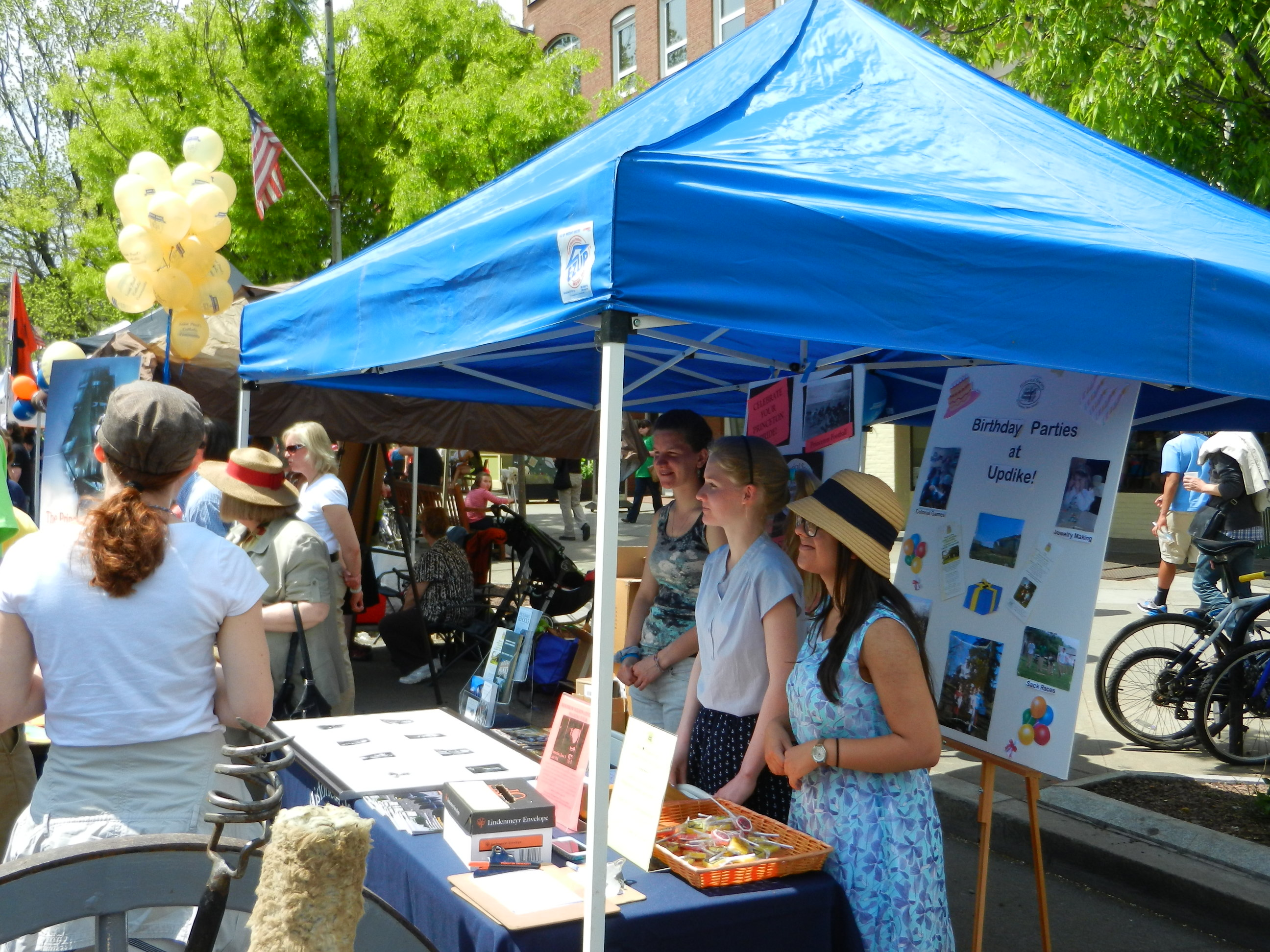
Lena Zlock shares her experiences as a volunteer at Bainbridge House.
My adventures as a docent at the Historical Society of Princeton began two years ago, as a socially awkward, but enthusiastic high school freshman. I sat with Albert Einstein on my right, sporting his fluffy slippers with hair to match. On my left, stonemasons’ tools rested next to a bust of Paul Robeson and a model of the USS Constitution, all under the watchful gaze of Commodore William Bainbridge. Spending two hours every Saturday in this unusual social circle prompted inevitable questions from bewildered friends:
"So, you do…um... what?"
"You get community service hours for that?"
Find out what's happening in Princetonfor free with the latest updates from Patch.
And most exasperated: "What are you doing with your life?"
It a timeless question for all museum volunteers, but an excellent one: What do I do, and why do I do it?
Find out what's happening in Princetonfor free with the latest updates from Patch.
I have been a fanatic history buff since discovering George Washington in pre-kindergarten. I am particularly interested in early American history and the Civil War, and I dream of becoming a professor in the humanities. I discovered the Historical Society of Princeton as a new freshman at Princeton Day School. Here, I could express my unrestrained fanaticism for the past to any visitor that would listen. And few things are more fulfilling to a historian than sitting in a room of century-old artifacts for two full hours.
But in my historical imagination, Princeton was little more than a small village on the postal route from New York City to Philadelphia. The only reason anybody gave it a thought was because of Princeton University, formerly the College of New Jersey. And thanks to the daring adventures of General Washington, Princeton gained a small foothold in history. I found this is a misconception not unique to me, but shared by many of the curious that have come through Bainbridge House, our main headquarters and museum. They are drawn by the allure of the University, its ivy-strung campus, and the opportunity to stock up on orange-and-black merchandise. But, they ask me with a puzzled expression, what else is there? Their attention is quickly drawn to the two major cities north and south of Princeton, sensing nothing more to do here.
Grasping on this misconception, my job as a docent and tour guide has evolved to setting the record straight about Princeton. Museums by nature draw together people from many regions, with many stories, perspectives, questions and ideas. In the short span of two years, I have had the opportunity to not only teach Princeton's fascinating history and its importance, but also to meet people from the area, as well as those who never stepped foot here. The result is an energetic collaboration between dozens of people, to discover and understand a rich and complex history.
Blame it on sheer ignorance, or my origins in the suburbs of Philadelphia, but I was surprised to learn a lot on my first day in fall of 2011. I had only a very vague idea of Einstein's connection to Princeton University. But as I quickly learned, Einstein, in fact, was not a faculty member of the University, but employed by the Institute of Advanced Study. And he lived just blocks away (in a house now occupied by IAS faculty members) and could often be seen cycling down Nassau Street. As it turned out, this was only the beginning of much learning on my part.
I do not want to give a lot away, as you should come and discover all this at Bainbridge House. But among the volumes of Princeton history that now fill my brain, I learned that Nassau Street was named after Dutch Prince William of Orange-Nassau; that street names in town have symbolism; and that Marian Anderson, the renowned African-American singer, was refused a room in a Princeton hotel. She would instead stay with the Einsteins. Princeton was not immune to the struggles of racial equality of the mid-20th-century. And at the same time, it was constantly being reshaped by influxes of immigrants who brought their diverse customs and skills to this small town in the New Jersey countryside. It reveals a deeper, constant struggle of identity, of what it meant to be a "Princetonian."
But these complex themes are not apparent, as you drive through shaded walks and past the University's looming Gothic buildings. Naturally, the visitors who step into Bainbridge House, confronted with an array of artwork, photography and artifacts, are surprised. From my perch in the galleries, I meet people from across the globe and every walk of life.
One family came from Ecuador. It was their first time in the United States, and they were traveling on their way to New York City. They approached me decked in Princeton paraphernalia, and asked, "Where is everything about the University?" I show them the main Princeton history room: the tools of the local Lenape tribes, who inhabited the area long before the University existed. I point out the furniture Einstein brought with him from Berlin, and we wonder aloud how these massive cabinets made it across the Atlantic. They tell me that they never imagined how interesting Princeton was. One visitor told me he was surprised by how many stories were tucked away into these small towns. Many American tourists did not know Princeton had segregated schools and hotels. Was this not a northern town, decades after the Civil War?
Each tour is a lesson for everybody involved: you get to hear the perspectives of other people. And with such an international concourse, the questions that have shaped Princeton's history become questions of humanity's story. As a docent, I give tours and answer questions, but I often see myself as the beneficiary of many tales and many experiences. This is how I imagine the role of a teacher: to broaden peoples' views and to challenge their assumptions, but at the same time, to engage with people who have different perspectives.
It is exciting to be a docent, at the edge of a history that is steadily being revealed. My goal, in working at the Historical Society of Princeton, is to make people look at the world immediately around them. We are conditioned to look at the world beyond us -- to gain a "global perspective"-- but this is to the detriment of the places closest to us. They become disregarded as backwaters, minor, not important.
But it is towns like Princeton where history is most intimate. These are microcosms of society: in close surroundings, traditions are formed, which, in turn, shape that area's identity. But those identities are challenged and reshaped through external forces: war, immigration and politics. Thus, the marks left by these struggles are deeply entrenched. But in the case of Princeton, they have only served to draw a community closer together.
Two years ago, I had no conception of Princeton as such a vibrant place, one of many people and ideas. Reader, I now challenge you to take a look again at the world just outside your door. Consider yourself in the context of Princeton, and ask yourself: What part are you in this community?