Health & Fitness
Letter: Avalon Bay Misrepresents Hospital Site Contamination
Princeton citizens should know that the AvalonBay EIS fundamentally misrepresents their own consultant's Phase I environmental investigation on the old hospital site, performed by EcolSciences.


To the Editor:
Princeton citizens should know that the AvalonBay Environmental Impact Statement (EIS), prepared by Maser Consulting, fundamentally misrepresents the Phase I environmental investigation on the old hospital site, performed by EcolSciences in September of 2011.
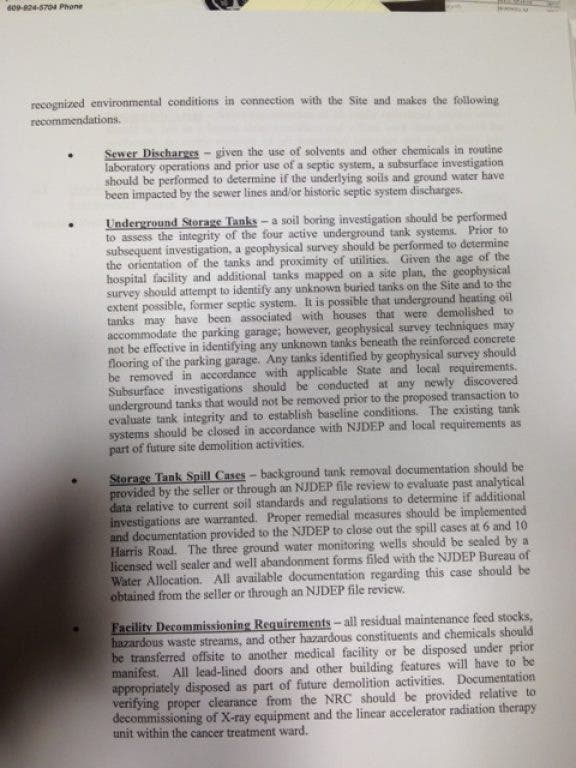
The Conclusions and Recommendations” of the EcolSciences report states that “a soil boring investigation should be performed to assess the integrity of the four active underground tank systems.” This recommendation contradicts the AvalonBay EIS, which states that “no underground tanks or contamination were found on the property” (EIS, p. 10). Whether or not these underground tanks indeed pose a public health concern, the complete misrepresentation of the Ecolsciences report in Avalon’s site plan submission to the Planning Board is scary. It breaks the public trust by bringing into question the motives for such a blatant misrepresentation.
Find out what's happening in Princetonfor free with the latest updates from Patch.
The AvalonBay EIS glosses over the fundamental issue of site contamination. The EcolSciences Report was made available this month only after environmental attorney Aaron Kleinbaum, retained by Princeton Citizens for Sustainable Neighborhoods, insisted that the undated environmentalinvestigations cited in the Maser EIS for AvalonBay, be madeavailable to the public (letter to Planning Board and municipal staff, 8/22/12).
The old hospital site is listed on theEnvironmental Inventory (DVRPC 2010) as a “known contaminated site.”
Find out what's happening in Princetonfor free with the latest updates from Patch.
In addition to the issue of storage tanks, the Ecolsciences report calls for “subsurface investigations to determine if the underlying soils and ground water have been impacted by the sewer lines and/or historic septic system discharges.” No such reports on subsurface investigations havebeen submitted by AvalonBay. Attorney Kleinbaum has called for such Phase II studies; he is particularly concerned with the subgrade laboratory at the hospital, which predated strict
environmental regulations. The Ecolsciences Report recommends remedial measures to close out the spill cases at 6 and 10 Harris Road. And on the decommissioning of the hospital, it states: “residual maintenance feed stocks, hazardous waste streams, and other hazardous constituents and chemicals should
be transferred offsite to another medical facility or be disposed of prior to manifest. All lead-lined doors … should be appropriately disposed as part of future demolition activities. Documentation verifying proper clearance from the NRC [NuclearRegulatory Commission] should be provided relative to
decommissioning of X-ray equipment and the linear radiation therapy unit with the cancer treatment ward.”
I know the public cares about environmental contamination and the decommissioning of the hospital. I want to make sure that the EcolSciences “Conclusions and Recommendations” (previously unavailable) are made public for
professional scrutiny and appropriate municipal action. I am distressed, as I think other Princeton citizens are also, that the AvalonBay EIS document misrepresents the scientific conclusions of the organization to which it contracted an
important job concerning Princeton’s public health.
Alexi Assmus, PhD
Maple Street