Health & Fitness
Big-Day Birding -- Princeton's Canal and Towpath
Rarest birds my companions along towpath and canal in Princeton this weekend, on foot and by kayak, plus eagles en route



My Princeton Patch readers know that, --among all my New Jersey excursions--, my haven of choice is the D&R Canal and Towpath.
Yesterday, Saturday, I experienced a private and personal Birding 'Big Day' in those settings: Morning's took place on the water, -- south, thanks to Princeton Canoe and Kayak rentals, at Alexander Road. Evening's unfurled on the Towpath north of Mapleton Aqueduct.
Nature in our region is profligate, even astounding. I'm never on a competitive literal Birding Big Day, as focused by the splendid Cape May Bird Observatory. This one was rather haphazard, having come upon me, unexpectedly, while entertaining a house guest from Manhattan.
Find out what's happening in Princetonfor free with the latest updates from Patch.
Anyone can experience nature's rarities in our region, any time -- assuming one 'moves with antennae'. Eyes, ears and spirit must be wide open. Intake of this magnitued fills the personal well for work weeks ahead. The walks, of course, are free. Two hours in a slender leaf-hued kayak cost under $20. [canoenj.com Princeton Canoe & Kayak on Alexander Rd. near US 1]
Of the two, birding-on-water wins hands down, except for time spent with 'our' eagles en route to the Aqueduct. Both parents were 'branched' beside the nest, --imposing technicolor bookends. They looked beyond American: Roman, imperial. I could see their images fluttering on a Caesar's standard, going off to conquer Gaul's three parts.
Find out what's happening in Princetonfor free with the latest updates from Patch.
What seemed a miserable soon-to-be-fledgling was hunkered on the nest, back to me, between those two blindingly white heads and beyond-24-karat beaks. The youngster wasn't moving a feather, although fledging is clearly in his future. He reminded me of a teen terrified to have been handed car keys for the first time. Both parents remained stoic. No matter the drama or lack of it, there's nothing like passing three eagles on your way to a walk.
In morning's perky kayaks, the moment we passed under Alexander Bridge, our hair was parted by swallows. Each time, I am riveted anew by that odd juxtaposition of creosote and swallow chatter. It is often accompanied by overhead tire whirr, all of which means I'm beginning my favorite Princeton kayak route.
Almost immediately, we heard that rarest of sounds -- the ovenbird's "teacher! teacher! teacher!" This is the song of the Sourlands. It is now, all too often missing, as deer increasingly devour forest understory required by these rarities for earth-bound oven-shaped nests. It is more than a year since I've heard an ovenbird, and never from the water.
A female cardinal laced between us. She and her mate were uncharacteristically silent, which may mean they have young at the nest, refusing to alert raptors on their insect quests.
My friend, Janet Black, --ever alert to reptiles and amphibians--, immediately spotted the minuscule head of a graceful snake, crossing the canal before our bows. In water, snakes are barely visible, unless one is extraordinarily attuned. In this deep water is that one learns 'the wake of the snake' -- resembling a monarch's wedding veil trailing through the nave of some storied abbey. Janet could watch this snake circling and circling in a rocky glen near to her kayak. She found another, just by its wake, on our way back north, on 'my' side of the canal.
Janet is the turtle-spotter. All were of the 'painted' species this day. None jumped off at our approach. It is such an honor, being trusted by turtles.
In a kayak, one is simply part of the water -- fresh or salt, ocean or bay, canal or river. Natural creatures accept kayakers' presence.
Our greatest oneness arrived with the rare and burnished green hern. Angular, he could be called tiny, --compared to the great blue. Greens are particularly alert. Their metallic feathers echo those of the glossy ibis. Words triggered by the green are 'wary' and 'fugitive'. No one can vanish so swifty and effectively among the trees or shrub dapple. No one is more arrestingly arrow-like in flight; and almost no one (save owls) more silent on the wing.
We had this green heron as companion all the way south, always a few hundred yards ahead. Sometimes beupmd our prows, reflected in the water. Often vanishing in greenery. Once in awhile in sun. The green heron is most at home where it is safely invisible, in shadow. For half our paddle, this wild creature served as our honor guard. At one point, another green heron skimmed low over the water far south of us.
At that point, a great blue heron, --majestic and commanding--, flew so low that that heron-displaced air ruffled my hair. Janet marveled: "He flew so near, I could almost touch his face." We both consider great blues omens of good .
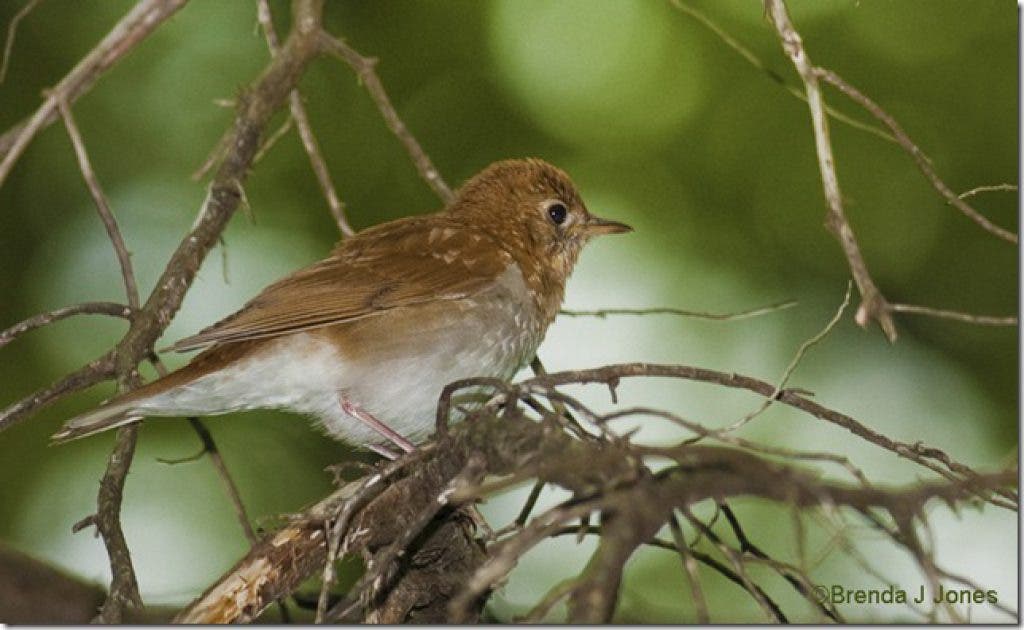
We were given the rare caroling of wood thrush for a great part of our early southward journey. At an open space along the canal, thrush solos were joined by the common yellowthroat's 'witchety-witchety-witchety-witch'. As a finale, we were given descending veery trills, interspersed with a slightly more determined white-throated sparrow's song.
Blue jays were silent - may also have young.
Fish crows mourned and muttered. Sometimes they seem to say "Uh, oh!"
A turkey vulture 'mantled' - spreading enormous wings to say, 'this is MY feast!' over a fawn on the bank. Neither of us had been eye-level with a vulture at his meal. Janet, closer, said he hissed at us -- at least he opened his beak over and over, with each mantling gesture, to speed us on our way. The fawn had become a constellation of slender bones and bright tissue. We reminded ourselves that this is wild nature, vultures the clean-up crew.
Here and there, from recent storms, trees lean over the water, and some have plunged into the canal. This adds to the journey's variety and beauty. Tree-slaloming is fun, as is coasting under leaning branches, entire bodies dappled into oneness with kayak and water.
Readers, please realize that we have natural gifts beyond measure on all sides in Princeton. Reach out to experience them.
And preserve habitat through your local land trusts, such as D&R Greenway, where I work. 23 years to save 23 miles -- and we march onward, stewards of New Jersey.