Health & Fitness
Vegetable Patch: Passover Without Meat
Vegetables, eggs and not-chicken-soup will be the stars at our Passover seder.
Passover and Easter are occurring quite close together this year, as they often do, and in fact, the first Passover seder is in the evening on Good Friday, April 6. In this ecumenical world, one of my extended family members will be offering vegetarian alternatives to the traditional Passover brisket and chicken soup to the Catholic family members attending the seder, who will be observing a meatless Good Friday.
We’re having a small family seder this year, too, in honor of my new grandson, Max, who will be 1 month old on April 6. He’s a bit too young to participate, but being that his parents and his uncle are vegetarians, our seder will be meatless, and fishless as well.
Find out what's happening in Princetonfor free with the latest updates from Patch.
A traditional American Passover seder meal usually includes gefilte fish (poached ground fish balls) with horseradish, chicken soup with matza balls, and brisket or chicken. Needless to say, we’re not doing any of that, but I must admit, it’s hard to envision a Passover without matza ball soup. So I’ll be using Molly Katzen’s (of Moosewood Cookbook fame) recipe for Not Chicken Soup , a simple vegetable broth with a bit or turmeric thrown in to make it look a little more yellow and chicken-y.
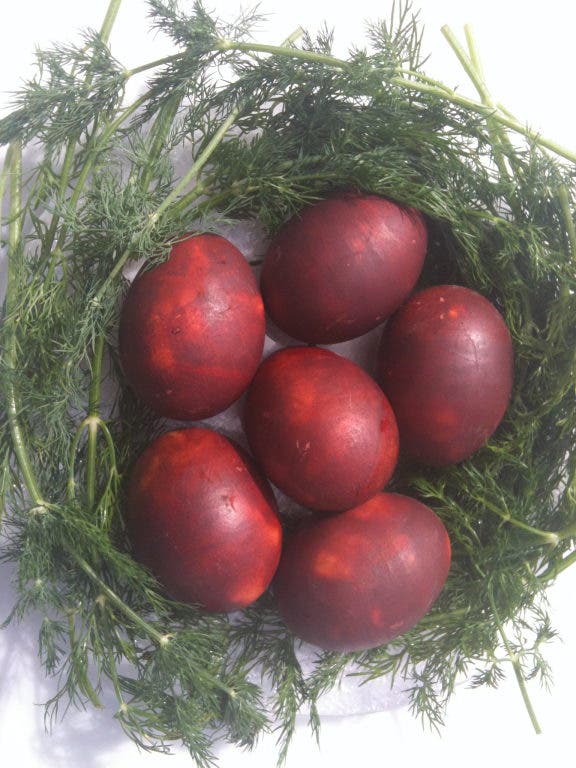
Another Passover tradition is eating hard-boiled eggs at the beginning of the meal, at least in part to symbolize the rebirth of the natural world in spring. Many people eliminate the eggs these days out of cholesterol concerns, but we them every year, using a special family recipe to color the eggs brown. “Huevos Haminados” come from the Sephardic Jewish tradition, and we make them by putting a dozen or more eggs into a large pot of water with lots of brown and/or red onion skins, and some salt and pepper, bringing it to a gentle boil, and simmering them for about 8 hours. (I was lucky to score a large bag of (free) onion skins at McCaffrey’s yesterday by arriving at the moment when the onion bin was being cleaned out and replenished. I learned there that some people dye Easter eggs with onion skins too…who knew?) The eggs turn a beautiful deep red-brown on the outside, and a delicate tan on the inside. I often make them in my crockpot, just putting everything in and cooking them on low, also for about 8 or more hours. They’re so pretty, I hate to take off the shells, but they are also quite tasty, just a little different from the usual. You can even “decorate” the eggs with natural pattern by using a piece of leaf parsley and attaching it to the egg with a piece of pantyhose. I’m too lazy to do that this year, but if you’re interested, here’s the recipe.
Find out what's happening in Princetonfor free with the latest updates from Patch.
For the main course, I’m going to make a Passover spinach pie (see below for the recipe). Kind of like Greek spanakopita, but made with matza instead of filo. I’ve adapted a recipe I originally found online which features lots of cooked fresh spinach and cheese, as well as matza, crumbled on the top and drizzled with olive oil and parmesan cheese (it comes out really crunchy and tasty). We’re also going to have a Moroccan-inspired carrot and asparagus dish (asparagus is a Passover tradition too, since it’s a spring vegetable) as well as an Italian cauliflower “pate,” both out of Olive Trees and Honey, a wonderful vegetarian Jewish cookbook by Gil Marks.
Passover desserts are always challenging, what with the prohibitions on flour and leavening. Max’s uncle makes some fabulous, absolutely-to-die-for macaroons , using three kinds of milk and coconut, which are great with fruit salad. And to top it all off, I know someone will volunteer to make chocolate matza (or “matza crack,” as it’s known in our family). It’s adapted from that yummy recipe that uses saltine crackers as its base, along with butter, brown sugar, and melted semisweet chocolate. No matter how full everyone is, we always have room for more of this.
Whatever you’re celebrating, enjoy!
Passover Spanakopita
Adapted from a recipe from “Café Liz” in Israel.
Makes 2 9x13 inch pies
Ingredients
3 9-oz bags fresh spinach
1 box matzah
16 eggs
8 oz. crumbled feta cheese
10 oz. grated parmesan cheese
Salt and pepper to taste
Good quality olive oil
Chop spinach roughly, put in a pot and pour hot water over top, enough to make the spinach wilt (don’t cover the spinach in water). I put a cover on the pot and let it sit for a few minutes. Then crumble 8 matzot into the pot with the spinach. Let the matzot absorb the water and dump the mixture into a colander (you might need 2) to drain out any extra water.
Beat 8 eggs with a fork, then add to spinach mixture along with 8 oz. parmesan cheese, feta cheese, salt and pepper.
Spray 2- 9 x 13 aluminum pans with Pam, or oil. Turn the spinach mixture into the pans. Beat 4 eggs with a fork and pour over one pan, then repeat for the second pan. Crumble up 4 matzot and sprinkle onto one pan, then repeat for the second pan. Sprinkle remaining Parmesan cheese on top, then drizzle with good-quality olive oil. Bake in 350 degree oven about 35-40 minutes, until eggs are set and the top is crispy. Can be made ahead and reheated.