by Lena Zlock
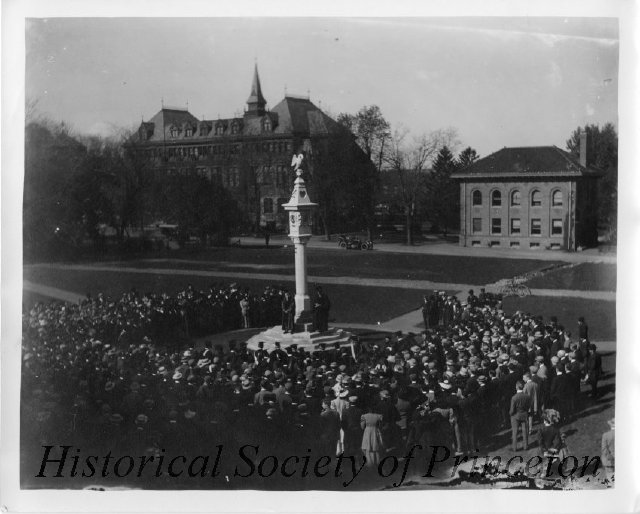
In our first “From the Archives” post, we ask, “What is going in this picture?”
It is not a Princetonian cult, but the “Dedication of the Mather Sun Dial,” 1907. Is this stone monument just another complement to the modern art standing across campus? A classic piece of Ivy League paraphernalia?
The Mather Sun Dial is a treasure of the University’s history, harkening to the Wilsonian era at the turn of the 20th century. The description of the photograph from the Historical Society of Princeton's Photo Archives reads, “Woodrow Wilson and Viscount James Bryce, British ambassador to the United States, at the dedication of Mather Sun Dial in 1907. The sundial is a replica of the 1551 Turnbull Sun Dial at Corpus Christi College. Sir William Mather gave the sundial to Princeton University to 'symbolize the connection between Oxford and Princeton [and]… Great Britain and America.'"
The event foreshadows Wilson’s diplomatic overtures with the Fourteen Points manifesto and the League Nations. But nearly a decade before the outbreak of war, Woodrow Wilson was Princeton’s champion, as the “schoolmaster of politics,” first McCormick Professor of Jurisprudence, and later the University’s 13th president.
Who was the man, the myth, the legend, the quintessential Princetonian? Here is what your history textbook left out.
Wilson came to campus from Wesleyan University, a “heretic in the temple,” a progressive on a conservative faculty. Despite his contrarian views, within a few years of his arrival Wilson was voted Princeton’s most popular professor. For twenty years, he delivered lectures to rapt audiences on American law, jurisprudence, history, political science and public affairs.
But when Wilson arrived at Princeton University, there was no program for the study of American history. Today, the University is a world renowned institution in the field, but in 1890 American history was a minor sidekick to political science courses. Wilson, as he was prone to be, was incensed.
In an October 24th, 1890 letter, he outlined a plan to cement the study of American history into the University’s curriculum (that letter is now being auctioned for a hefty $6,900): “...There is no special and permanent provision in our course of study for instruction in American history… we very much need an additional chair in history, in order that special provision might be made for American history and the Department be as well manned as in other colleges of our grade and aims.”
History buffs reading this will cheer with glee. But why does this moment matter? For the past two hundred years, countless men were pounded with the classics, literature, some mathematics and a dash of geography. This was radical: Wilson was suggesting that, despite the young age of our nation, we had a history to be studied, a story to be told, one that was critical to understanding the world around us.
His passion for American history manifests itself to this day in the Mather Sun Dial, a monumental recognition of America’s ties with Great Britain, and optimally situated next to the history classrooms of McCosh Hall. The establishment of a History Department was the beginning of Wilson’s vast influence on the fabric of Princeton. As a university with no law school, Wilson’s promotion of jurisprudence brought a special strain of legal studies to Princeton, grounded in philosophy, hard questions and debate. For two hundred years, Princeton lived in a self-contained bubble its educational focus was inward and introspective.
With his zeal for public affairs and civic activism, Wilson shifted focus to the world beyond the FitzRandolph gates: how can our students take what they have learned here and be armed to confront global challenges? The legacy of service to the public lives on through the McCormick Chair of Jurisprudence and the Woodrow Wilson School of Public Affairs. Long before he began his meteoric ascent to the United States presidency, Woodrow Wilson was transforming institutions into the birthplaces of leadership and change. At the dawn of the twentieth century, Wilson pushed the university to fulfill what became its motto: "In the nation's service and in the service of all nations."