Neighbor News
New Marsh Mural at Tulpehaking Nature Center, Abbott Marshlands
Opening Reception on Sunday, April 12, 2-4pm

Hamilton, NJ: The staff at Tulpehaking Nature Center, Abbott Marshlands, Roebling Park, announce a new mural, designed by Felicity Cruz. The mural depicting Marsh Life was painted with acrylic paint by Felicity in February/March and topped with a protective finish in April. NatureCenter staff collaboratedwith Felicity to work ontheconcept,composition andspeciestoincludeinthemural. The public is invited to attend a free Opening Reception on April 12, 2–4 pm. The exhibit will run through May.
The Marsh Mural is representative of the abundant aquatic life, insects, resident and migrating birds, and mammals that live in the Abbott Marshlands. It illustrates a summer scene with flora and fauna living in harmony. Located at the nature center in an alcove near the reception area and gift shop, the mural is accompanied by an exhibit of sketches created by Felicity and Phoebe Galione.
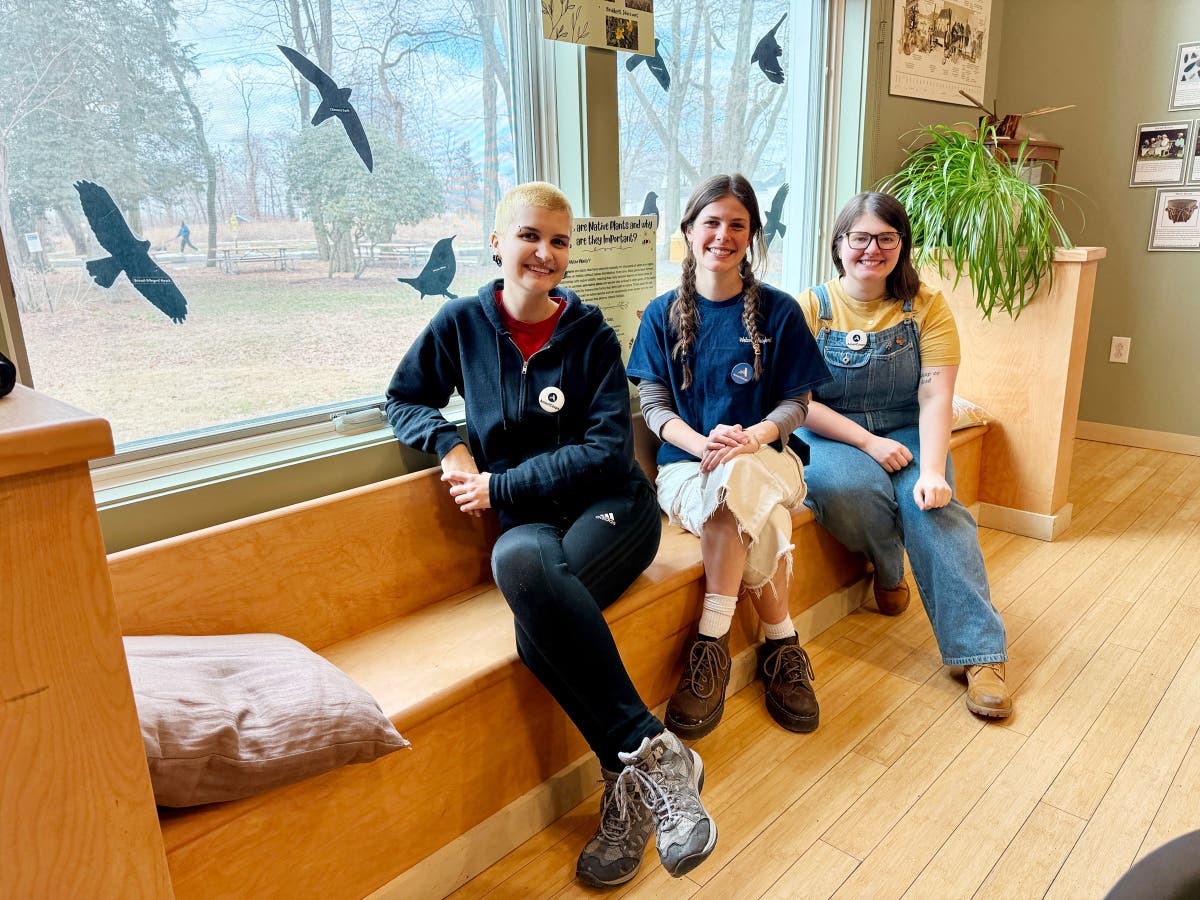
Felicity recruited fellow watershed ambassadors to assist with the mural painting. (There are 20 watershed ambassadors throughout the state and an additional 3 source-water protection ambassadors.) Those who assisted with painting, lighting and photography were Phoebe Galione, Jamie Lubov, Mike Sherr, Michelle Hatfield, Devin Pastras, and Matthew Tunkel.
Find out what's happening in Princetonfor free with the latest updates from Patch.
Felicity, a Pennington resident, graduated from the University of Rhode Island with a BS in Wildlife & Conservation Biology. As a watershed ambassador, Felicity promotes watershed stewardship through science education, community events, projects and presentations at local schools. Felicity also conducts water quality assessments; that data is used by the NJDEP to compare to water quality around the state and to help ensure good standards are maintained.
As a watershed ambassador, Felicity is stationed in one of the 20 Watershed Management Areas (WMA) in New Jersey. Her WMA is the “Assiscunk, Crosswicks & Doctors Creeks Watershed.” It contains a large portion of Burlington County and small portions of Mercer, Monmouth and Ocean Counties. These waterways flow to the Delaware River, which in turn flows into the Atlantic Ocean. Many of Felicity’s presentations highlight the importance of protecting her WMA for the greater good of the larger ecosystem. Portions of the Abbott Marshlands are just outside the Tulpehaking Nature Center in Roebling Park. Others are Northern Community Park between Bordentown Township and Yardville on Groveville Road, and D&R Canal State Park between Bordentown City and Trenton. It also includes the Crosswicks Creek water trail for kayaking, canoeing, etc. (Please be mindful of tidal charts when venturing out; wear flotation devices.)
Find out what's happening in Princetonfor free with the latest updates from Patch.
Felicity knew that a mural would be a great way to get people to visit Tulpehaking Nature Center and be inspired to visit the trails in Roebling and the other parks. People who visit will learn about animals and plants. It is also important for Felicity to communicate science through different media. Through her position, she feels fortunate to reach many audiences and teach them about wetlands and waterways through live demonstrations, presentations, interactive games and art. She hopes her mural inspires others to promote science and conservation.
If you go: The Tulpehaking Nature Center is located at 157 Westcott Ave., Hamilton, New Jersey. Public visiting hours are Wed.-Sat. 10-4pm and Sun. 1-4pm.
Background:
The Abbott Marshlands are situated in Lenapehoking, the traditional and ancestral homeland of the Lenape. These lands include over 3,000 acres of open space along the Delaware River in Central New Jersey. Although a satellite view of the area quickly reveals its ecological unity, the land is divided among two counties, four municipalities, and numerous landowners. Crisscrossed by a canal, a railroad, and even a major highway interchange, the essential nature of the northernmost freshwater tidal marsh on the Delaware River becomes evident. It provides rich habitat for a wide variety of birds, fish, mammals, and plants. Visitors remark on it being an urban oasis, a critical wildlife habitat in the Delaware River’s estuary to be relished and protected.
Friends for the Abbott Marshlands nonprofit is the only organization whose sole focus is the promotion and stewardship of the marshlands. They coordinate their work with the staff at the Tulpehaking Nature Center in Hamilton, the Mercer County Park Commission, the Delaware and Raritan Canal State Park and the Bordentown Bluffs and Point Breeze properties. The Abbott Marshlands Cooperative Stewardship Council members include representatives from the New Jersey Department of Environmental Protection, the D&R Canal Commission, the New Jersey Department of Transportation, Mercer County, and local municipalities of Trenton, Hamilton, Bordentown City and Bordentown Township. FFAM assists by providing a volunteer trail stewardship program, an active calendar of programs on marshlands ecology and history, and other community outreach activities including the Voices for the Marsh biennial juried photography exhibition this summer. (See the prospectus for more information.) Their website, https://abbottmarshlands.org, provides extensive information regarding ecology, cultural history, archaeology, recreation, education and stewardship. The public is invited to join in this important endeavor. For more information, visit https://abbottmarshlands.org/volunteer-opportunities/, meet some like-minded people, and attend one of the free walks to learn and experience what it’s all about.
The Historic District:
The Abbott Farm Historic District became the first National Historic Landmark in New Jersey, designated by the U.S. Department of the Interior in 1976… Now celebrating 50 years. It is a unique archaeological site, recognized as the largest Middle Woodland village of its type on the east coast of the United States. It was named after Charles Conrad Abbott, whose early archaeological work and writing, from the 1850s onward, spurred much research there.
Historically, what we call the Abbott Marshlands was previously known as the Trenton Marsh, the Hamilton Marsh or sometimes the Hamilton-Trenton-Bordentown Marsh. In 2011, a coalition of marsh supporters, working on an interpretive plan for the marsh, changed the name to the Abbott Marshlands to acknowledge the historical and natural significance of the area.