Schools
Nobel Prize Winner Kip Thorne To Speak At Princeton University
Thorne will deliver his talk, "Exploring the Universe with Gravitational Waves: From the Big Bang to Black Holes and Colliding Stars."


PRINCETON, NJ — A joint winner of the 2017 Nobel Prize in Physics, will deliver the Department of Physics’ 43rd annual Donald R. Hamilton Lecture at Princeton University on Thursday, April 12, 8 p.m. Kip Thorne will deliver his talk, “Exploring the Universe with Gravitational Waves: From the Big Bang to Black Holes and Colliding Stars,” in Princeton University's McDonnell Hall, Room A-02. The lecture is free to the public.
Thorne, a 1965 Princeton graduate alumnus and the Feynman Professor of Theoretical Physics, Emeritus, at Caltech, will speak about the two types of waves found in the universe: electromagnetic waves and gravitational waves.
He will discuss how prior Princeton physicists’ research served as the foundation for the dawning field of gravitational astronomy, using the LIGO and VIRGO instruments to detect gravitational waves from colliding stars and black holes. Thorne will discuss this exciting work that is opening new windows onto the universe.
Find out what's happening in Princetonfor free with the latest updates from Patch.
Thorne shared the 2017 Nobel Prize with Caltech’s Barry C. Barish, the Ronald and Maxine Linde Professor of Physics, Emeritus, and MIT’s Rainer Weiss, professor of physics, emeritus.
The Hamilton lectures are an endowed series of public talks given in honor of the late Donald Ross Hamilton, an atomic and nuclear experimental physicist who made major contributions to Princeton and the Department of Physics. More information about the Hamilton lectures and the Department of Physics events can be found at www.princeton.edu/physics.
Find out what's happening in Princetonfor free with the latest updates from Patch.
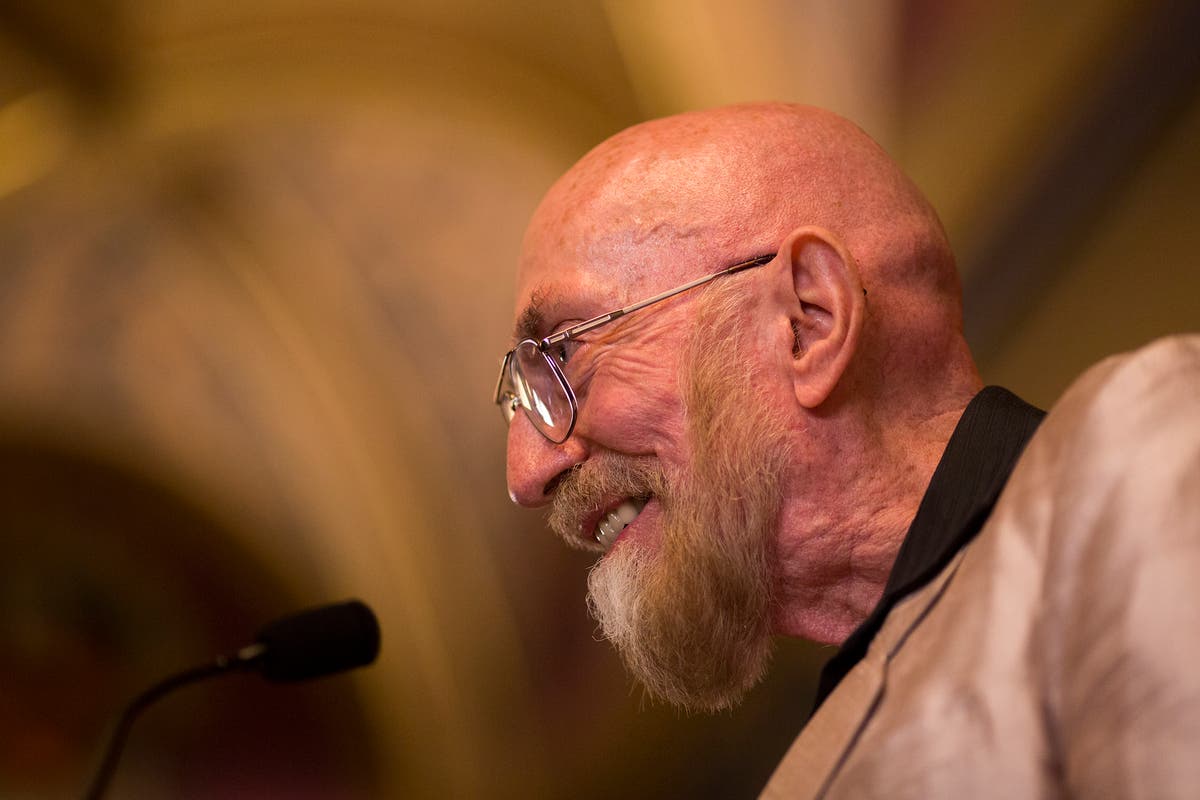
Attached Image: Kip Thorne addresses a press conference after receiving the 2017 Nobel Prize in Physics with Barry Barish, at California Institute of Technology on October 3, 2017 in Pasadena, California. Thorne and Barish helped co-founder the Laser Interferometer Gravitational-wave Observatory (LIGO) which made the first-ever direct detection of gravitational waves, or ripples in the fabric of space and time, which had been predicted by Albert Einstein 100 years earlier. (Photo by David McNew/Getty Images)
Get more local news delivered straight to your inbox. Sign up for free Patch newsletters and alerts.