Politics & Government
Princeton U. Pledges To Honor Municipal Contributions Despite Tightening Budget
Eisgruber told the council the university's annual voluntary contribution increase will be protected, despite campus-wide budget cuts.


PRINCETON, NJ — Princeton University made nearly $9 million in voluntary contributions to the municipality and its public schools last year, even as its president warned that declining endowment returns will force hard choices for years to come.
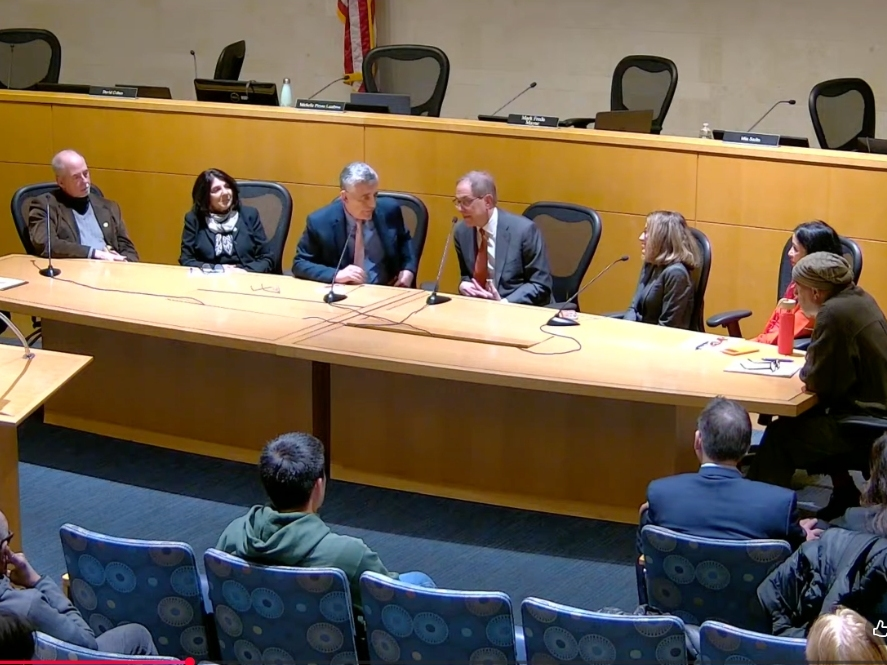
In his annual address to the Princeton Municipal Council on Monday, university President Christopher Eisgruber described a financial transition that is already being felt on campus, with staff raises capped at 1 percent and tenured faculty receiving no raises at all this year.
"We are going to have to make choices in different kinds of ways than we have made in the past," Eisgruber told council members.
Find out what's happening in Princetonfor free with the latest updates from Patch.
According to a background report submitted to the council ahead of the meeting, Princeton University made $5.9 million in voluntary contributions to the municipality in 2025. That includes a $5.4 million unrestricted payment, $300,000 earmarked for mass transit, and $200,000 to support career personnel costs at the Princeton Fire Department.
The university separately contributed $2.93 million to Princeton Public Schools in 2025, including a $500,000 payment tied to priorities identified in the district's recent strategic planning process.
Find out what's happening in Princetonfor free with the latest updates from Patch.
Beyond voluntary contributions, the university paid $9.5 million in property and sewer taxes to the municipality in 2024 — making it the largest taxpayer in both Princeton and Mercer County. Of that total, $3.2 million went directly to the public schools.
Moody's Investors Service, which assigns Princeton a AAA bond rating, noted in a January 2026 rating action that the university "anchors the local economy, is the municipality's largest taxpayer, and makes significant contributions to the municipality's budget annually."
The university's five-year voluntary contribution framework, announced in January 2024, commits $28.2 million in unrestricted funding to the municipality and an additional $11.35 million for specific projects including mass transit, infrastructure, emergency equipment, fire department personnel, municipal facilities, and emergency housing.
The framework also includes $300,000 over three years to Housing Initiatives of Princeton for rental assistance, $500,000 over five years to the 101:Fund for college scholarships for low-income Princeton High School graduates, and up to $10 million to a nonprofit fund providing property tax relief for low- and middle-income residents.
Eisgruber told the council the university intends to honor that commitment despite the financial pressures.
"We have an agreement with this town where our voluntary contribution will increase year over year — 4 percent is the number that we've got in there — and we intend to adhere to that commitment," he said. "We regard that as an important commitment that we have made, both for our partnership and for the university's mission, but it's something that has required work from our team to protect."
The Financial Squeeze
In his annual State of the University letter, published Feb. 2, Eisgruber explained that Princeton's endowment now funds roughly 65 percent of its operating budget — up from 55 percent in 2016. The university spends approximately 5 percent of the endowment each year, and needs average annual investment returns of at least 8 percent to sustain that model indefinitely.
For more than three decades, Princeton enjoyed returns well above that threshold. That margin is now gone. The university has cut its long-term return assumption from 10.2 percent to 8 percent, reflecting what Eisgruber described as a structural, decades-long decline across university endowments.
"The difference between a 10.2 percent and an 8 percent return rate is very consequential," Eisgruber wrote. "Over a ten-year period, that reduction would amount to a cut of more than $11 billion."
The university has already asked departments to cut budgets by 5-7 percent amid uncertainty around federal research funding. Tenured faculty are receiving no raises this year; staff raises are capped at 1 percent. Eisgruber told the council that deeper, more targeted reductions are likely over a multi-year period.
"We are going to remain a very strong university financially," he said. "But we are going to have to make choices in different kinds of ways than we have made in the past."
What It Means For Residents
Council members acknowledged the constraints while pressing the university on housing, transit, and civic partnerships.
Councilman Leighton Newlin framed a vision for the university to enter a formal partnership with the Princeton Housing Authority to develop mixed-income affordable housing — potentially on the former Butler tract — with a meaningful focus on university workforce members.
"Can the people who teach here, maintain this place, support this institution and serve this town, actually afford to live here?" Newlin asked. "Because if they cannot, then we are building something that is indeed exceptional, but not sustainable and not equitable."
Eisgruber responded positively, stopping short of a firm commitment but pointing to the university's track record of inclusive housing in its development projects and expressing interest in working along the Alexander Street corridor.
"I do hope at some point that we are building on Butler tract, and the university has a history of making sure that we have inclusive housing when we build projects," he said. "We hope that we will be able to at some point do things along the Alexander Street corridor."
Councilwoman Michelle Pirone Lambros thanked the university for its support of the new Loop Express transit route, which she described as a step toward reducing car dependency in town — a 20-minute service running down Nassau Street and Harrison Street to the shopping center.
"It really is a step in the direction of moving us away from a car-centric town," Pirone Lambros said.
The university's free TigerTransit bus system, which operates 17 all-electric buses, provided more than 820,000 passenger rides in 2025 and is open to the public. The university also maintains approximately five miles of private roads used by the public at its own cost, including snow removal.
Councilwoman Leticia Fraga, in her final year on council after nine years, reflected on the partnership's track record — including the university's support for Habitat for Humanity homeownership projects in the Witherspoon-Jackson neighborhood and its Pay with Points dining program, which directed more than $369,000 to 18 local restaurants in 2025.
"When we work together, we can overcome anything," Fraga said.
Council member Mia Sacks, noting that the university and town are bound together by circumstance and shared interest, offered what may have been the meeting's plainest summary of the relationship.
"We can't get divorced," she said. "We're stuck. And so we have to work together and make the best of it."
Have a correction or news tip? Email sarah.salvadore@patch.com
Get more local news delivered straight to your inbox. Sign up for free Patch newsletters and alerts.