Neighbor News
The FDA is Redefining What is a "Healthy Food"
The FDA has not revamped its guidelines on what is a "healthy food", since the 1990s.

According to those out of date guidelines, Low Fat Pop Tarts, Frosted Flakes and Spaghetti O's would all be considered "healthy foods", but wild caught salmon, organic raw almonds and organic avocados, would all be classified as "unhealthy foods".
To anyone who is up on the latest facts on nutrition, this is crazy. The main problem is that good healthy fats were considered "unhealthy" in the 1990s, when these guidelines were written, while high sugar content got a pass!
Back then, the FDA was considering fat, saturated fat, sodium and cholesterol content as being unhealthy factors, while vitamins, minerals and fiber were considered healthy factors.
Find out what's happening in Ramseyfor free with the latest updates from Patch.
That FDA criteria, which is still current, puts the total fat in a healthy snack food per serving, at a maximum limit of 3 grams and only 1 gram of that fat can be saturated fat.
The FDA is now re-evaluating these criteria and the changes can't come soon enough.
Find out what's happening in Ramseyfor free with the latest updates from Patch.
The American Heart Association (AHA) and the World Health Organization (WHO), recommend limiting daily added sugar intake to 9 teaspoons (38 grams) for men, 6 teaspoons (25 grams) for women and from 3 to 6 teaspoons (12 to 25 grams) per day for children, depending on their age. Remember that this is added sugar, not total dietary sugar. In general, I recommend to have less than 25 total grams of dietary sugar per day, which applies to most healthy adults.
The Lipid Hypothesis:
The biochemist Ancel Keys, PhD, came up with the Lipid Hypothesis in the 1950s, which is that eating saturated fat, resulted in high cholesterol and heart disease. He concluded that was true, since statistics pointed to that conclusion from Italy, Australia, Japan, Canada, the UK and the USA. Dr. Ancel published his findings and the medical community bought into the Lipid Hypothesis hook, line and sinker.
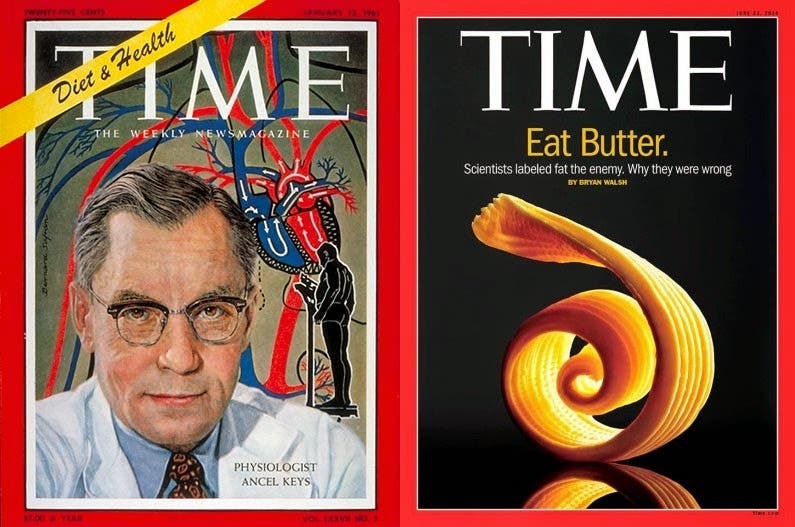
The problem was that Dr. Keys had data from 22 counties and this pattern only was true for about 1/3 of those countries. Some other counties showed high saturated fat consumption and low heart disease, while still other counties showed low saturated fat consumption and high heart disease. There was no pattern and his conclusion was manufactured. His reward for this fraud was having his photo on the cover of Time Magazine on January 13, 1961 . Time Magazine did eventually get it right, over a half century later. Their June 11, 2014 cover story was "Eat Butter - Scientists Labeled fat the enemy. Why they were wrong".
In a 2013, a British Medical Journal paper, by Dr. Aseem Malhotra, advised to ignore the bad advice of the Lipid Hypothesis. He went on to state that reducing saturated fat intake can increase your incidence of obesity and heart disease.
The real warning should be for sugar, trans fat, table salt and excessive protein consumption.