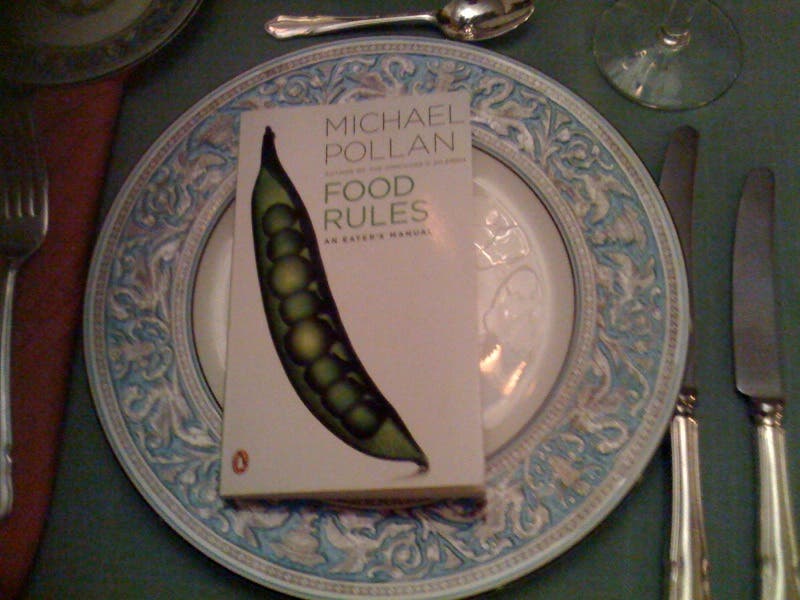
New York Times health writer Jane E. Brody says she has "come across nothing more intelligent, sensible and simple to follow than the 64 principles outlined in a slender, easy-to-digest new book called Food Rules, An Eater's Manual."
It is the latest opus from journalist Michael Pollan, author of the best-selling The Omnivore's Dilemma and In Defense of Food: An Eater's Manifesto.
So of course I read all 64 rules before planning my next supermarket trip, and evaluated some of the rules' feasibility.
Find out what's happening in Ridgewood-Glen Rockfor free with the latest updates from Patch.
Rule No. 12—"Shop the peripheries of the supermarket, and stay out of the middle."
But gosh, I needed to get some basic things like flour (I often make my own bread), whole wheat pasta and coffee. I also wanted to get apple juice. These items are not carried on the peripheries of any of the Ridgewood stores where I shop.
Find out what's happening in Ridgewood-Glen Rockfor free with the latest updates from Patch.
They are in those middle aisles, supposedly the province of evil food companies out to put us into early graves with unpronounceable additives plus sugar, salt and fat. (Of course, if they put too many of us into early graves, they will reduce their sales long term.)
Rule No. 15—"Get out of the supermarket whenever you can."
The idea here is to shop farmers markets, and anyone who has fought the crowds on summer Sunday mornings at the Ridgewood train station's farmers market knows that many of us take that to heart—no matter how hard the station construction made it this summer.
(My grandchildren and I almost got run over trying to buy the farm fresh produce beloved by Pollan.)
There were, however, no organic signs on the farmers market tomatoes, fruit, lettuce and other things we bought, and I often wonder just how free of pesticides they are.
Organic or not, local farm produce is fine and dandy. The problem is that when it is 15 degrees here in the northeast, the supermarket is your only option. (Year-round farmers markets import the same stuff the supermarkets get.)
And, frankly, I think it is simplistic to believe that all supermarkets and food companies are out to get you, and that most of us are too stupid to understand it. No matter what Pollan and Brody think, most of us really can read labels.
That said, I have long been alarmed at the feedlot practices for cattle and avoid buying meat that does not specify "No antibiotics." And I will not buy anything other than free-range chickens and turkey.
No. 39—"Eat all the junk food you want as long as you cook it yourself."
I kind of like this rule.
When I was growing up, we had French fries most every Friday night, along with meatloaf made from just ground beef, peppers and onions. The fries were hand cut, with my mom pushing a whole potato through a cutter.
I lived for that meal as a kid, and duplicated it many times over the year using a Cuisinart to make the fries. (Much easier than those old hand cutters.) But those fries were still dumped in hot oil and fried to a light gold. I don't know that they were a whole lot better for you than the frozen fries we resort to every couple of weeks when we get home late and the kids are coming.
The key, of course, is every couple of weeks. And we read the labels on those frozen fries. Some brands are better than others.
Rule No. 55 —"Eat meals."
This is presumably to discourage snacking on the run and to encourage everyone to sit down together as they supposedly do, according to Pollan, in more civilized countries like France.
But a new Marist poll noted in Prevention Magazine shows 70 percent of American families sit down to dinner at home six nights a week, a statistic that doesn't fit the Pollan/Brody theory of Americans as a bunch of dimwits who eat at McDonald's every night.
Rule No. 8—"Avoid products that make health claims."
The same might apply to books that make eating healthy sound easier and cheaper than it is.