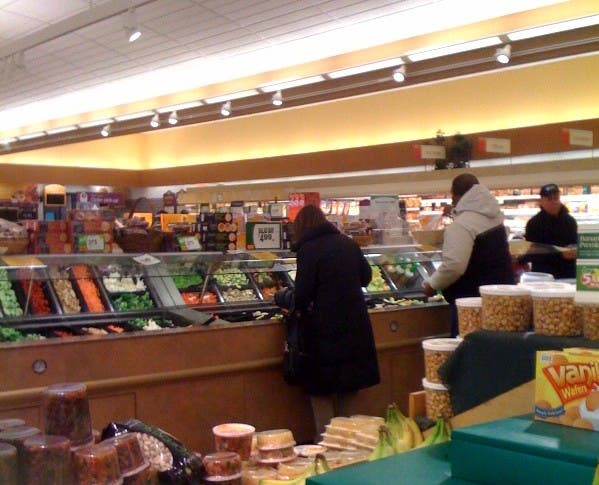


Smorgasbords offering a variety of foods emerged in 19th century Sweden as buffets at hotels and restaurants. By the 1950s, smorgasbords became a popular restaurant style in the United States.
By the 1960s, many non-smorgasbord restaurants began offering "salad bars." You could fill up at the salad bar while you waited for your entrée. (Interesting note: There is a dispute over which restaurant chain offered the first salad bar. Several claim the honor.)
Today, smorgasbords have pretty much disappeared in the United States, but the salad bar has become ubiquitous—not in restaurants but in supermarkets. There are islands with soup, lettuce, carrots, cucumbers, tomatoes, beets, cheese, zucchini, hard-boiled eggs, deviled eggs, grilled chicken, tuna, tofu, and many, many kinds of olives.
Find out what's happening in Ridgewood-Glen Rockfor free with the latest updates from Patch.
I have to confess that I rarely visit salad bars, not because I believe various Internet scare stories that say they are bacteria ridden, but because I am lucky enough to be able to go home for lunch and make my own out of lettuce and leftover dinner vegetables. It's cheaper.
And while I am sure commercial salad bars are not bacteria free, I trust that they are not much worse than my kitchen, and just as awash in bacteria-killing cleaning agents that may or may not be healthy for us in the long run. Some bacteria are good for you, and the bad ones seem to become resistant to antibacterial cleaning agents pretty quickly.
Find out what's happening in Ridgewood-Glen Rockfor free with the latest updates from Patch.
Nevertheless, I can't resist those antibacterial sprays and wipes. And the salad bars in local supermarkets look not just pristine, but appetizing as well, so I suspect somebody is running around cleaning up after any sloppy shoppers. The last thing stores want is someone claiming food poisoning from their salad bars.
Which salad bar you prefer depends on your goal, lunch or dinner, as well as food preferences and budget. And how much you spend probably mirrors the amount of calories you take in.
For the budget conscious, both Stop & Shop and King's in Midland Park price their salad bars at $4.99 a pound. Whole Foods is more costly, $7.99 a pound, but offers more exotic fare.
"Salad" bar may be something of a misnomer, since you could just fill your plastic container (King's and Stop & Shop) or cardboard box (Whole Foods) with enough grilled chicken, tuna or tofu to make it a main course.
Today's salad bar may not be as diverse as a true smorgasbord (no dessert), but it offers many options—pickled beets, bacon bits, the olives, shredded cheese, fresh peas, potato salad, egg salad, plain boiled eggs, chicken, salami, tuna, cucumbers, carrots, mushrooms, tomatoes, and, oh yes, lettuce and spinach.
There is a tendency to think anything with the word salad in it is healthy. That's true if you're filling your box with spinach and romaine with a few extras on top, but not if your idea of a salad is potato or egg salad topped with grilled chicken with beets and olives on the side. If you're not careful, you can box up a pound of food with a lot of calories even before you add the dressing.
Whole Foods, which appears to do a brisk lunch business, has now bookended its horseshoe-shaped salad bar with a hot soup counter on one side and drinks on the other.
We decide to build two salads to sample. We weren't tempted by the "fire roasted tofu" or the "braised tempeh." While we had heard of tempeh, we weren't quite sure of the difference between it and tofu. Wikipedia says the soybeans in tempeh are fermented, and the whole bean is included so it has more protein, fiber and vitamins than tofu. We still weren't tempted.
But we did try the ancient grain medley—which was enlivened with some shredded carrots—and the wheat berry, quinoa Waldorf salad. They really were not bad, but we were a little afraid of the calorie count, not to mention the price, $10.35.
We also built two different, more traditional salads at Kings for less than $5.
Our conclusion: Either Kings or Stop & Shop would be better for our wallets and waistlines.