Health & Fitness
History from the Strawberry Patch
There's history in every delicious bite! Who today would imagine that Bergen County was once the market garden for New York City, growing and shipping immense quantities of strawberries to market.



By Kevin Wright©2011
The piquant fragrance of strawberries always brings back boyhood expectations of summer, just as school was letting out. My grandparents’ well-guarded strawberry patch was down back of the barn, surrounded with a waist-high chicken-wire fence to exclude marauding rabbits and prying neighbors. I recall its starry blossoms in early May, shining upon a green mat. Anticipating the first delectable fruit of summer, we helped tend plants in well-hoed loam, fertilized with ashes and manure. The bed was always mulched with straw to conserve moisture, to keep down weeds, and to protect maturing berries from contact with the soil. When picking season finally arrived, we consumed as many from the stalks as we ever harvested for shortcake, for slicing in bowls of cereal, for preserves and other wonderful desserts. Their season was short but sweet.
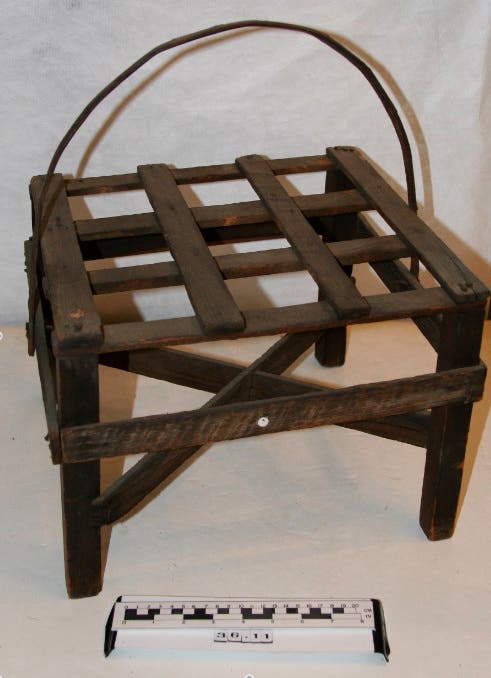
Many share this olfactory memory. Even at 92 years of age in 1916, James C. Demarest could recall the same fragrance from a passing wagon loaded with strawberries. Just as today—on farms where you can pick your own strawberries—the plants were set in long rows with intervening paths wide enough for pickers to work comfortably without trampling the fruits of their labor. In James’ youth, pickers earned a penny per basket, carefully covering each small splint basket they filled with an oak leaf before placing it in a handled wooden cradle. Children were excused from school to work the fields during the short but profitable season. A century ago, a farm wagon could carry a thousand baskets of this dainty fruit and a Bergen County farmer could pocket $14 for a thousand pints, taking home the first cash income after a long winter. Strawberry culture accordingly received special attention.
Find out what's happening in River Dellfor free with the latest updates from Patch.
Operating a produce market at the foot of Barclay Street, New York, Charles W. Idell, who resided in Hoboken, knowledgeably informed the Horticultural Society of London in 1826, “The first strawberries marketed in New York were wild ones from Bergen County, N. J. [African-Americans] were the first to pick this fruit for the New York market and invented those quaint old-fashioned splint baskets with handles. The baskets were strung on poles and thus peddled through the city.” Demand created by rapid growth of the industrial city, however, quickly outstripped the haphazard supply of wild fruit. Commercial cultivation of strawberries began about 1820 with farmers around Hackensack shipping berries grown in open fields and on hillsides by wagon and sloop twice weekly. Berries sold without their hulls or green caps, which were left on the vine. The half-pint splint baskets, called punnets, neatly nested atop one another in larger baskets called hampers. Strawberries sold for 3¢ to 8¢ per basket, earning farmers $30 to $40 per acre. The primitive handmade shipping containers were returned empty to the shipper.
Although strawberries from Virginia were the first to appear in Broadway saloons about the middle of May, they commanded 50¢ for a pint basket. A plate of strawberries and cream sold for about the same price. Once the crop from Bergen County flooded city markets, prices dropped. The Crimson Cone, a medium-sized cultivar of the Early American Scarlet, was variously known as the Scotch Runner or Dutchberry—New Yorkers, however, simply called them “Hackensacks,” honoring their place of origin.
Find out what's happening in River Dellfor free with the latest updates from Patch.
The Paterson & Hudson River Railroad opened in 1835, with the Eire Railway taking control in 1853. In June 1847, one train alone conveyed 26,667 quarts of strawberries to ferry landings on the Hudson River for sale in Manhattan. Two years later, the same railroad transported 80,000 baskets, equal to 833 bushels, in a single day. By that time, strawberries sold for about 9¢ per quart with consumption in New York City reaching 5,000 bushels for the season. By 1850, market gardeners no longer grew strawberries in garden “beds,” but in “strawberry fields.” In late June 1858, the second tollgate on the Bergen Turnpike counted the passage of 1,100 wagons from Hackensack to the Hoboken ferry, carrying one and a half million baskets in a single day.
Opening of the Northern Valley Railroad between Jersey City and Piermont on May 26, 1859, gave further impetus to the trade, carrying 400,000 baskets in its inaugural year. In those days, railroads charged 12-1/2¢ per hundred baskets and the Erie stations at Ramsey and Allendale alone accounted for 1,126,000 baskets. In 1863, the Bergen Journal regarded ten million baskets as a low estimate for shipments from Bergen County into New York City in a single season.
The strawberry has a long history in these parts. American Indians admixed crushed wild strawberries with cornmeal in making their bread, gathering the fragrant fruit from abandoned maize land and the understory of open woods. Wild berries were small, acid and seedy in comparison to later hybrid cultivars, but were widely regarded as superior to European varieties. Being hardy but uncertain bearers, species indigenous to North America, such as the Large Early American Scarlet or Virginian Strawberry, the Boston Pine (possibly re-imported from Europe about 1800), and the Chilean (native to the Pacific coast), were crossbred to create the first market standards. The Hudson, descended of the American Scarlet, was an early commercial favorite, making its first documented appearance in 1791. Since market berries had to retain flavor and firmness in shipment, substantial horticultural prizes for developing a reliable market variety encouraged experimentation and hybridization after 1835. The reliable Boston Pine strawberry, grown along the Hudson River since at least 1825, was re-christened the “Bartlett,” after crossbreeding improved not only productivity, but color, flavor and firmness. While European gardeners perfected “Fancy Varieties” with firmer, more flavorful and more attractive crimson fruit, these were less suited to market production, requiring tender nurture.
Charles M. Hovey, of Boston, editor of the Magazine of Horticulture, introduced an improved strain in 1834, but, as a pistillate variety, it had to be interplanted with pollen-bearing plants to produce fruit. Consequently, it never proved reliable enough for commercial production, but remained popular in home gardens for many years. Hovey’s work, however, inspired other nurserymen to improve the fruit’s marketable qualities. A Scots gardener named James Wilson, who settled in Albany, New York, introduced a promising new market variety in 1853, which his son John popularized. Building on its reputation for large crops of firm fruit of uniform size, Wilson’s Albany Seedlings superseded all other commercial varieties by 1860, boasting an average yield of 200 bushels per acre without the labor traditionally invested in traditional straw mulch or removing runners. But farmers raising Wilson’s Albany profited from quantity rather than high prices for superior quality as the berries were notoriously tart and darkened quickly after ripening, limiting their shipment to markets close at hand. Coming out of western New York in 1863, Russell’s Strawberry proved a successful commercial alternative that yielded good market fruit reliably and abundantly.
McAvoy’s Superior Strawberry initially earned a reputation for hardiness, a long-bearing season and large juicy berries. Its use spread among growers after 1856, but, like most early amateur varieties, it proved better suited for household gardens, being too tender for market. Although offering mammoth berries with a spicy flavor, the temperamental Triomphe de Gand proved less productive than other field varieties and an irresistible target for worms. In 1870, Colonel Wales Cheney, of Wyoming County, New York, crossbred the Triomphe de Gand with Russell’s Seedling to produce a juicy, aromatic and scarlet-colored berry.
On June 26, 1874, the Bergen County Democrat hailed Henry H. Zabriskie as Bergen County’s “Strawberry King.” A correspondent who visited his small farm in Prospect Park claimed, “Berries, three times the size of large berries, are found by the hundreds of quarts and with a flavor, which the ordinary berry cannot equal. These berries, known as the Col. Cheney berry, must be cut in three or four pieces to be eaten. One was three inches in diameter and seven in circumference. We can scarcely estimate the quantity of berries, which this ‘farm’ produces, but they must be counted by thousands of quarts, and all of the fruit is graded far above the general run of berries.”
Mr. Zabriskie thought the choicest varieties for cultivation—out of sixty kinds then available—were: Peak’s Emperor (a dark-colored variety, introduced around 1869, that was best suited to light soils), the Green Prolific (a good cropper that withstood heat and drought better than other varieties), the Kentucky (a hardy variety introduced around 1870), the old reliable Wilson’s Albany, and the great berry, the Col. Cheney. The latter, however, failed to produce a good crop unless fertilized from the flowers of other varieties that bloomed at the same time, most notably, the high-growing Wilson’s Albany. Henry Zabriskie therefore planted these two varieties in neighboring beds, allowing either wind or bees to cross-pollinate them.
As commercial cultivation advanced, some farm families continued to weave their own splint baskets during winter. Others hired a basket maker, who came in the fall and gathered hickory timber from the woods, weaving splints into baskets over winter. Each shipper had his own painted mark to identify his empty baskets, which were piled in a heap at the railroad station upon their return from market. Farmers sorted through the pile, looking for baskets with their peculiar identifying paint mark. As sorting baskets proved tedious, it became common to simply count out what one was due, regardless of the farm brands.
Always uncertain as to size, most punnets held less than half a pint. Their sloping sides, however, were designed to prevent berries at the bottom from being crushed in transport. Starting about 1840, Andrew M. Hopper, of Pascack (now Hillsdale), New Jersey, became the first farmer to use crates, holding from 100 to 200 half-pint splint baskets each, for shipping berries to market. Nicholas Hallock, of Flushing, New York, introduced square whitewood fruit boxes in 1858.
According to the Bergen Democrat of June 16, 1865, the Erie Railroad shipped 10,000 baskets daily from Hohokus Station; 30,000 baskets daily from Godwinville (now Ridgewood); 50,000 baskets daily from Ramsey’s; and 40,000 baskets daily from Allendale. Not less than 50,000 baskets traveled daily to New York either by the Plank Road or the Hackensack Railroad. Farmers in the neighborhood of Closter Dock shipped their fruit across the Hudson River by periauger. In the industry’s heyday, the enterprising farmers of Old Bergen made daily shipments of 250,000 baskets to commission houses in New York. As late as May 1911, the extensive strawberry patches of Richard W. Cooper at New Milford (now Oradell) were white with blossoms. But by this time, strawberries from as far distant as Texas were available in local markets.
I cannot depart this tasty subject without offering the following recipe for Strawberry Short Cake, reproduced from the Cultivator & Country Gentleman of July 1866: “For the short-cake take three pints of flour, and rub dry into this quantity two large teaspoonfuls of cream of tartar; add half a teacup of butter, a little salt, one teaspoonful of soda dissolved in a pint of milk and water. Mix quickly and thoroughly; roll an inch thick, and bake twenty minutes in a quick oven. Take the berries, adding cream and sugar to make a sauce—small-sized berries with a sprightly flavor are the best for this purpose. When the shortcake is baked, divide in three layers, butter each, sprinkle with sugar and grate nutmeg over them, and spread the strawberries between. To be served warm, cut like jelly-cake.”
Visitors to the King’s Birthday Celebration at Historic New Bridge Landing on Saturday, June 11, 2011, will be able to view a special exhibit of Bergen County strawberry baskets, hampers, basket molds, and field trays. Anyone interested in local history is encouraged to join the Bergen County Historical Society, a non-profit, 501(c)(3) volunteer organization, founded in 1902. For membership, go to: http://www.bergencountyhistory.org/Pages/membership.html
For further reading, I recommend an important source: S. W. Fletcher, The Strawberry in North America, New York: The MacMillan Company, 1917.