Health & Fitness
Part Three: A Brush with the Wild, The life and art of Charles Livingston Bull.
Wildlife artist Charles Livingston Bull marries Fanny Elizabeth Seymour, moves to New York City and begins to build a national reputation for illustrating popular books and magazines.



By Kevin Wright©2012
Launching a Career in Wildlife Art and Illustration
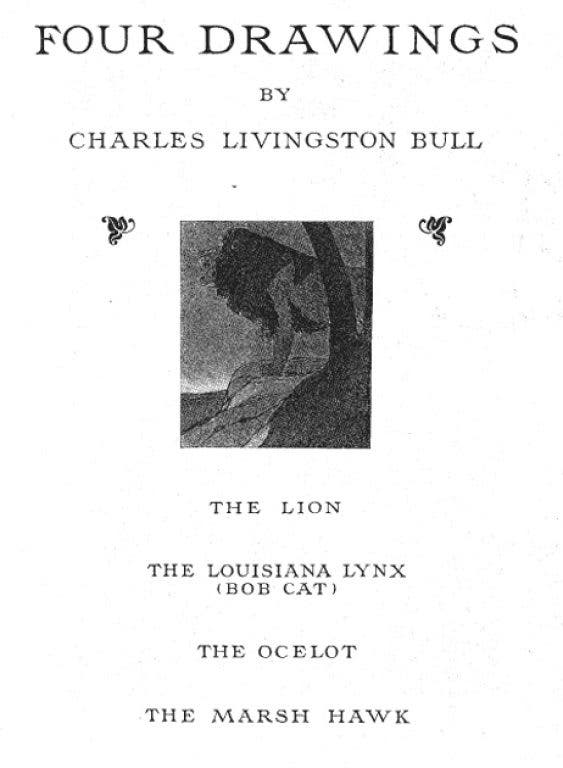
Charles L. Bull was listed for the first time in the Rochester Directory as an artist in 1901, residing in the family home at 564 Averill Avenue, Rochester, New York. Indeed, a signed ink-on-board drawing, entitled, “The Most Beautiful, story illustration for Chika the Burgon, 1901” survives to indicate his approaching success as an illustrator. Bull published “Four Drawings,” entitled “The Lion,” The Louisiana Lynx (Bob Cat),” “The Ocelot,” and the “Marsh Hawk,” for The Century Magazine in March 1902. He won national attention for “The Elk,” published on June 20, 1903, the first of many cover illustrations he would do for the Saturday Evening Post, and for “Sled Dogs,” which the same magazine published on its cover on November 15, 1902. Bull apparently moved to New York City at about this time, taking up residence near the New York Zoological Park in the Bronx, where he quickly impressed and befriended the zoo’s young curator of birds, C. William Beebe. He also found profitable employment illustrating Marshall Saunder’s Beautiful Joe's Paradise or, The Island of Brotherly Love in 1903, and Charles G. D. Roberts’ book, Earth’s Enigmas. He and Philip R. Goodwin produced ten color plates, plus a frontispiece, for the first edition of Jack London's Call of the Wild, a tale of an abducted dog’s journey from California into the primitive frozen wastelands of the Arctic, serialized in June-July 1903. His artwork also appeared in Frank Leslie’s Popular Monthly in December 1903 and in The Windsor Magazine in 1903 and 1904. He illustrated Charles G.D. Roberts’ The Watchers of the Trails: A Book of Animal Life, published in 1904; Frank T. Bullen’s Denizens of the Deep, with Theodore Carreras in 1904; the frontispiece for Ridgewell Cullum’s In the Brooding Wild, in 1905; and Charles D. B. Roberts’ The Haunters of the Silences, in 1905.
Find out what's happening in River Dellfor free with the latest updates from Patch.
Just as his career as an illustrator took a quantum leap forward, Charles Livingston Bull married Fanny Elizabeth Seymour. She was the daughter of Rochester hardware salesman and bookkeeper, Henry Franklin Seymour, and his wife, Florence Steele. Her father worked for Hamilton & Mathews on Exchange Place in Rochester until 1888, when H. Franklin Seymour & Company opened their own hardware business at 28 East Main Street. By 1894, Seymour & Company operated a hardware store, selling mechanics’ tools, at 117 East Main Street. Frank Seymour’s daughter, Fannie E., is first listed as a bookkeeper there in 1896. Interestingly, the Federal Census for 1930 indicates that Charles Livingston Bull and Fanny Seymour were both 22 years old when they first married, which would mean they did so in 1896. At that time, Charles Livingston Bull worked only three blocks away in a bicycle sales-and-repair shop—perhaps he visited Seymour’s store for tools and parts. In 1898, when H. Franklin Seymour & Company moved to 40 Triangle Building, Fannie was no longer listed as an employee. In 1899, the H. F. Seymour Company was advertised as a hardware store, specializing in Williams Typewriting Machines, at 801 Chamber of Commerce. From 1901 through 1903, Miss Fannie Seymour was listed as a boarder in her father’s house at 64 Plymouth Avenue, Rochester, New York. Henry Franklin Seymour removed to New York City in 1904, apparently to join his married daughter.
In any event, William Beebe and his wife, Mary Blair Rice, invited Charles and Fannie Bull to join them on a scientific expedition to Mexico over the winter of 1903-04, where the two couples traveled to identify and collect native birds for the Bronx Zoo. While Bull sketched from nature, he also shot and collected specimens for taxidermic mounting, intending to use them as models in his artwork. The wanton killing apparently offended Beebe, who nevertheless did not seem to mind gathering wild birds for his zoo cages. As Fannie Bull found the wilderness too dangerous for her liking, she and Charles departed the expedition. The manifest for the S. S. Seneca, sailing from Tampico, Mexico, on March 9, 1904, for New York includes Charles L. Bull, artist, and Mrs. Charles L. Bull, who were returning home to their residence in New York.
Find out what's happening in River Dellfor free with the latest updates from Patch.
False Leads
For the awakening moments of Charles Livingston Bull’s artistic career, most admirers simply rely upon the obituary account of Beecher S. Bowdish, who grandly claimed Charles Livingston Bull “remained in Rochester until about 1900, studying taxidermy at Ward's Natural Science Establishment, where he succeeded Dr. William T. Hornaday as taxidermist. From there he went to the National Museum in Washington and here again, succeeded Dr. Hornaday as taxidermist. There, too, he came in contact with such men as Charles R. Knight, Louis Agassiz Fuertes, and other ranking naturalists and artists…He spent much time at the National Zoological Park, sketching birds and animals. On a trip to New York in 1902 he took a number of these pictures with him and 'Frank Leslie's Magazine' endeavored to secure his exclusive services. The offer was refused, but Mr. Bull found ready sale for his wild life pictures wherever he went. He took up his abode in the Bronx, near the New York Zoological Park, where he resumed his daily sketching of animals and birds. He and William Beebe, then curator of birds at the Zoo became warm friends and made a trip to Mexico together.”
Unfortunately, unless correspondence passed between friends, Bowdish was not at hand to witness this crucial period in Bull’s life, which explains several inconsistencies in his widely accepted biographical sketch. For records show Beecher S. Bowdish enlisted at Geneva, New York, on June 20, 1898, to serve two years at the outbreak of the Spanish-American War. He was mustered on the same date to Company B, and mustered out on November 30, 1898. He enlisted again in New York City with the 11th Infantry Division on February 13, 1899. In 1900, Beecher S. Bowdish, of New York City, was a private serving at the American naval base at Aguadilla, Puerto Rico. He was discharged on March 3, 1902 at Angel Island, California, at the expiration of his term of service. On December 31, 1904, he married Cristabel M., youngest daughter of Charles J. Everett, in New York City.
To a large degree, Beecher Scoville Bowdish and Charles Livingston Bull were kindred spirits as well as contemporaries. Bowdish became a noted authority on birds, collecting specimens, eggs and nests and publishing a number of ornithological papers. First known for his studies of Puerto Rican birds, Bowdish was an early convert to the merits of banding rather than collecting, and was one of the founders of the New Jersey Audubon Society. The First Annual Report of the New Jersey Audubon Society, published in 1911, lists him as Secretary. He and Chester A. Reed published a New Jersey Bird Guide for the New Jersey Audubon Society. Charles Bull was a fellow sustaining member. Bowdish was also chief clerk of the National Association of Audubon Societies.[1] Although born in Phelps, NY, he resided for most of his life in Demarest, New Jersey, and died on February 21, 1963, at the advanced age of 91. He was also a corresponding member of the Delaware Valley Ornithological Club, a recognized expert on bird protection and the economic value of birds, often lecturing on the pleasures of bird study.
To reconcile with Bowdish’s published claims, we speculate that Charles Livingston Bull sketched wildlife at the National Zoological Park in Washington, D. C., to fulfill his various commissions, taking the opportunity to attend night classes at the Corcoran Gallery of Art. He may also have studied and sketched live animals at the Philadelphia Zoo, where he may have shown his work at the Philadelphia Art School, befriending other artists and illustrators such as Howard Pyle, N. C. Wyeth, and Charles S. Chapman. He supposedly followed this routine for seven years, steadily building his reputation as a freelance animal illustrator.
Coming Soon: Part Four, The Oradell Artist
————————————————————————————————————
Ask yourself—Just how valuable are the lessons of history? If you enjoyed this article, then please consider joining the Bergen County Historical Society, a non-profit, 501(c)(3) volunteer organization, founded in 1902. We are dedicated to preserving important evidence of the past and promoting historical literacy through interesting programs and publications.
We don't receive public operating support or grants the way other groups do, but rely entirely upon private donations, membership dues and volunteer contributions of time and talent. We are presently trying to raise $350,000 to construct a first-rate historical museum building and library for Bergen County on the Society’s property at Historic New Bridge Landing, 1201 Main Street, River Edge, NJ 07661. For further information or membership application, visit: http://www.bergencountyhistory.org
[1] Edward Fuller Bigelow, The Guide to Nature, Agassiz Foundation, Vol. 4, Issue 10, 1912.