Politics & Government
Cell Phone Tower Proposal Still Receiving Poor Reception
Residents and the Zoning Board of Adjustment question T-Mobile representatives regarding a proposed monopole.
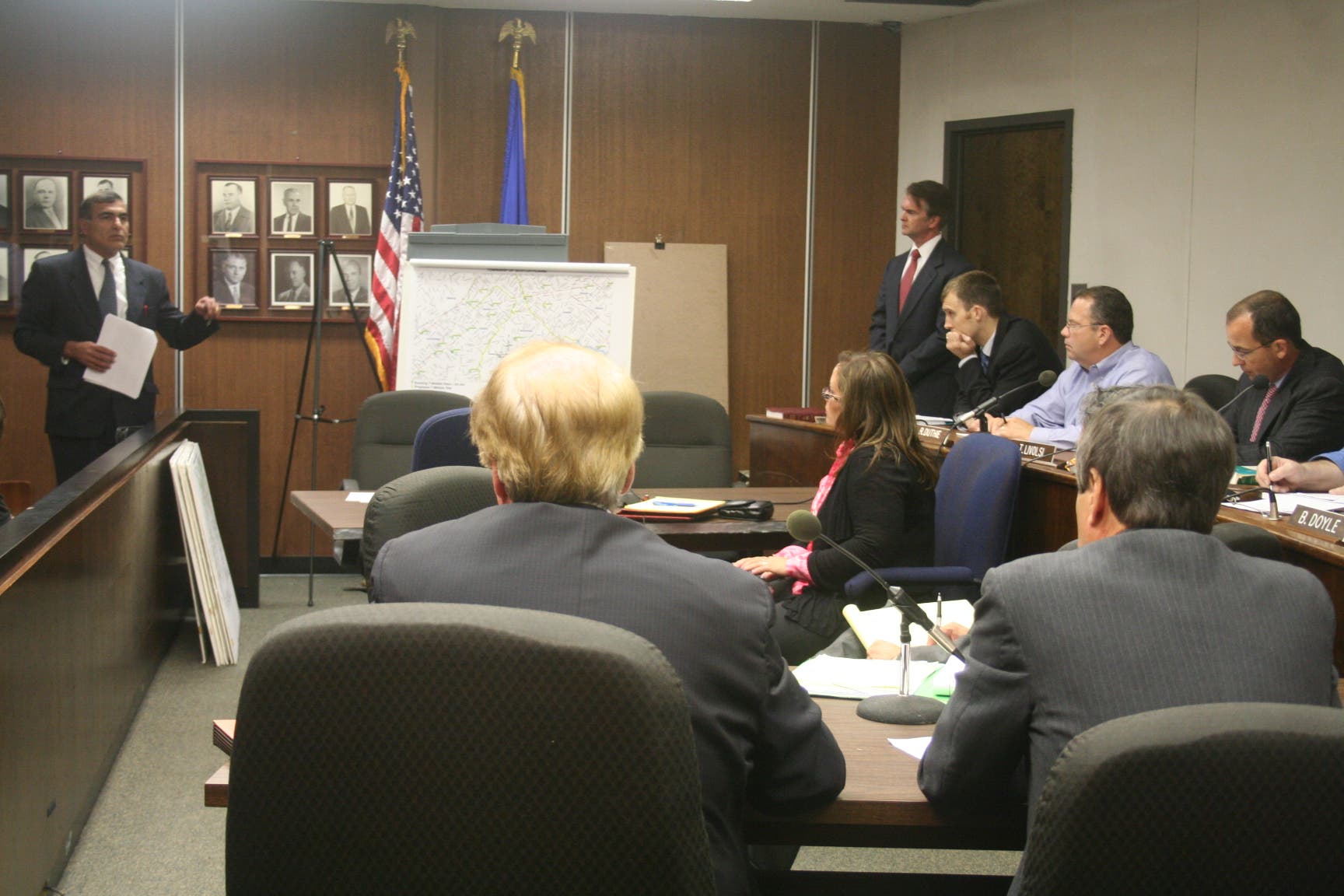


The fate of a proposed 117-foot monopole tower on the property of Willow Grove Swim Club remained unresolved Wednesday night, despite four hours of expert testimony and questions from residents and members of the Scotch Plains Zoning Board of Adjustment.
The proposal was last discussed at a meeting July 2. The next public hearing on the tower takes place Wednesday, Oct. 20.
Ben Shidfar, a telecommunications expert retained by T-Mobile, testified that the cell tower would bridge a gap in cell coverage around the proposed tower. During his testimony, he insinuated that if the tower is not constructed, residents in the "gap area" could lose access 911 services.
Find out what's happening in Scotch Plains-Fanwoodfor free with the latest updates from Patch.
During the public comment session that followed, residents accused Shidfar of "fear-mongering." Wearing pins that read "No Cell Tower," they referred to coverage maps from the T-Mobile website, which indicate "moderate" to "excellent" phone coverage and mobile web access in the area around the proposed cell tower.
Shidfar insisted that the maps used on the website are for sales and marketing purposes, and as a result, are neither as accurate nor as comprehensive as those he brought to support his testimony. He said that the maps he used include "projected coverage," calculated by computer, and a reception-based driving test performed and submitted to T-Mobile by a third-party company.
Find out what's happening in Scotch Plains-Fanwoodfor free with the latest updates from Patch.
Ronald E. Graiff, a radio frequency consulting engineer retained by the Zoning Board, said he was not convinced that there was a coverage gap based on the information presented by Shidfar.
"The evidence, to me, isn't sufficient that the gap exists there," Graiff said.
He requested that T-Mobile representatives provide additional coverage maps and statistics pertaining to the number of dropped calls in the supposed service gap area and the number of T-Mobile users who live in that area.
Graiff did inquire, however, whether a 100-foot tower would provide coverage similar to the 117-foot tower. He requested additional data to explore the construction of the slightly lower tower.
Following the meeting, William Gregorym of Roosevelt Avenue, said he remained frustrated with the tower proposal and its potential impact on his neighborhood.
"They're putting this industrial equipment in a residential area," Gregory said. "That's not why I moved here."
He also criticized the Willow Grove Swim Club for leasing its property to OmniPoint Communications, a subsidiary of T-Mobile. "I feel they sold out the community for a couple of bucks," he said. OmniPoint has leased the land from Willow Grove since Dec. 2006.
T-Mobile's tower proposal is the second attempt by the telecommunications firm to install a tower at the property. In 2007, the Zoning Board rejected a T-Mobile application because it did not take the tower's environmental impact into account.
T-Mobile has also applied to build a cell tower in Scotch Plains' Hillside Cemetery. That proposal has been met with similar resistance from residents.
The installation of the monopole requires a use variance before it can be built. In order to obtain such a variance, at least five of the seven members of the Zoning Board have to approve the proposal for the board to permit an exception to the standard zoning laws.