Politics & Government
T-Mobile Expert Testifies on Proposed Cell Tower
He says that the tower, if approved, would fall within federal limits on radiofrequency exposure, but residents remain unswayed.
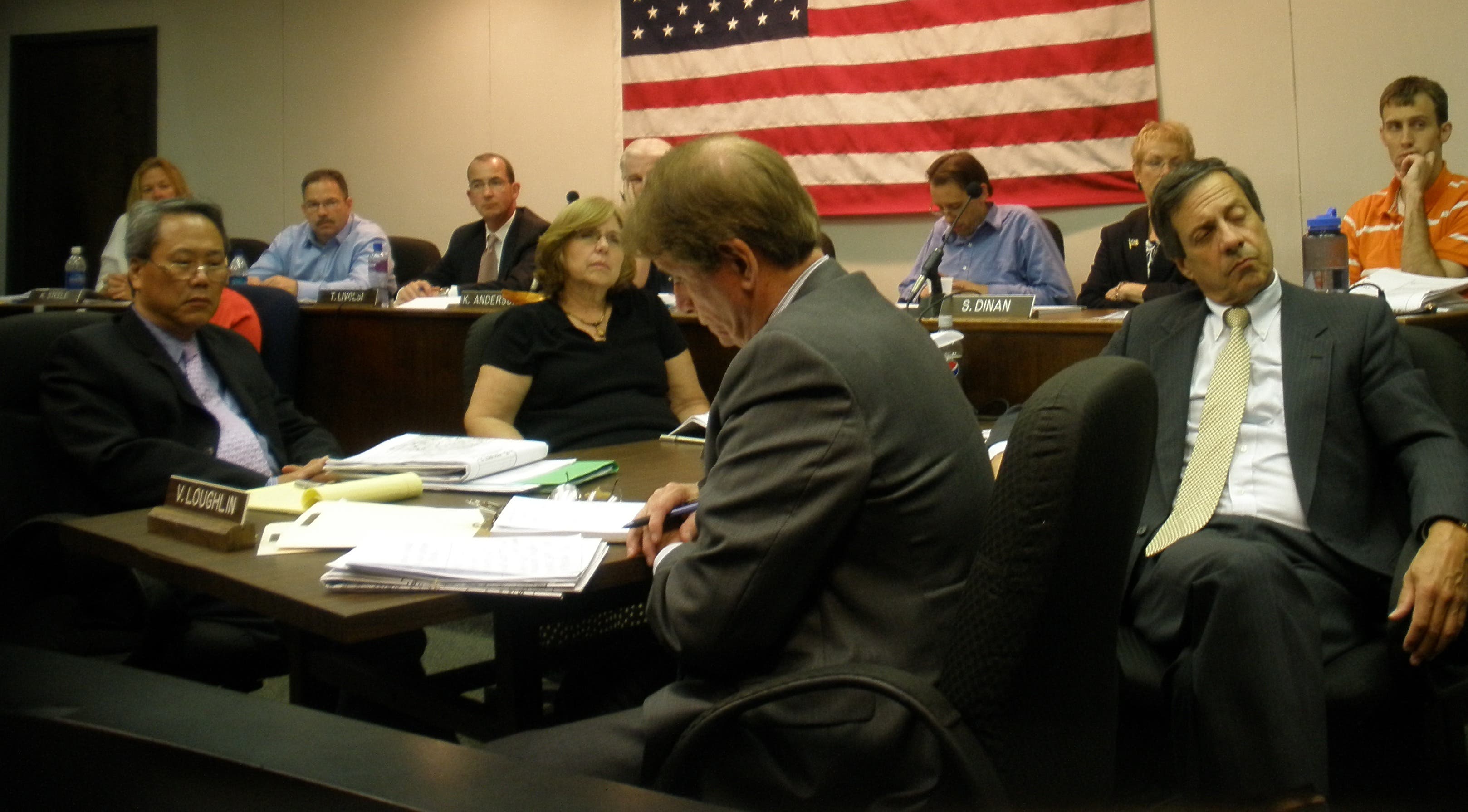


About 80 community members filled the gallery last night for the monthly meeting of the Scotch Plains Zoning Board of Adjustment. The meeting centered around a proposal made by T-Mobile to construct a 117-foot cell tower on a piece of leased land within the property of Willow Grove Swim Club in Scotch Plains.
T-Mobile's chief attorney, John Edwards, opened by briefly addressing the two primary concerns of board members and of the audience: the tower's safety and the tower's appearance.
"The testimony that you will hear tonight and during the next few meetings will prove that [the tower] is not going to hurt anybody," he said.
Find out what's happening in Scotch Plains-Fanwoodfor free with the latest updates from Patch.
Edwards added that the monopole's intended location – in the corner of the swim club's parking lot – is "the best place we could find, and particularly well suited to fit the need we have."
Dan Collins, an expert in the field of radiofrequency compliance law, was the first and only witness called by T-Mobile at last night's meeting. "It is our responsibility to prove that the radiofrequency exposure [from the tower] would be within safe limits," he said. "We are in compliance with federal law by an extremely huge margin."
Find out what's happening in Scotch Plains-Fanwoodfor free with the latest updates from Patch.
Collins stated that the Federal Communications Commission takes into account the specific emitted frequency of a transistor when it sets maximum exposure standards for humans. According to Collins, the FCC limit for the proposed 1900 MHz bandwidth frequency that T-Mobile's antenna would emit is one milliwatt per square centimeter, a standard that Collins referred to throughout his testimony as "100 percent of the federal limit."
Collins also noted that New Jersey's exposure standard is five times less protective than the federal standard, meaning that under state law, New Jersey citizens could be exposed to five times as much radiofrequency emission as federal law allows.
After establishing these statistics, Collins used a computer to demonstrate that the maximum exposure a person could receive from the proposed cell tower would be 0.06 percent of the federal limit, or about 1600 times less exposure than the FCC maximally allows. The person would need to stand exactly 120 feet from the tower to receive this exposure, he said. A person standing directly next to or beneath the tower, he said, would receive far less exposure.
Collins strengthened his testimony by assuming an even more conservative situation. "T-Mobile also has a license to broadcast at 2100 MHz, which it is not expected to do," he said. "However, if [this frequency] is used, the new worst-case scenario for exposure would be 0.09 percent of the FCC limit, still less than one-tenth of a percent."
Furthermore, Collins compared these potential exposure limits to "ambient levels," which he defined as average exposure levels within different areas. Collins stated that the average home – due to the nature of electronics and household appliances – emits five percent of the federal exposure limit.
"Simply standing in your home exposes you to more than fifty times the radiofrequency emissions of the tower at its worst," he said.
Questions dealing with Collins' testimony were then posed by members of the Board of Adjustment, the town's assembled panel, and community members in attendance.
Board of Adjustment chairman Kenneth Anderson asked if a physical problem with the equipment used to construct the tower could skew the mathematical calculations.
"If something is wrong with the equipment, it would emit less frequency and therefore lower exposure levels," Collins answered.
Multiple questions focused on the exposure levels that homeowners and children would receive if they stood close to or underneath the tower. However, Collins reaffirmed that the maximum radiofrequency exposure that a 1900 MHz frequency tower would emit would be 0.06 percent of the FCC limit, and that only a person standing 120 feet away from the monopole would receive this maximum exposure.
Several attendees, however, questioned Collins' calculations. Ronald Graiff, a radiofrequency consulting engineer hired by the township, asked if beam tilt, or the slight angling of antennae, could affect the calculations.
"T-Mobile will not use beam tilt," replied Collins. "However, if T-Mobile did tilt in the two to four degree range, this would result in an exposure level just a little higher [than the original calculation] because the antenna got a bit closer to the ground. From experience, the result would be 0.061 percent of the federal limit with beam tilt, still way below the acceptable level."
Many attendees emphasized that Collins' calculations, which assumed the average person to be 6-feet-6-inches tall, did not take into account the elevated topographic region around the monopole or the possibility of someone standing on the second floor of his or her home, both of which could decrease the distance from the antenna to the person.
"Being closer to the beam is not an issue," said Collins. "If the monopole was ten meters high, it would already satisfy compliance under federal law."
"What would the calculations be if we raised the height [from 6.5 feet] to sixteen or twenty feet?" Collins continued. "Maybe it would get up to 0.1 percent. That's still a comfortable number in my mind."
Nonetheless, Collins agreed to prepare a report for the next meeting that will take into account the possibility of the 2100 MHz frequency, beam tilt, and the prospect of a person looking out of a sixteen-foot second-story window.
"If that number gets even to 0.5 percent [of the federal limit], I'll come back and explain why," he said.
In total, sixteen community members, many of whom live near the tower's proposed location and some of whom have children enrolled at McGinn Elementary School, posed questions to Collins that dealt with a broad range of topics, including cell tower monitoring, the effect that other cell towers in the area would have on the proposed monopole, and the possibility of other carriers attaching antennae to the tower.
Throughout, Collins reiterated that cell towers like the one being proposed have never come close to reaching the federal exposure limit.
Around 11:00 p.m., Anderson ended the meeting and announced that the next meeting will take place Wednesday, Sept. 15. T-Mobile has three more experts – a site engineer, a radiofrequency engineer, and a site planner – lined up to provide testimony.
Despite the testimony presented, the opinions of most community members in attendance remained the same. "I'm unswayable," said Melvin Smallwood, who lives on Roosevelt Avenue, a few doors away from the Willow Grove Swim Club. "It's an atrocity in plain view, right in the middle of a park, a pool, and a school."
"I hope that the board is wise and realizes that we said no to this [proposal] once before and our feelings have not changed," said Gene Morrow, a resident of Scotch Plains.