Business & Tech
Apple Mogul Steve Wozniak Appears at Rutgers University for Entrepreneurship Day
Discussed his history of working with technology, from a love of ham radio to Apple's massive role in the technological marketplace.
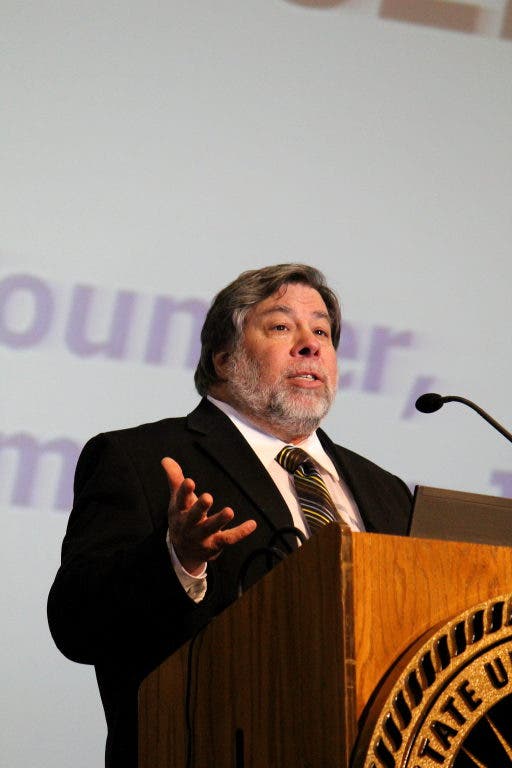


Rutgers University received a crash course in entrepreneurship and Apple Computers, Inc., on Monday by the technological titan's co-founder, Steve Wozniak.
Wozniak was the keynote speaker for the University’s third annual Entrepreneurship Day, speaking to Rutgers staff, students and young entrepreneurs about how Apple was started on little more than a dream, a vision and ambition.
“We are delighted today to welcome a man who captures the entrepreneurial spirit as well as anyone in America,” said University President Richard McCormick. “A Silicon Valley icon whose joint efforts with another genius brought into the world the Apple computer brought into the world the Apple computer, which would revolutionize computing and ultimately change the way we learn, communicate, work and play.”
Find out what's happening in South Brunswickfor free with the latest updates from Patch.
Wozniak, also a chief scientist at Fusion-io, took to the stage at the College Avenue gymnasium, and for nearly one hour spoke animatedly about the events which led up to the development 35 years ago of Apple.
“When we started Apple, we were very young, in our 20's,” he said. “We had no money, we had no savings accounts, we had no friends or relatives to loan us any money, and we had no business experience. “We just had some ideas and some inspiration.”
Find out what's happening in South Brunswickfor free with the latest updates from Patch.
Wozniak compared his early desire to become an engineer to a childhood storybook character he used to read about named Tom Swift Jr. — a boyhood genius who, in times of world crisis, would build things to help solve problems, he said.
“I decided in my life I wanted to be like that,” he said. “I wanted to be an engineer because engineers create all these new things and if we could create new things, life would get easier. And instead of a five day we’d have a four day work week.”
Technology and education are the solutions to our future, particularly with electronics, Wozniak said. It is important that people take the things they learn in the classroom, about “the world as it is,” and apply those fundamentals to create new and unique things.
It was through learning these fundamentals that Wozniak was able to climb what he called a “staircase” to success.
Wozniak told the crowd of over 200 about his first intrigue with simple ham radios as a young boy back in what he called “the days of tubes,” all the way up until using small, budget micro-processors that would become the first Apple I computer.
He encouraged people to be “disruptive” of the norm, noting that companies like Apple, Google and Facebook all got to where they are because the people who created them did just that.
Wozniak didn’t stray from his own disruptive behavior, noting that he and the late Steve Jobs found themselves getting into phone phreaking, a process of “hacking” or finding loop holes in telephone networks.
“That year I heard about the device called a blue box, a device that made certain tones that if played into an American telephone, you could make calls all over the world for free,” he said. “We [he and Steve Jobs] went home and built a blue box. It was exciting. I had to design the best one that’s ever been done in the world.”
He described their history, from how he and Jobs first went into business together selling blue boxes to college students, to the 50,000 unit order of Apple computers, to the success of the company today.
Following his speech, Wozniak held a brief question and answer session, where members of the audience thanked him for his inventions and asked about things ranging from his (brief) career as a plane pilot to how he plans on bridging the gap between consumption and technological innovation.
But before that, he didn’t forget to remind people to, like him, do what they love, do it for personal reasons, and do it without fear of succeeding.
“You know, everyone grows up kind of wanting to leave some kind of mark on the world,” he said. “It starts with channeling inspiration.”