Schools
Board of Ed Gets a Jumpstart on Budget Discussions
Usually the conversation starts in November or December. But school district leaders have moved the timetable for budget discussions up to reflect a new fiscal reality.



The South Orange-Maplewood School District will be facing a "pretty serious shortfall in 2011-2012 in terms of millions of dollars," the school superintendent explained at last night's Board of Education meeting.
The BOE started preliminary budget discussions for the 2011-2012 school year last night, months earlier than is usual. Elected board members and school administration noted that the early timing of the discussion reflected a new reality—one in which state aid has diminished dramatically, costs continue to escalate, and a new state cap of 2% on annual school district budget levies limits revenue.
BOE President Mark Gleason introduced the discussion. "We are talking about this earlier because it's going to be hard," said Gleason. While the tax cap did leave school boards with a "handful of exclusions" (one of which is health care costs), Gleason noted that the number of exclusions had shrunk from 12 to 4.
Find out what's happening in South Orangefor free with the latest updates from Patch.
Superintendent of Schools Brian Osborne described the situation in broad terms using only two slides. He noted that it is "pretty unusual to be looking at the budget in summer." Discussions usually begin in November or December.
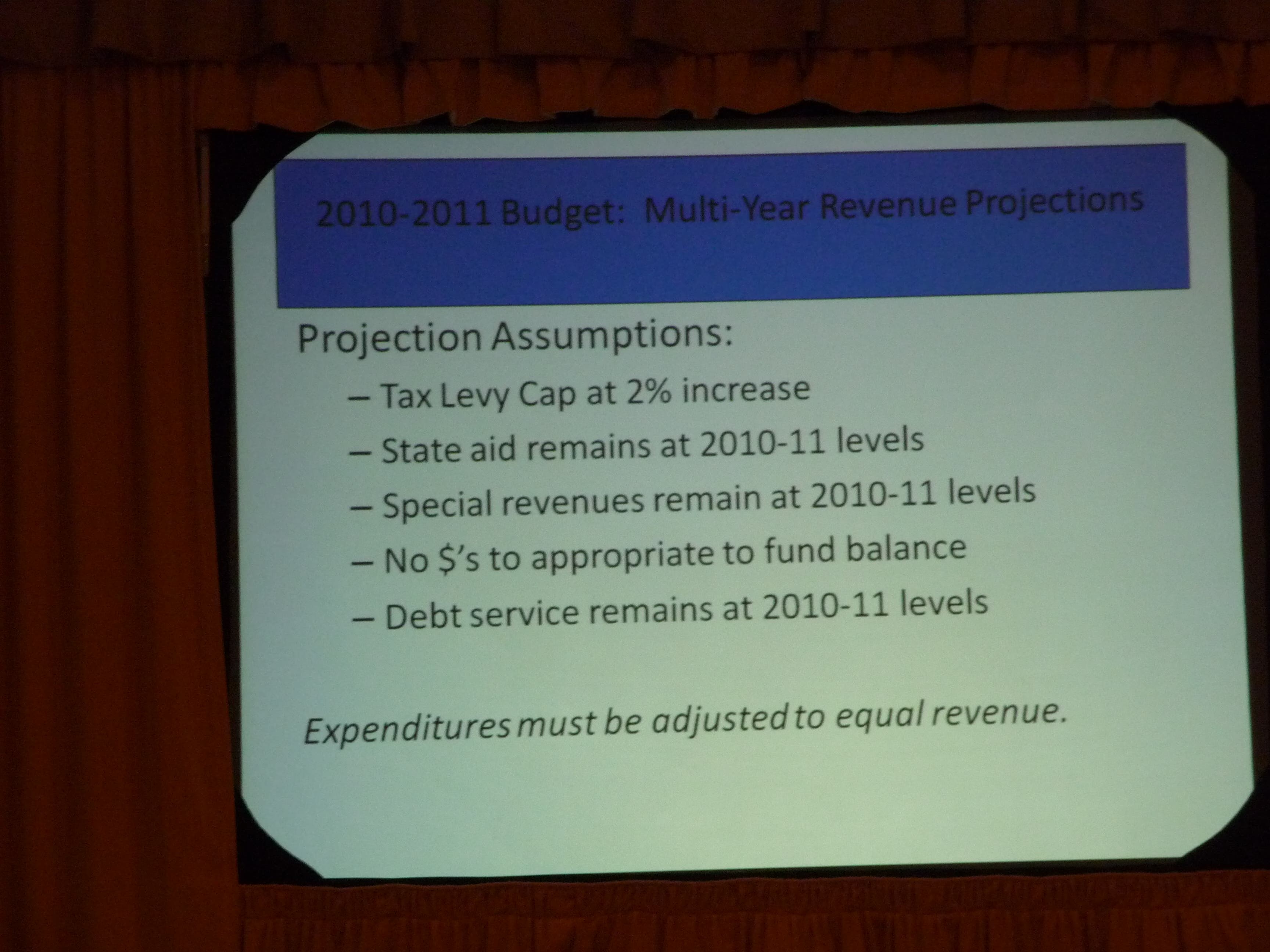
Osborne said the administration was building its multi-year revenue projections on the following assumptions:
Find out what's happening in South Orangefor free with the latest updates from Patch.
- Tax levy cap at 2%
- state aid revenues at 2010-11 levels
- special revenues remain at 2010-11 levels
- no dollars to appropriate to fund balance
- debt service remains at 2010-11 levels
Osborne noted that the projections made certain assumptions that may not come to pass. For example, the facilities committee is looking at projects that would increase debt service. (Along with health care, debt service is one of the four items exempt from the tax cap.)
Osborne reported that, for years, the district enjoyed increased budget revenues of about 6%—some years 5%, some years 7%—but that last year budget revenue decreased more than 3%. For 2011-2012, the decrease in revenue was projected to be smaller (-1.23%). Small increases in revenue of between 1% and 2% were projected for several years after that.
Osborne noted that each percentage point represented about $1 million. "We are facing a pretty serious shortfall in 2011-2012 in terms of millions of dollars, " said Osborne. He added that while the district is still anticipating $1 million or $1.5 million from the state for this upcoming budget cycle, that amount could be cut.
In addition, said Osborne, "We have structural challenges," with "costs that go up greater than 2%" per annum.
Osborne said that the point of the slides and the start of the discussion at this early date was to make the Board of Education "cognizant" of the situation. Osborne said that if the BOE wanted to make changes in policies in order to impact the budget—such as changing class sizes—then the board ought to let the administration know as early as possible so that staff could do the research and get the process going. He noted that changes in policy could take months.
Gleason concurred. "The board needs to give the administration guidance. We should give them advance notice of analyses we would want."
Gleason noted that the finance committee was leaning toward "sticking with" the 2% tax cap.
Still, Gleason admitted there were "not a lot of areas where we can trim out the fat. We've done a lot of that already." Gleason remarked that 60% of the budget was salaries and benefits. "We are going to have to look at head count," said Gleason. It was a point he came back to several times during the discussion. "Eighty percent of districts had to cut head count this year."
BOE member David Giles was hesitant about adhering to the 2% cap. "I'm not there, committing ourselves to 2%."
BOE member Richard Laine suggested "squeezing" as many dollars as possible out of the current budget to carry over to the next. But Osborne cautioned that this strategy had not borne out for the district in recent history. "Last February, the state targeted districts for mid-year cuts based on how much surplus we were showing." Osborne said this was "not a good tool anymore. It exposes us to state administration."
Ultimately, Gleason went on the record saying he supported "going with" a 2% cap on the budget. "Property taxes are too high," he said simply, noting that bringing in a balanced budget was "going to be tough." Gleason felt strongly about looking at class size—particularly on the high school level. He felt that the high school might be able to implement a college model of large lecture-style classes followed by smaller break-out classes supported by teachers' assistants. He also said "we need to look for opportunities to restructure the way we pay for things."
Several times during the discussion, Board members noted escalating costs that were largely out their hands to control such as health insurance, salaries and benefits (salaries and benefits were avoided for detailed discussion due to ongoing contract negotiations with the teachers' union, SOMEA). But BOE member Lynne Crawford decried another factor that was out of the BOE's hands: the cost of out-of-district placements for special education students. Crawford noted that some of the out-of-district schools were private institutions that paid CEOs upwards of $190,000. "The state does not put controls on private out-of-district schools," said Crawford. "We need to look at lobbying. People on the outside are not helping us."
Beth Daugherty said she was "more hesitant to be so firm on the 2% cap." As chair of the facilities committee she was "sensitive to these needs. It's important to keep these buildings desirable. I would hate to see that all go to the wayside." She said, in fact, that she would probably support going over the 2% cap.
Gleason felt that it was "very unlikely we are going to do an 2011-12 budget without losing head count. We are going to have to look at administration and look at the high school." Gleason noted that increased enrollment at the elementary level made cutting head count there unlikely. He also noted, positively, that improved scheduling had helped to make cuts less painful at the high school in recent years.
Daugherty agreed that the high school was a place to look for head count reductions, since she felt there were creative ways to provide a breadth of learning opportunities for high school students in non-traditional ways. Laine cautioned not to "jump over the middle schools."
Gleason noted that other school districts that wanted to exceed the tax cap would need voter approval; however, the South Orange-Maplewood district would require a vote by the Board of School Estimate which is made up of elected officials from Maplewood and South Orange.
To close the discussion, Gleason turned to the audience: "We welcome suggestions from the public," he said. "Telling us to preserve everything is not helpful," he noted. But, said Gleason, if residents see opportunities to make cuts that the Board is overlooking or ways to get a better return on investment, he asked that they please share their ideas.
Get more local news delivered straight to your inbox. Sign up for free Patch newsletters and alerts.