Community Corner
High Adventure for Local Scout Troop
South Orange-Maplewood's Boy Scout Troop 5 goes to Philmont Scout Camp and learns about true leadershp courtesy of Scoutmaster Roger Brauchli.


South Orange-Maplewood Boy Scout Troop 5 and its Scoutmaster Roger Brauchli have been to heaven and back.
That is, they've been to Philmont Scout Camp in New Mexico, the crown jewel of Boy Scout camps. Philmont is known for its spectacular beauty and challenging hikes, and is called a "scouting paradise" by those who have made the trip. This summer, eight scouts from Maplewood and South Orange's Troop 5 experienced paradise and fulfilled a dream for Brauchli. It was a dream that had been postponed for Brauchli after undergoing open heart surgery a few years ago.
Philmont, founded in 1938, is located near Cimarron, New Mexico, in the Rocky Mountains, is the largest youth camp in the world at 137,000 acres and has welcomed close to one million scouts since its opening. There is a three-year wait list and lottery for troops wanting to experience it.
Find out what's happening in South Orangefor free with the latest updates from Patch.
Brauchli and adult volunteer Rick West came up with the idea of going to Philmont about eight years ago while the boys were still Cub Scouts. In order to go to Philmont, the scouts needed to be at least in eighth grade. Brauchli, with over 40 years of scouting under his belt, had never been to Philmont and he had always dreamed of going. He started making plans to take the troop there when open heart surgery put the trip on hold.
Three years ago, with Brauchli on the road to recovery, Troop 5 started to preparing in earnest.
Find out what's happening in South Orangefor free with the latest updates from Patch.
Assistant Scoutmaster Bob Durr managed the logistics. It took nearly a year of planning on the part of the troop and the scout leaders. Durr made the trip to Philmont as a scout in 1974 and shared his experience with the boys. An example of this was that hiking in the back woods is nothing like the overnight trips the troop had been taking up until this point. To get themselves conditioned, Durr had to work the scouts hard.
“I took them on some interesting prep hikes throughout New Jersey and New York. They got to see old abandon iron ore mines in Harriman State Park. They crossed the New York/New Jersey boarder on the Appalachian Trail, hiked 20 miles in one day along the historic Delaware Raritan Canal.”
Durr made sure they would be ready for any kind of weather: “They even found out how beautiful our own South Mountain Reservation is in the winter with two feet of snow on the trails. Rain or shine, snow or wind, we hiked in every kind of weather condition to prepare for Philmont. We used light weight stoves for cooking dehydrated food and learned the valuable lessons on having enough water and/or conserving it when we needed. All in all, we logged over 99 miles in prep hikes.”
But altitude would also pose a challenge to the sea-level scouts.
To acclimate everyone to the altitude, the crew spent two days in Denver and Colorado Springs, touring the Air Force Academy's famous chapel, hiking to the Garden of the Gods, taking a cog railway trip to the top of Pike's Peak and rafting on a Class 4 whitewater trip through the Royal Gorge on the Arkansas River.
But the scouts weren't there just for the views.
“One of the primary goals of the Boy Scouts is to teach youth leadership,” said Mark Goodman, Assistant Scout Master. Goodman went to Philmont as a scout in 1976.
“The boys were responsible for picking the overall trek itinerary, navigating the trails, setting up the camp and preparing the food. The youth elected leader is known as a Crew Chief. Our Crew Chief was Thomas West. Thomas was also elected as Senior Patrol Leader for the whole troop for the 2011-2012 scouting year.”
While there, the Brauchli, Durr and Goodman, were known as advisors. Their job was to make themselves available to support the crew chief and to look out for the safety and welfare of the troop, but the scouts themselves were responsible for making the decisions.
As for choosing the itinerary, the scouts chose one of the most strenuous hikes in order get to all of the highlights of Philmont. Itinerary number 32 included the highest peak at Philmont, Badly Mountain at 12,441 feet and the Tooth of Time at 9,003 feet. It was an 83-mile hike in the wilderness that they needed to complete in ten days.
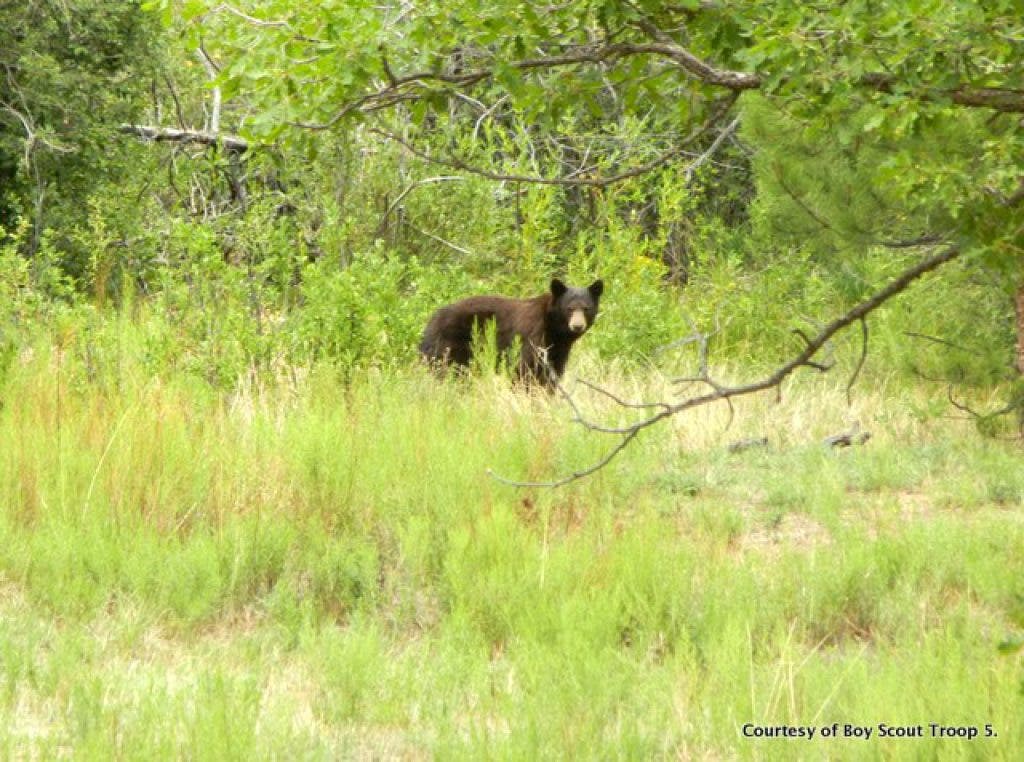
And since they were in the wilderness, they had to expect wildlife. New Jersey has bears. Philmont has more bears and also 'mini-bears' — or particularly pernicious chipmunks. While the crew only saw the big bears four times, the boys needed to put anything that was “smellable” into bear bags.
Bear bags were suspended by ropes between two trees so that the regular and mini-bears couldn't get to into it. “Smellable” includes food and things like deodorant, toothpaste, lighters, pens, bug repellant — even duct tape.
“The boys also had a lot of fun watching the chipmunks run around their feet at each campsite picking up the smallest of food scraps that would drop to the ground.” Durr recalls, “These brave little fellows would climb into the packs searching for the stray candy bars. We had one that actually got into one of the boys packs, chewed a hole into the next day’s lunch meal storage bag and pulled out a bag of peanuts and ran off with it before we could stop it. The back pack was strapped tightly close and the mini bear still managed to get in and away with the nuts.”
But it wasn't all about the hiking.
Along the way, the scouts saw the only know T-Rex foot print ever found, participated in an archeological dig, helped build a new trail at 8,000 ft, learned a bit about life on a working ranch, and performed black powder shooting, rock climbing and repelling. They learned to use a compass and map (there are no trail blazes at Philmont).
At the end of each day, the crew debriefed around the camp fire. At Philmont this is know as thorns, roses and buds. Thorns are the day's disappointments. Blisters and sore muscles are thorns. Roses are the day's joys. Beautiful views and reaching the day's goals are roses. Buds are things anticipated. Real food and hot showers at the end of the trip are buds. These discussions helped foster crew bonding — something needed to help the young troop as the challenges got harder.
And there were challenges.
The crew knew this going in. Brauchli, while recovered, would have a more difficult time keeping the same pace as a crew of teenage boys.
But there is a climbing technique that helped everyone get up the steepest of grades. Called the “caterpillar technique” because it looks like a caterpillar tractor tread from above. The lead hiker starts and goes 10 feet and then steps to the side and stops. The line keeps moving. When the second hiker gets 10 feet past the lead hiker, they too pull off to the side and stop. And so on. This allows everyone to take a collection of short breaks while keeping the line moving up the grade.
The trip left a an indelible mark on everyone. At the last campfire, during the last thorn and roses discussion, the entire crew all said they wanted to do it again.
“I’m especially proud of how the boys all made sure Roger (Brauchli) was part of the crew no matter how long it took us to go up a steep grade or over Baldy Mountain even if it meant we may not of made it to the top of Baldy in time to beat the lightning storms.” said Durr.
But it didn't end there. Durr continues: “A very special moment came on the last day of hiking that really showed me how much the boys respected us as a crew. In the last half mile and with the gateway to base camp in sight, the boys stopped all on their own and asked Roger to lead them into base camp. As they put it, they felt honored to have him as their Scoutmaster, and after being Scoutmaster of Troop 5 for 40 plus years, he deserved to lead them in. Truly this was the most moving moment for all of us.”