Arts & Entertainment
Leonard Lopate Brings WNYC to CHS
Veteran interviewer and host of The Leonard Lopate Show speaks at Columbia High School as part of the Adult School's Redpath Lecture Series
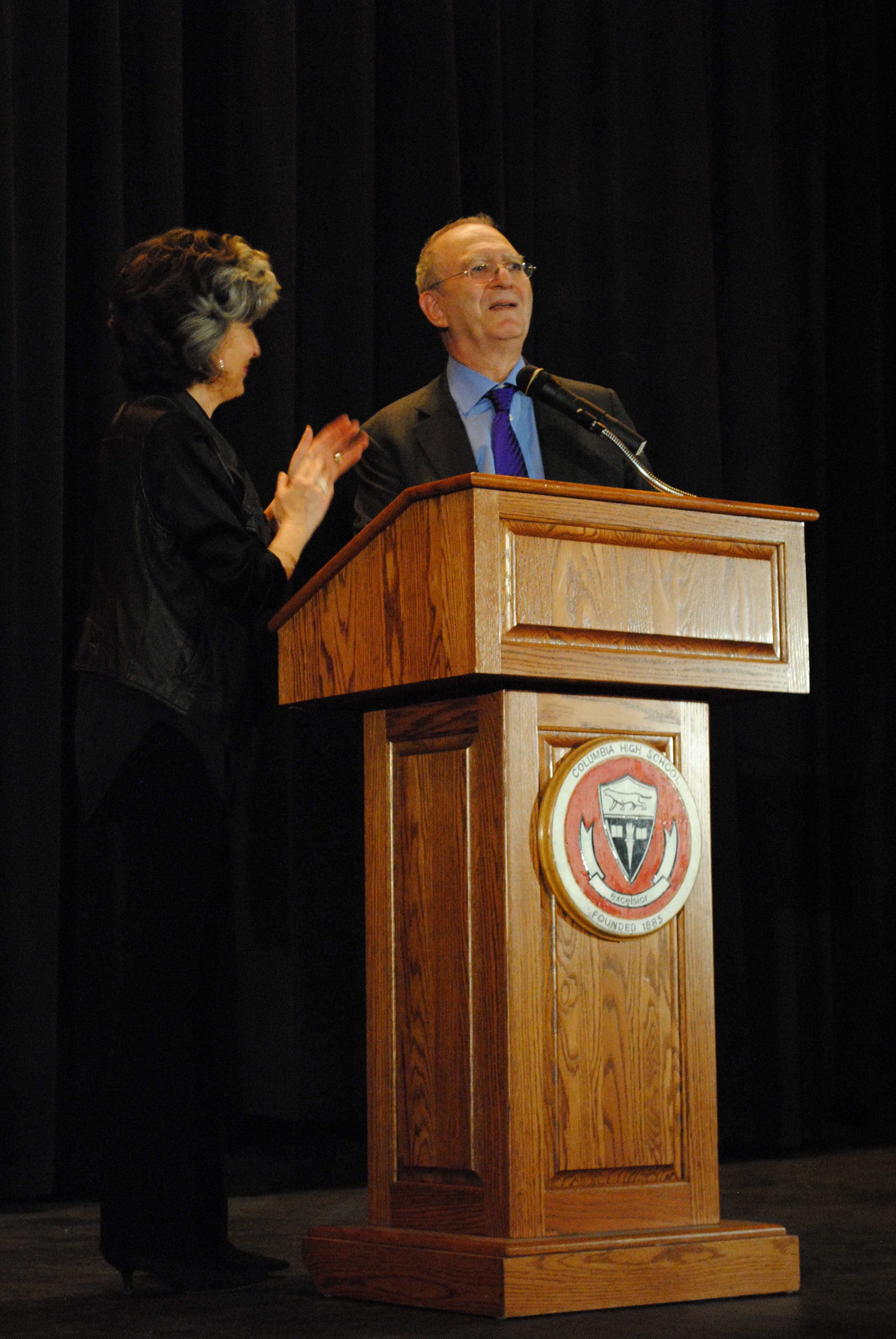


On November 17, a familiar voice filled the auditorium at Columbia High School. The voice belonged to Leonard Lopate, host of WNYC's aptly titled The Leonard Lopate Show, who was returning to the proscenium at CHS to tell his Tales of Public Radio.
Lopate spoke at the school in 1994, according to Sue Marcus, director of the South Orange-Maplewood Adult School. Marcus invited Lopate to speak again as part of the Adult School's Redpath Lecture Series, named for Robert Redpath, a trustee of The Adult School whose widow endowed the school with a fund to bring in speakers in his honor. According to Marcus, Redpath's widow wished to fund lectures that reflected Redpath's interests.
Before the speech, Patch briefly sat down with Lopate to ask about his career, his guests and his visits to the Maplewood/South Orange area. When asked about his '94 visit, he joked, "[That was] a long time ago. I wonder if I'm giving the same speech." Lopate said that he wasn't sure if his stories have changed so much over the years, more than they've "been enriched."
Find out what's happening in South Orangefor free with the latest updates from Patch.
"I'm in an odd situation where I do the same thing every day and yet it's always very different … so even if I have the same guest on again, that experience is going to be very different than it was the last time." Like snowflakes, no two of Lopate's shows, or lectures, are quite the same.
Earlier in the day on his show, Lopate interviewed Dick Cavett about his career in broadcasting. Lopate told Patch that Dick Cavett and his show were "a force for good, because in commercial television, he was bringing people like Eudora Welty… and Christopher Isherwood, and people who just were not regulars on even the Carson show." Though Lopate said Carson was a brilliant interviewer, Lopate's voice filled with elation and admiration when he spoke of the guest variety on Cavett's show, comparing it to the selection on The Ed Sullivan Show, complete with an imitation of Old Stoneface himself.
Find out what's happening in South Orangefor free with the latest updates from Patch.
It was evident from the conversation that Cavett's show had a great impact on Lopate. Speaking of that wide range of guests, Lopate said, "That doesn't happen anymore … it happens on shows like mine, because I think that a public radio audience wants to know about a full range of things rather than the same thing that's being discussed ad infinitum on most talk-shows."
Indeed they do, but the medley of segments that Lopate and his staff provide to our ears is not only to please us. He picks nearly all of his guests, with his producer booking only about 20%. Lopate chooses whom he would like to have a conversation with, and listeners respond to that.
Lopate himself admits that having such an array of guests goes against everything modern broadcasters are supposed to do. He says that he receives a great deal of e-mail from people suggesting topics of the day. It's a revolving door of the same five topics, according to Lopate—whatever is hot in the news at that moment. "How many times can you hear the same thing again and again?"
"Our feeling is, we're just going to do whatever we think is good and interesting, and assume that people trust us … some people will love it and some people won't."
Lopate says that in the old days of public radio, the type of programs on one station switched constantly—from talk, to jazz, to gospel. "All of the research suggests that you should not do that," Lopate said. Rules go out the window at The Leonard Lopate Show, as he and his staff put on the talk-radio edition of The Ed Sullivan Show—or as Lopate said, "It's like doing a radio version of The New Yorker."
When asked if he has ever had the desire to sit down to dinner with a guest, Lopate said that it has been known to happen, and he has made friends in former guests. More commonly, however, a guest will come on his show and project a "false intimacy."
"They come on the show and talk to me as though we've been buds all our lives. They call me Lenny. Now, my family doesn't call me Lenny…"
Lopate is a big fan of North Jersey audiences. "I've been here and I've been to some other places in this part of New Jersey, and been really complimented by the kind of response that I've gotten."
According to Lopate, New Jersey is the second largest supporter of WNYC after Manhattan, coming in before any of the other boroughs. "But," he continued, "this is the same state that elected Chris Christie, so I don't get it."
During his lecture, Lopate spoke of his journey to the "variety show" he currently hosts. He said he did not start out for a career in radio, and was just "having fun" when he hosted a radio show on WBAI from midnight to 5 a.m., which he titled 'Round Midnight, since he was never really sure what time he would actually go on. He then transitioned to WNYC, hosting a mid-day show with veteran radio personality Pegeen Fitzgerald.
Lopate spoke about his commitment to pursue guests he was interested in, and said that "it was a struggle in the beginning." After he "lucked out" and got Russian poet Yevgeny Yevtushenko to come on the show, he had earned the right to say "well, Yevtushenko was just on the show" when trying to persuade new guests to come on.
Since then, his list has grown exponentially. This was evidenced when Lopate took out a stack of paper with all of his previous guests listed on them. He told the audience that he used to feel bad about not being able to get a certain person to come on his show, but realized that he had nothing to feel bad about, with all the names on his guest list.
Lopate said that, at the start of his career, no one in charge was paying much attention to his show, since all of his bosses were preoccupied with trying to become TV moguls. This made it easier to transition the show into "a reflection of the things I was interested in," said Lopate, "and then later when they realized what kind of a monster it was and they wanted to change it, it was too late."
After Lopate finished speaking,this member of the audience felt she knew "Lenny." Moments and conversations came alive as he shared anecdotes and inserted tidbits of history.
One thing was obvious after a day filled with interviews and dialogue: Leonard Lopate likes to talk–but we knew that.

![2,325 Students Earn Diplomas From Seton Hall University [WATCH]](https://patch.com/img/cdn20/users/22844250/20260519/032716/styles/patch_image/public/55278277363-6da6b3e950-o___19152531198.jpg)