Schools
Your School District by the Numbers
In preparation for the upcoming 2011-2012 budget process, the South Orange-Maplewood School District dissects the baseline data

A storm is a'coming. And it's the 2011-2012 school district budget process. School district administrators and board members alike have been talking ominously for months about the perfect storm of rising costs and sinking revenues, plus a lack of substantial aid from the state that will lead to yet another challenging budget cycle.
Board of Education members—particularly those on the finance committee—have promised a number of cost-benefit analyses for the December meeting so that the Board can start discussing prioritization of programs, projects and materials.
Board of Education President Mark Gleason expressed concern last night that those analyses were not yet available, but finance committee chair Andrea Wren-Hardin assured him "we fully expect to have those analyses prior to the December board meeting so they can be vetted."
Find out what's happening in South Orangefor free with the latest updates from Patch.
Signaling one topic that may be up for discussion in the budget talks, Beth Daugherty asked Wren-Hardin if the curriculum committee was creating analyses about the cost effectiveness of using online learning opportunities.
The draft budget is scheduled to be delivered by the administration at the Board of Education meeting January 19. Budget approval should happen around mid-March with the Board of School Estimate approving the tax levy by late March.
Find out what's happening in South Orangefor free with the latest updates from Patch.
Meanwhile, retiring district business administrator Karla Milanette said that the budget process was "well underway. We had meetings even in summer." Milanette said the first part of the budget process was to establish the baseline data. She then provided the Board of Education with a comprehensive picture of the district at this place and time. Here are the highlights:
Enrollment
District enrollments, as reported to the state Dept. of Education as of October 15, are relatively flat and indicate that the district has returned to a relatively stable period, said Milanette. She noted that enrollment in the elementary schools went up 4%, was virtually flat in middle school (plus .7%) and went down in the high school by 3%. Special education enrollment showed a major drop (22%) mostly due to the fact that the special education preschool program was severely cut this year.
Overall, enrollment went up .7% from 2009 to 2010 (6,414 to 6,459). This is much less than the 4% overal jump of 6,188 to 6,414 from 2008 to 2009.
Later, Assistant Business Administrator Cheryl Schneider elaborated on the enrollment data, and noted that the demographer's projections for 2010-2011 were very accurate. Schneider said that, after this year, elementary enrollment is projected to start slowly decreasing but that the population bubble would hit the middle schools by 2013-2014.
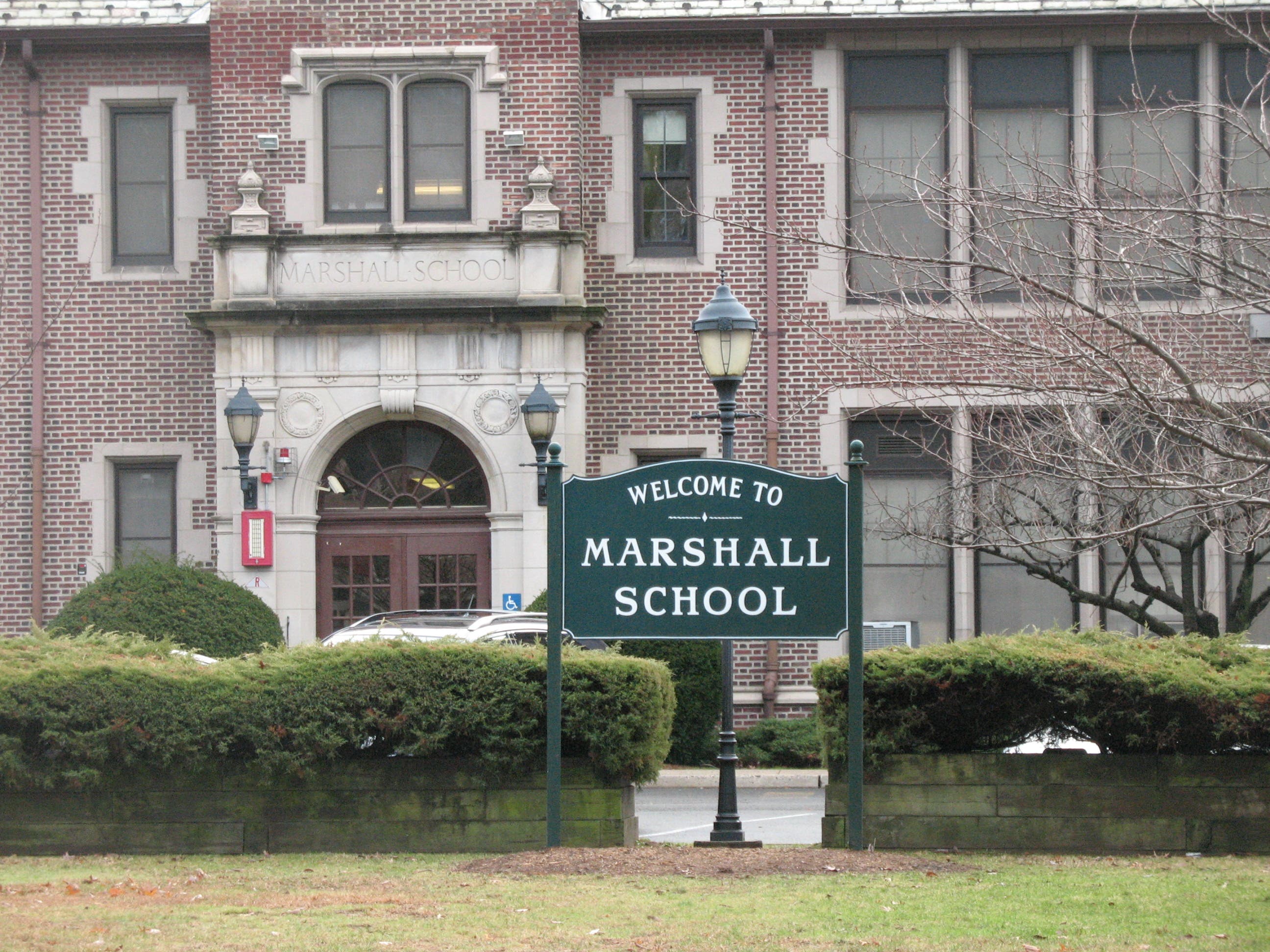
Schneider noted that space was tight in all the elementary schools. She said that Jefferson was the one school that had two available classrooms but that Marshall was seeing full capacity.
"Marshall is the only school where numbers were higher than expected and an extra class was needed." Schneider said that it has not been originally anticipated that all of the districts inclusion kindergarten students would be in the Marshall building.
Schneider also said the redistricting had been successful in getting all the elementary schools enrollment numbers down under 600.
While Schneider said the elementary schools are coping with the bubble, she and Superintendent Brian Osborne said that they were "closely watching" the bubble as it approached the middle schools. "I'm talking with the middle school principals," she said. Added Osborne, "The next projections we will really put through the paces."
Although the demographer was now using the 2010 numbers to work up projections for 2011-2012, Osborne said that the bubble was attributable to a increase in live births from 2002-2oo4. He said that a sharp increase in enrollment was not anticipated.
Low-income students
Milanette reported that the number of students qualifying for free or reduced-price lunches had decreased slightly from 2009 to 2010 from 1223 to 1200. The number of low-income students is used to determine qualification for federal Title I funding and the requirement to provide a breakfast program. The number still represents about 19% of overall enrollment.
Transported students
The district is transporting 1,981 student each day. Of the students transported, 963 are regular students being transported to district schools (530 of those are courtesy busing for Marshall-Jefferson school pairing, Seth Boyden Demonstration School and hazardous walking routes). An additional 734 students are transported to non-public schools (or paid aid in lieu of transportation), and 284 special needs students are transported to in-district and out-of-district schools.
Salaries and benefits
The district employs 747.89 full-time equivalent staff members, including 689.89 teachers who are members of the South Orange and Maplewood Education Association (SOMEA), 33 members of the Administrators, Supervisors and Coordinators Association (ASCA) and 25 central office staff. These number are down from 845.89 full-time equivalent staff members in 2009-10. A major cut was the instructional aides whose numbers shrank from 85 to 2 with the outsourcing of the 76 paraprofessional aides and cuts to ESL, 504 and regular education aides.
Negotiations are underway with both ASCA and SOMEA, both of which are working without contracts. The total benefit package for all groups (including group insurance, social security, unemployment compensation, workmen's compensation, health benefits, tuition reimbursement and retiree unused sick-day reimbursement) is approximately 26% of salaries.
School facilities
The NJ Department of Education requires that districts budget a minimum of 0.2% of buildings' replacement value annually for routine maintenance. For the past few years, the school district has allocated a minimum budget of 1% of building value due to the age and condition of the buildings. The anticipated annual maintenance allocation for 2011-2012 per a worksheet dated 11/15/2010 is $6,456,902.
General fund, surplus and reserves
The net unreserved general fund balance was $284,974 in June 2009, the last date for which audited numbers are available. Milanette noted that this is equal to .3% of 2008-09 expenditrues and is below board policy, but she explained that the amount dropped below policy due to the NJDOE requirement that amounts in excess of 2% be reserved as surplus. That surplus then must be appropriated to the current budget year revenues. An amount of $3,065,389 was legally reserved and appropriated toward the 2010-11 revenues. Milanette said that the general reserve amount now is less than 2% because the NJDOE includes the final state aid payment in the calculation of surplus even though receipt was deferred until after June 30. The report will be updated to reflect the general fund balance at the end of 2009-10 when the audit is completed.
Long story short, however, the school district will have less reserve funds for this year's budget as it was to its budget at that time.
Get more local news delivered straight to your inbox. Sign up for free Patch newsletters and alerts.