Business & Tech
ZBA Hearing on Convenience Store Carried to April 4
Residents were frustrated that they did not have the opportunity to comment on the proposal to allow a 7-Eleven at the current service station location at Parker and Valley; Board officials assured them that all will be heard before a decision is made.

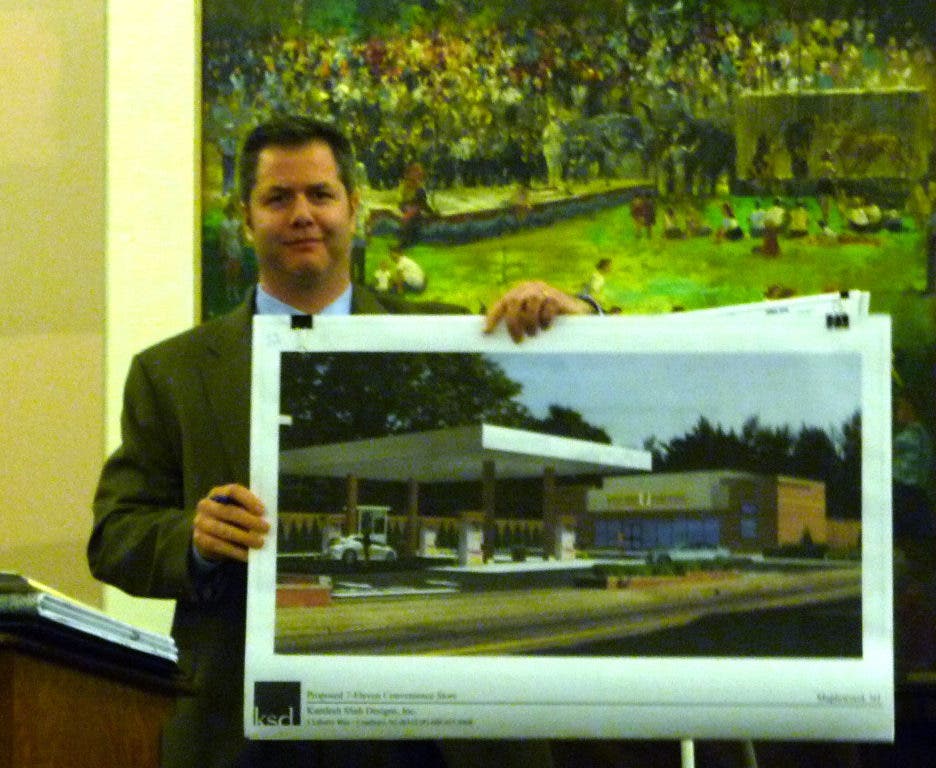
The Maplewood Zoning Board of Adjustment hearing on granting variances for a 7-Eleven convenience store at the site of a service station at Valley Street and Parker Avenue will continue on April 4.
The ZBA made no decision on whether or not to grant the variances at its March 7 meeting. Residents who came in hopes of commenting on the project were frustrated — and disrupted the meeting on two occasions.
However, Board member Robert Marchman assured all community members that they would be heard before any decision on whether or not to allow a second use at the gas station site was made.
Find out what's happening in South Orangefor free with the latest updates from Patch.
At the beginning of the meeting Board Chair Larry Seltzer noted that no decision would be made at the meeting since the Board wanted to see specific responses to its queries from the applicant's traffic consultant. The Board asked that the expert have that response ready for testimony at the April 4 meeting.
Seltzer also told members of the public present that public commentary would not be heard until all expert testimony on the application had been heard. Members of the public would, however, have the opportunity to question experts specifically on their testimony.
Find out what's happening in South Orangefor free with the latest updates from Patch.
John A. Palus of Dynamic Engineering and certified planner Elizabeth C. McKenzie, AICP, PP, testified on behalf of the applicant Ali Enterprise, LLC. Ali Enterprises is seeking to add a use at the southeast corner of Valley Street and Parker Avenue across the street from Columbia High School.
Palus explained how the site plan had been adjusted in response to comments and suggestions made by the South Orange-Maplewood School District at a Jan. 19 meeting between district representatives and Ali Enterprise representatives.
Palus noted that a sidewalk was being added at the east side of the property at grade in order to ensure safer passage to the convenience store for high school students who might otherwise walk through the service station. (Later Palus said that the sidewalk could and would be raised, in response to comments.)
In addition, cameras will be added in the front and back. Palus said that the applicant was willing to hardwire the cameras to the police station. Only motion lights would be placed in the back of the property and they could be adjusted so as not to react to animal activity — such as invading raccoons. A chain link fence would be added in back to ensure there was no loitering behind the building, no loitering signs would be posted, a guard would be hired to patrol from 11 a.m. to 2 p.m. on school days to ensure the students used the sidewalk and did not loiter
Finally, Palus assured the board that decibel levels would be keps low, the canopy columns would be faced in brick, signage would be minimized, and additional trash cans were being added to the site plan.
McKenzie gave her justifications for the granting of the variances. She noted that Maplewood code requires a 10,000 sf lot for service stations and a 5,000 sf lot for convenience stores. At 18,000 sf, McKenzie said that the current location would be more than adequate for both uses if it were subdivided.
(Later Board engineer Robert Bratt questioned if McKenzie or any consultant for the applicant had actually plotted both uses on subdivided lots to see if they met standards for setbacks, egress, etc. McKenzie said they had not.)
McKenzie noted that the service station is the conditional use for the site (the lot is actually one foot too shallow to meet the town's 100-foot depth standard for service stations). She said that both service stations and convenience stores are allowed by the current NB — or neighborhood business — zoning for the lot.
McKenzie said that a variance must be granted if the applicant can show no substantial impairment to the public good.
She also argued that "there are some benefits to combining the uses." She said that gas stations and convenience stores were now common pairings — that people who wanted to get milk while buying gas would only need to make one trip instead of two, decreasing traffic. McKenzie also said that it was nice for residents to have a 24-hour use — a place to get coffee on your way home from a late night meeting for instance. However, the applicant later offered to close the store from midnight to 6 a.m. to conform with town service station hours of operation requirements.
McKenzie also noted that many courts had "come down hard" against proximity requirements — those that do not allow certain uses within so many feet of schools, residences and churches. She said it is because such requirements can vary so much from municipality to municipality. She also said that many regulations had come into play since proximity requirements first came into use in the 1940s; those regulations basically negated the need for proximity restrictions, said McKenzie.
ZBA Counsel Michael Edelsen expressed concerns that the applicant's consultants had not sufficiently considered pedestrian traffic from Columbia High School across the street. He felt there was "potential for conflict with vehicles and pedestrians."
In response, the attorney for the applicant, Louis Ragu, elicited some grumbling from the audience when he said he didn't see the difference between an office building and a high school. "You're not giving high school students credit that they can cross a street."
Later, the owner of Maplewood Pizzeria took issue with that remark, saying that jaywalking was a chronic issue with the students and that he called the police "every day" to deal with loitering and boisterous behavior from some students. The business owner also said he and his staff had placed a trash can at the Shell Station currently operated by Ali Enterprise and that they cleaned it — and its flower plantings — of litter regularly.
Residents led by John Davenport had also hired a traffic consultant at a cost of $3,000 to analyze pedestrian and vehicular traffic at the intersection. Ragu asked that the residents' consultant work with the applicant's traffic consultant in preparation for the April 4 hearing. McKenzie had noted that she did not visit the location during school hours and that she was not a traffic engineer or expert.
Seltzer reminded members of the public early in the meeting that the ZBA does not make public policy, but makes its decisions "based on what the law mandates and allows."
It was a difficult piece of information for some to digest in light of the emotions elicited by the proposed variance.
Get more local news delivered straight to your inbox. Sign up for free Patch newsletters and alerts.