Politics & Government
Freeholder Candidates Spar in Debate
Everything from Open Space Taxes to transparency in county government had the candidates differing in opinion.


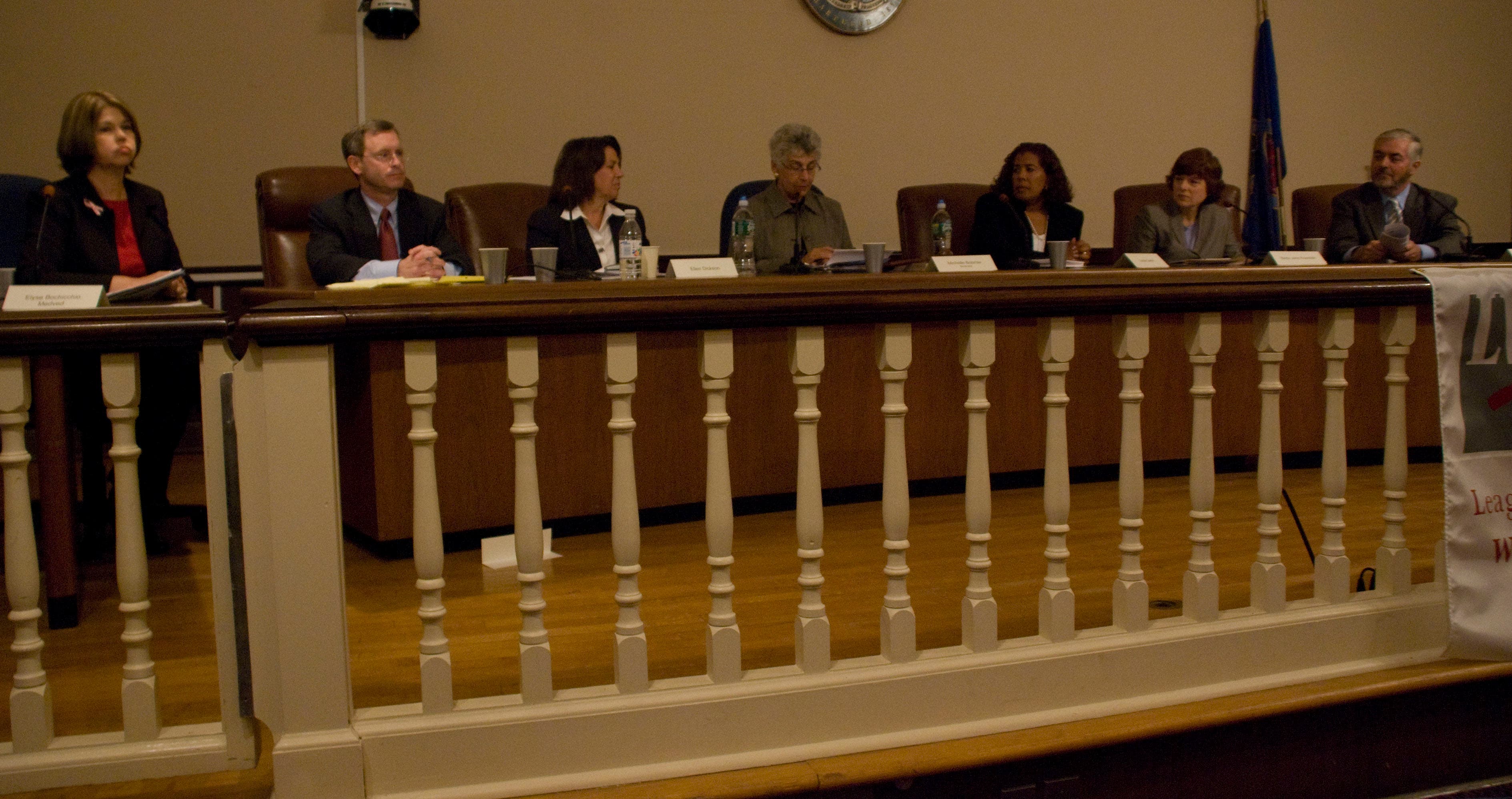

The candidates for Union County Freeholder answered three rounds of questions at Tuesday night's debate at the Cranford Municipal Building.
Six candidates are seeking three open seats on the Board of Chosen Freeholders: Democrat Linda Carter, Republican Ellen Dickson, Republican Brian Flanagan, Democratic incumbent Bette Jane Kowalski, Republican Elyse Bochicchio Medved and Democratic incumbent and Freeholder Chairman Daniel Sullivan.
The candidates answered questions posed by reporters from four county publications: The Cranford Chronicle, The Scotch Plains Times/Westfield Leader, The Alternative Press and the Westfield Patch. Each candidate was allowed a two-minute opening statement at the start of the night. Their answers for the question-and-answer session that followed were limited to one minute. The night concluded with a two-minute summation from each candidate.
Find out what's happening in Summitfor free with the latest updates from Patch.
Opening Statements
Proceeding by party and in alphabetical order, Ellen Dickson (R) was the first speaker of the freeholder debate. Citing her experience as Council President in Summit last year, she said, "I am very, very aware of the painful process of trying to put budgets together." She said she would seek to lower taxes, and referred to a poll that found that "54 percent of our residents feel they have lost ground financially" and "10 percent of our seniors are missing payments on their credit cards."
Find out what's happening in Summitfor free with the latest updates from Patch.
Brian Flanagan (R), who said he has been a county resident since 1995, argued he would bring fresh ideas to the board. "Unchecked, the entrenched freeholders increased their spending and our debts while cities and towns struggle to keep teachers, police, firefighters," he said. "This must end. We must lighten the load." He cited his experience on the Planning Board and Wireless Communications Committee in New Providence.
Elyse Bochicchio Medved (R), a former councilwoman in Rahway, reinforced Flanagan's argument. "The exclusively Democratic board are increasing spending of the people's money and are increasingly out of touch," she said. "In 2010, this has gone even further." She emphasized her willingness to meet with residents face-to-face.
Linda Carter (D), a Plainfield councilwoman, was the first Democrat to speak. She said she supports "the county's stimulus program, which is educating the unemployed," and the county's $276 million tax-relief plan. "I understand tough budgeting and progressive movements," she said.
Bette Jane Kowalski (D, incumbent) emphasized her support for Runnell's Specialized Hospital and the overhaul of the Union County Vocational Technical Schools. "Today's challenge in governing is not to lose sight of what's most important," she said, "helping those who need it most."
Daniel Sullivan (D, incumbent) was the last to speak. "Our priority is to find ways to save tax dollars without dire cuts," he said. "The Democratic team on Column A has a plan with the right priorities to help people in these toughest of times." He pointed to the tax-relief plan, which he said will be implemented in January, and the Vo-Tech renovation.
Question One: Budget Cuts
Westfield Patch editor John Celock asked the first question of the night: What areas of the Union County budget would you cut, if elected?
Carter (D) answered first. She declined to state which specific areas of the county budget she would seek to cut, but said, "We need to look at every line item. We need to make sure the services that we are offering are the services that are needed for the county, are the services that are needed for the municipalities." She emphasized increasing the number of shared services to help save municipalities money.
Dickson (R) spoke next. She said she would seek to "prioritize essential services," and would cut MusicFest.
"That is not the job of the government," she said of the annual live music festival. She added that she would also "look hard at golf operations. We do not need to build a $10 million clubhouse in this county."
Dickson acknowledged that the state-mandated, 2 percent property tax cap will be "exceedingly difficult for the county to adhere to this year." She called for "budget hearings" to start "right now."
Kowalski (D) rebutted Dickson's prediction regarding the property tax cap. "The county is already within the cap for the state this year," Kowalski said. "There are a number of things that are exempt from the cap. We are following state guidelines."
She pointed to the cost-savings measures that the county has already implemented, including a wage freeze for county employees, but did not state where she would make further cuts. "We're going to keep looking where we can make significant savings."
Flanagan (R) came out swinging. "First of all, that response that I've heard so far from our opponents is full of platitudes," he said. "They have governed with rising property revenues from 1995 to 2005. Since that time, revenues have started to decline because property values have declined. This board does not know how to govern in declining-revenue world."
He did not, however, specify which areas of the budget he would cut, instead alleging that the budget that the Freeholders had crafted was too "complex" and "convoluted…to deconstruct" in the course of a one-minute response.
Sullivan (D) touted a $276 million tax relief and waste collection plan that the freeholders approved in August. The plan extends a lease agreement with Covanta, which operates the Union County Resource Recovery Plant in Rahway. Under the agreement, Covanta would dispose county waste at a reduced, fixed rate until 2045, and give Union County a 10 percent share of the proceeds generated from the sale of energy created by the incineration of the county's waste..
Sullivan did not propose any cuts, but instead said simply that the freeholders have "looked at our expenses." He attacked Dickson, who has stated she would seek to trim the Union County Police Department. "We're not going to cut public safety like Ms. Dickson would do."
Medved (R), who concluded the first round, criticized the tax relief and waste collection plan. "If Mr. Sullivan wants to hang his…15 years on the $276 million we're going to save – that is spread out over to all the years from now until 2045, it is spread out over each town. It will probably be a miniscule amount per," she said.
With continued technological innovation, waste-disposal rates could drop far below the fixed rate that the county established with Covanta. According to an August report by NJ.com, the website for The Star-Ledger, average waste-disposal rates dropped from $120 per ton in 1995, to $75 per ton in 2008. In 2010, Union County paid $64.44 per ton, and that amount will drop to $61 per ton under the terms established in the extended lease agreement. Nevertheless, she argued that the county could have found a cheaper deal by seeking an agreement with a waste disposal plant in South Jersey, where, she said, disposal rates are lower.
Medved also echoed Dickson's argument regarding a new clubhouse and practice facility at Galloping Hill Golf Course in Kenilworth. "Didn't they know it was tough times when they decided to make Galloping Hill an elite golf course, when they wanted to make an elite dining hall?" Medved said. The renovations started in 2009, and were completed in spring 2010.
Question Two: The Purpose of County Government
Michael Shapiro of The Alternative Press asked, What do you believe should be the purpose of county government?
Medved (R) said, "Maybe this county freeholder board has reached past its scope. We do need the county police, we do need the sheriff's office. But we should look where they overlap with cities."
She added, "I do think it's the role of the county to support the arts, but I don't think it needed to go into the MusicFest business…. I think this board is going into everything it feels like going into, without really learning how to keep [taxes] down."
Sullivan (D) disagreed. "How about providing hundreds of thousands of rides to seniors, making sure they go to doctors offices?" he said. "How about making sure our children are immunized? How about making our sure roads, our bridges are safe? These are just some of the things that the county does." He also pointed to the sheriff's office and the prosecutor's office.
Sullivan then went onto castigate Medved's argument regarding the county's waste-disposal agreement. "It sounds like Ms. Medved is telling us to put our garbage in our cars and drive it down to South Jersey because it's cheaper that way," he said.
Flanagan (R) argued that the county should provide "core governmental functions," such as the county court system, the jails, and the holding of some public lands. "But aside from those core governmental functions, we need to focus on what is essential," he said. "The county is supposed to be a limited form of government. It's not supposed to be all things to all people."
Kowalski (D) highlighted the role of the county police. "When police in any of our municipalities face an emergency, it is the county police who are there to help." She added that she is also seeking to stimulate job growth and economic development.
Dickson (R), however, expressed skepticism regarding the county's ability to reinvigorate the local economy. "In 2006 and 2007, the unemployment rate in Union County was 4 percent. It is 9.6 percent presently," she said.
"All of your social programs and spending – 'going boldly forward' – is not helping our residents," Dickson continued. "Their backs are up against the wall, and the taxes are too high…and it's not helping our unemployment." She also argued that she would seek to "eliminate county police" and "eliminate the DPW."
Carter (D) echoed Kowalski's arguments regarding the county police. "You need county police to come in with their specialized services to help," she said. "Each municipality having a bomb squad, each municipality having a K-9 unit, is probably not the best…for us." She advocated seeking more partnerships and increasing shared services to save the county and municipalities money.
Question Three: Runnells Specialized Hospital
Leslie Murray of the Cranford Chronicle asked, What are the candidates' plans for the future of Runnell's? Should the county continue to operate the hospital, or should privatization be considered?
Kowalski (D) argued that the hospital, which provides care tailored to senior citizens, should remain a part of the county budget. It "is an extremely successful institution," she said.
She acknowledged that "a few years ago, Runnells was not in such good shape financially." But she asserted that "this Democratic team, we have made sure Runnells is self-sustaining economically and is moving very solidly in the future."
Flanagan (R) departed slightly from his running mates with regard to Runnells. "I do think that Runnells Hospital…could be considered a core component of our county," he argued. "But that being said, I have not seen any information that our board has been working assiduously to keep down" the hospital's costs.
Carter (D) pointed out that "Runnell's is a self-sustaining hospital." A Councilwoman in Plainfield, she added, "Being in a town recently where a major hospital has closed, I understand the devastation of what it means not to have a facility close by and what it will do to those around you."
Dickson (R) countered that "everything's on the table to reduce taxes." The hospital, she argued, "maybe isn't operating in the most efficient way." For example, although only Union County residents pay for the hospital, non-residents may use it as well.
Nevertheless, she concluded that while "I do not support selling the hospital, I think it needs to be examined."
Sullivan (D) accused Dickson of "double talk." He said that when he became a freeholder in 1995 during a Republican administration, "Runnells was running a deficit of $12 to 15 million per year."
He followed with another jab at the Republicans. "Don't be misled by what you're hearing here tonight. When you hear, 'We're going to examine this, we're going to look at it,' they have a plan to get rid of it. We've lost Muhlenberg Hospital, we've lost Union Hospital, where are our seniors going to go?"
Medved (R) called Sullivan's comments "an even new low in the smear campaign." She asserted that she and her running mates did not have plans to sell the facility, but instead simply intend to consider its finances in the context of the overall county budget.
Question Four: Solar Panels
Walter Peyton, of the Scotch Plains Times/Westfield Leader asked, Is this a program for the towns? Why should the towns not simply pursue solar with towns and other towns?
Dickson (R) called the solar panel project "a ridiculous way to spend $45 million." She said it remained unclear which governmental entity would be responsible for maintaining the panels, cleaning them and fixing them. She added she was not convinced that it would save the county money.
Carter (D) argued in favor of the plan, which she said was offered as a choice – not a mandate – to local towns. "This is a plan that went to municipalities…and they voted on it accordingly," she said.
Flanagan (R) asserted, "It turns out that these panels (a) are not as sustainable as people think they are; (b) most of them right now are old technology, they are actually behind the curve in technology." He also argued that the county gave "a blank check" to the solar panel developers.
He added that the "free and vigorous" debate regarding the solar panels was "precisely the kind of exchange that we don't typically see at the Board of Chosen Freeholders."
Kowalski (D) said, "This plan for solar panels is going to be saving all the municipalities who participate in it. That's why they're signing on. It has been very carefully reviewed by the financial people, by the energy experts, by the municipalities. I just find it kind of surprising that anyone would be opposed to solar energy." She argued that "the younger generations" are "going to be the ones that get the benefits of the shared energy costs."
Medved (R) stated, "I would like to find as much as anybody else cleaner energy, cheaper energy, energy that doesn't need incinerators, oil. But I do agree with Mr. Flanagan that these solar panels are not the most cost efficient, that maybe we need to wait until the technology can bring the price down."
Sullivan (D) referred to "a Board of Chosen Freeholders press release," which claimed that solar panels "will save $18 million for taxpayers, 60 percent savings for electricity." That press release, he said, was distributed by the Somerset Board of Chosen Freeholders, an all-Republican board.
"An all-Republican board is providing tremendous savings to their municipalities, tremendous savings to their taxpayers, lowering greenhouse gasses, everything, he said. "We're moving forward with that program."
Question Five: Property Tax Relief
Celock asked the candidates to provide specifics of their property tax relief plans for the coming year.
Sullivan (D) re-emphasized the $276 million tax relief and waste-disposal plan. He estimated that the plan would provide "savings of about $100,000 per municipality." He argued that "it's a plan that can work, it's a plan that will provide immediate tax relief and lower disposal costs for municipalities. I have yet to hear from Republicans how they're gong to do anything like that."
Medved, who criticized the tax relief plan in the first round of the debate, again attacked the proposal. "I really am surprised that [Sullivan] keeps talking about the $276 million," she said. "I didn't suggest that you can take your car to South Jersey. There are places in New Jersey that do $64 a ton now, and are working on even lower prices. His plan doesn't tell you that this whole incinerator project still has at least $175 million in debt. This plan is extending the payments of debt."
Kowalski (D) rebutted Medved's debt allegation. "We are responsibly using the funds that are at hand. The county has among the highest bond ratings among any other body." She also highlighted the county's "training program for green jobs."
Flanagan (R) presented an argument he would return to later in the night: "Ms. Kowalski talks about some very nice things," he said. "The bottom line is we need some adults in the room. People who can say, 'No. It would be nice for you to have that, but you can't.' It's time to say, 'No.'"
Dickson (R) returned to the waste disposal program, which "locks us in," she said. "The technology…could change by 2050." She added that "there's a lot of fat in this budget, and I wouldn't have any problem trying to cut this budget."
Carter argued that the county has a responsibility to help the municipalities that are struggling financially. "We try to develop more of the shared services that work, shared services, over time, that help relieve some of that tax burden," she said. She also reiterated the wage freeze for county employees. Co-opting Flanagan's argument earlier, she concluded, "We're not in a time where we can continue to…say, 'Listen, have whatever you want.'"
Question Six: County Services and Municipal Services
Shapiro asked the candidates whether they would favor the county offering services currently provided by Union County municipalities? If so, which ones?
Flanagan (R) said he would support a reduction in size of the Union County Police Department. "Our municipal police departments are often, if not all the time, the first responders in county parks," he said. "That having been said, the Union County police can serve vital services, for example, with a centralized bomb squad [and] auto theft….Not day-to-day patrol."
Kowalski (D) offered a similar argument. "There are 566 municipalities, and everyone has gotten used to having everything right next to them, and we can't afford that," she said. "It makes sense for the county to work with municipalities on public service, on Haz-Mat and the SWAT and the emergency services."
She discussed Fanwood's decision to shift its dispatching operations to the county. She also highlighted the county's pilot EMS program, which will provide a county ambulance to assist municipalities' rescue squads during the daytime.
Medved (R) poked fun at Kowalski and Flanagan's apparent agreement. "I'm starting to feel like they're starting to listen to us," she said. But then she pressed on the attack. The Democrats, she argued, "were in power for 15 years," if they "were going to work on duplication of services…I feel it would have been done by now."
Carter (D) emphasized the role of shared services, specifically with regard to municipal public works departments. "Public works, they have to get their salt for the winter time," she said. "Why not have shared service with county to reduce the cost of salt that they have to get?"
Dickson (R), however, called attention to the apparent benefits of home rule and local service. "Do you want your county to assume control, or do you want your individual municipalities to retain control?" she asked. "If we have a hazardous tree on a county road, it can take one to two years to get it removed. Our county roads are much dirtier." She concluded by asking "why can't we regionalize with parts of Morris County and parts of Essex County?"
Sullivan (D) immediately responded to Dickson's regionalization comment. "You just heard the first secession-movement shot across the bow," he said. "What we're hearing from our opponents is that the county police is going to be the first to go...the county roads are dirty…. You work together to come up with shared solutions. I don't hear any shared solutions, especially from Ms. Dickson."
Question Seven:
Murray asked, Should Union County should continue to host MusicFest? Why or why not?
Carter (D) expressed support for the annual live music festival. "I've seen 80,000 people in attendance at various functions," she said. She added, however, that "anything that we're doing needs to be looked at…. We need to make sure that we prioirtize all the expenses that we are handling in the county."
Dickson (R) reiterated her earlier pledge to eliminate the festival. "I would absolutely get rid of MusicFest," she said, "unless you could charge for it, break even or get more sponsors…. We need to know what the full cost of that concert is. It looked much more expensive than the numbers I've seen quoted." She also criticized the festival's timing. "It was in September, over the Jewish holidays, over 9/11."
Kowalski (D) offered tempered support for the festival. "In these times, I'm not going to say there's anything in the budget that's above scrutiny," she said. "But, let me remind you, people in Union County are struggling. Most people cannot afford a Broadway ticket for $100 or more. We provide arts programs, and MusicFest was a part of a whole series of arts programs that we have."
Flanagan (R) rebutted Kowalski with an analogy: "Sometimes when you have a lot of children and things are tough, you say, 'We're not going to the movies this week, we're not going to the movies this year, so we can pay our mortgage,'" he said. "Instead of 'cut,' we hear 'provide.' Instead of 'peal back,' we hear 'do more.'" The county needs to cut the festival – and cut spending overall, he argued – to lower taxes and retain residents and businesses.
Sullivan (D) countered that MusicFest and other arts programs improve residents' quality of life. "It would be one dreary place if they took office," he said. "Let's cut the Flicks in the Park, let's cut the weekly concerts, let's cut the arts shows for seniors, let's just cut everything." In an apparent surprise to Sullivan, who had intended his comment as sarcasm, members of the gallery punctuated his statement with applause.
"If you like that," Sullivan said to those who clapped, "you'll like living under Republican leadership, because that's what it will be."
But with regard to MusicFest, he added, "80,000 people can't be wrong."
Medved (R) argued that the county could cut MusicFest, and still retain some of its smaller arts programs. "Nobody cares more about the arts than I do," she said. "The smaller things are done on a lower cost. The MusicFest is a huge – it's a huge PR machine. They never let you forget who brought it to you."
She concluded, "If you want real services, if you want money back in your pocket, you don't want to be led by bread and circuses."
Quesiton Eight: County EMS
Do you support the county's pilot EMS program, which would provide an ambulance to assist volunteer EMS squads from 6 a.m. to 6 p.m., hours when those squads often have difficulty mustering sufficient crews to respond to emergencies.
Medved (R) said she would need "to examine which towns really need the help." She warned against arguments that played on residents' fears: "a heart attack by an elderly person in the middle of the day."
Sullivan (D), however, then presented an argument that evoked groans from members of the gallery: "Ms. Medved, I don't know how you can put a price on human life."
He argued, "The municipalities said they have a critical lack of volunteers in the core hours, from 6 a.m. to 6 p.m. If you're looking for an ambulance, I don't think you care if it says the Township of Cranford or the County of Union." He concluded by adding that the program would come at "no cost to municipalities."
Flanagan (R) pounced on that assertion. "I love no cost," he said. "If it was no cost, I would support it. But everything costs."
He then addressed the other major element of Sullivan's argument. "We're being painted as, 'You want to throw sick people on the street. You want people to die.'" He warned that "this is an attempt to consolidate power at the county level."
Kowalski (D) emphasized that "there is a laack of volunteers in those daytime hours…. This is meant to fill that gap." She noted that the ambulances are being donated by Rahway – "we're not buying new ambulances" – and that the county will "accept what insurance pays, so it's not going to cost the municipalities."
Dickson (R) questioned whether every municipality truly wanted the county EMS service, as the Sullivan and Kowalksi claimed. "I get phone calls and emails from EMS volunteers in Summit who were upset," she said.
She added that the program, which will be comprised of 17 EMTs and other workers, would mean hiring "a cadre of employees." Moreover, she argued, the program would likely be monopolized by one or two towns. "If there's a demonstrated need, in Elizabeth maybe, but I don't think it's needed in Westfield, and I don't think Summit was even consulted," she said.
Carter (D) characterized the county EMS program as a "needed service. When you have an EMS service that goes out, and then has to travel from your location to JFK [Medical Center], and there is not another EMS in the area to respond, you need to be able to go to somewhere else. A lot of the towns, yes, there are some partnerships and agreements. But when you look at it, sometimes, you need a little bit more."
Question 10: County Rule versus Municipal Rule
Celock asked if the candidates favored the elimination of municipal government or the elimination of county government. He cited Maryland and Virginia, which have consolidated local government at the county level, and Massachusetts and Connecticut, which have eliminated county government.
Kowalski (D) responded first. "I wouldn't say that everything should be moved to the county government," she said, "but I do think that the county can provide services more efficiently in many cases than the individual municipalities. Public works and certain medical services and public safety – these are places where it makes sense to regionalize. I don't know if we would want to regionalize schools at some point. But that is working in some other states. I think that's what makes the partnership between the county and the municipalities so well, is because we have a balance."
Flanagan (R) said that geography and population density affect that balance between county and municipal government. "The model where county government is the principle form of government for services tends to be a southern and western model in the United States," he said. "It also may very well work in the southern and western counties of New Jersey because they are fitting with the original concept of county government – less populated places, spread out from each other. We have something more akin to Massachusetts or Connecticut…. I would like to see a complete dissolution of county government, quite frankly" and an "intelligent sharing of services among municipalities."
Carter (D) echoed Kowalski's call for balance. "We on the county level need to do more, and municipalities also need to do more," she said. "We have high density, highly populated areas where there really needs to be a look where, 'Okay, is the municipality doing it well?' If there's something we can offer, we need to do that."
Dickson (R) said she supports a Massachusetts model, whereby "southern counties continue with county government, and northern counties continue" with municipal governments. For Summit, she argued, "it made more sense to share our DPW with Chatham… our fire department with Short Hills."
Sullivan (D) invoked the governor. "Even Gov. Christie realized that counties are in the best position for municipal services," he argued. "He exempted them from the cap if they took over municipal services…. We can't run to Chatham, we can't run to Millburn, we have to resolve our problems here in Union County."
Medved (R) said that county government has "a huge amount of overlap" with the municipalities. She also sought to clarify earlier comments regarding the county police. "We are not taking away county police, just seeing where they are needed," she said.
Question 10: Use of the Open Space Trust Fund
Shapiro asked, Do you believe open space funds are being used wisely? If not, what would you do differently?
Dickson (R) said that the Open Space Trust Fund "is part of my platform." She said she would "suspend it for two years, take a good look at what we've bought – we were only supposed to buy 100 acres, we've bought 300."
Carter (D) said she supports the Open Space Tax. "This was something that was put toward the voters, and they have made their choice," she argued. "If we're not able to preserve the open space that we have, it will be gone. We won't be able to get it back."
Flanagan (R) argued that the Open Space Trust Fund "was supposed to serve a very limited function. It was supposed to serve a very limited percentage that came in. It was also supposed to bond against that revenue. It has done so. The problem is, what happens when the fund runs out – as its set to in 2020 – and that debt is left over?"
Returning to arguments he made earlier, he concluded, "It's nice…but someone's got to pay for it."
Kowalski (D) focused on voters' approval of the fund. "People who are paying for the trust fund…overwhelmingly approved it 10 years ago….. For about 17 cents a day, we have been able to save over 300 acres of green space….programs for children, dozens of playgrounds, historical sites. You can't put a price on what has been done with these dollars."
Medved (R) emphasized that she supported preserving open space – "nobody's going to argue that we want all cement" – but argued that when voters approved the Open Space Trust Fund 10 years ago, the economic climate was much different than it is presently. The freeholders, she argued, "don't want to tell you how much in debt they are…they want to show you a tree and say, 'Isn't this nice?'"
Sullivan (D) criticized the argument that the county was supposed to have limited the open space it bought. "We purchased too much open space? We should have stopped at 100 acres?...When it's gone, it's gone," he said, adding that Union County is the "second smallest county in the State of New Jersey, and the most densely populated.
He specifically pointed to a new county park in Berkeley Heights that opened earlier that day. "If you could have seen the faces of the children and the parents, they saw their tax dollars at work," he said. "They were enormously appreciative."
Question 11: Freight Lines through Union County
Murray asked, There's a contract to reactivate two freight lines that run through eight counties, including Union. What should the county do, moving forward, and was the money that's being sent put to good use, or was it a project that's ill advised?
All six candidates agreed that the project "is dead."
Question 12: Freeholders' Accessibility
Peyton asked, What would you do or have you done to make yourselves more accessible to constituents?
Flanagan (R) emphasized transparency and document disclosure. He argued that the Board of Chosen Freeholders is most accessible when its members recognize that it "is not intended to be a lifetime appointment."
Kowalski (D) argued, "All of us try to be as accessible as possible…. I hope that the residents realize that they don't need to hesitate about contacting us. And it's really quite easy to get to us through the website."
Medved (R) referred to her 2002 campaign for Freeholder. "I said that I would dedicate some time to sending notices to different communities that I would be in the meeting room in your library, your rec. center or your community center, so you can come and see me." Medved said she would continue that, if elected. "Nothing beats meeting people in an unintimidating way," she said.
Carter (D) referred to the Plainfield Council, which, every quarter, holds a meeting in a different ward of the city. She added, "You can come and knock on the door, that's not even an issue or a problem."
Dickson (R) argued that "the freeholdlers could start by making their meetings a little more easily accessible to people who want to speak on resolutions. I heard a recap where they heard 37 resolutions in 7 minutes." She also referred to the Summit Council's practice of holding a meeting every quarter on the Village Green, and said she would be "happy to do a diner tour."
Sullivan (D) pointed to the county's digital initiatives. "We just redesigned the website to make it more user-friendly," he said. "We're now available on Twitter, Facebook…. It's a constant effort to reach out to our citizens, to be able to communicate with them." He also highlighted the county information van, which has made an appearance at virtually every county-organized event since it was purchased.
Get more local news delivered straight to your inbox. Sign up for free Patch newsletters and alerts.