Business & Tech
Market Forces: Race Farms
Each week Patch talks with a vendor at the Summit Farmer's Market to bring you more about the people behind the produce (and those pickles and pies).
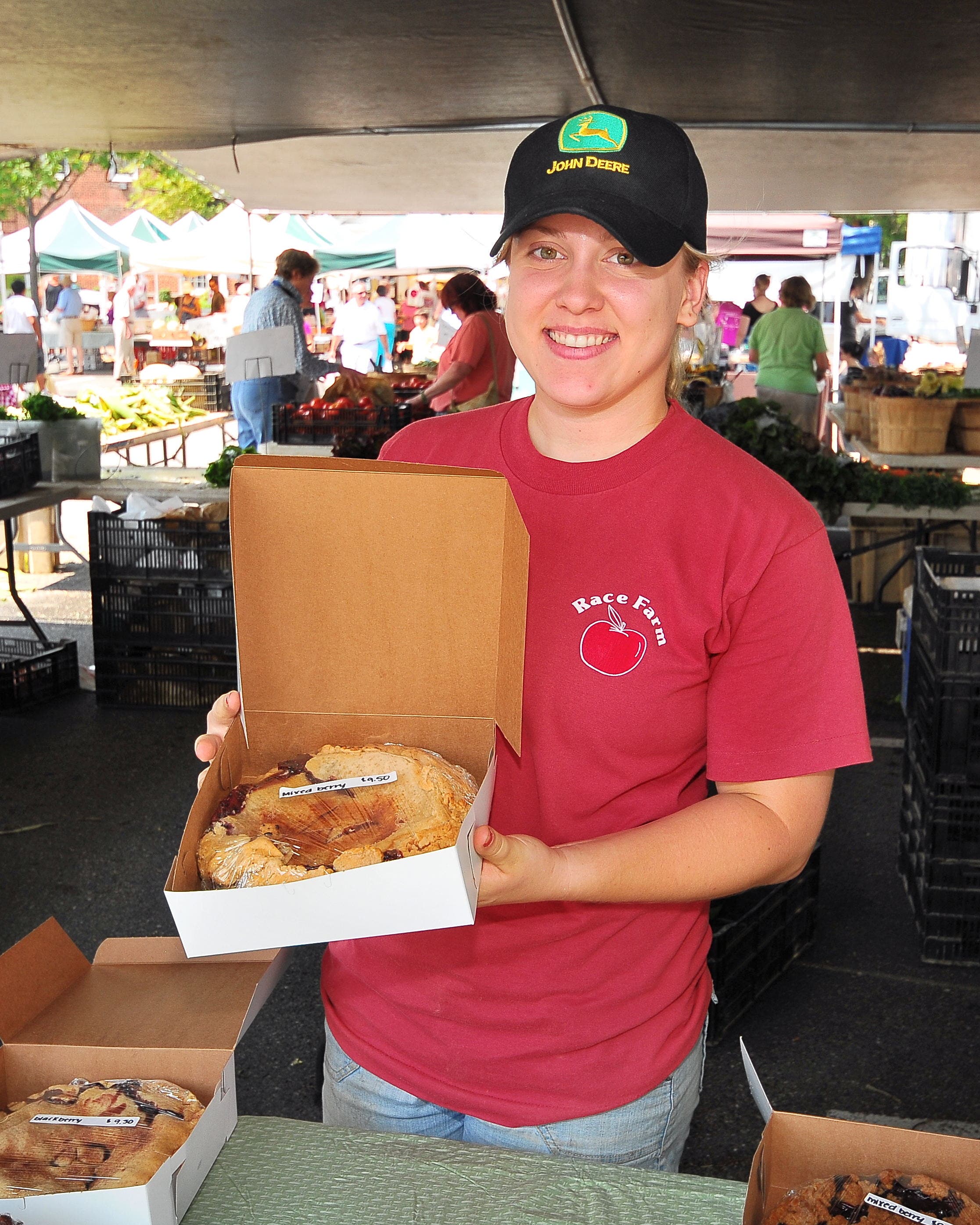
Under a large tent along De Forest Avenue, the spread from Race Farm in Blairstown includes corn, tomatoes and summer squash; pint-size green cardboard boxes filled with fresh strawberries and figs; and donuts and pies from the farm's bakery. Jordan Race, 19, works the cashier counter. She is the fourth generation of her family to work the farm. Patch spoke with her father Doug Race, co-owner of Race Farm, about the family farm and farming in New Jersey.
What’s your farm like?
It’s 70 acres, but we’re farming 120 acres, obviously leasing. We’re a fruit and vegetable farm. We also have greenhouses. We do a lot of perennials, annuals, vegetable plants—we grow our own plants for the field and we also sell them. That’s a little earlier in the year so Summit doesn’t see a lot of it.
Find out what's happening in Summitfor free with the latest updates from Patch.
Just about anything you can grow in New Jersey we do grow it. It starts with strawberries and ends with apples and pumpkins in the fall. We have a local market, and we do a large “pick-your-own” business, mostly in the fall. And we also do the green markets–some in New Jersey and we do one in Union Square in Manhattan.
We are fairly diverse. We don’t grow a lot of any one thing, we grow a little of a whole bunch of things. Everybody thinks that Union Square is a great market, but you can’t go in and sell 10,000 pounds of tomatoes in a day. You can maybe sell 10,000 pounds of a lot of different things. You’re also spreading out your risk. If you have a crop failure in something you have your other crops to compensate.
Find out what's happening in Summitfor free with the latest updates from Patch.
How did you get into farming?
We bought the farm in 1938. My grandfather bought it and started farming around then, and he passed it on to my father, and my father passed it on to me. The lifestyle, either you love it or you don’t. I am one of three. The other two couldn’t get away from it quick enough. I loved it so I stayed on. It’s a great life for a kid to grow up on a farm. And my children—we have four—two loved it; they went to college for business classes but now they are in it for the fourth generation.
Every year there’s always a different challenge. There’s the benefits of being your own boss and making your own hours, but it’s mostly the challenge of trying to better it every year. There’s always new technology; you’re constantly going to seminars and conferences in the winter. You either love it or you hate it, it’s one or the other.
What’s your favorite part of the job?
Honestly probably the Fall really. Because at that point you’ve worked and struggled and worried all year long to try to get everything in, and at that point you literally get to see the fruits of your labor, no pun intended. If you do love the job you take a lot of pride in what you produce. It’s beyond the money, because if you’re in farming just for the money, you’re in the wrong business. And at that point you’re usually worn down and you’re looking forward to the winter and some rest.
Describe a typical day on the farm.
It depends on if you’ve got market or not. Some days we’ll start as early as 3 a.m., 3:30 a.m. if you’re getting ready for market. The New York market we have to start loading about 3, 3:15 a.m.; Summit by 4 a.m. That’s the big thing: to get the truck loaded. Obviously you’ve picked, washed, packed, the day ahead. Then some crops require daily picking. You get your daily stuff out of the way, and then in the afternoon you hopefully have time to get to what you need to take care of, like your weeding. That’s the nice part of the job, that it’s never the same thing every day. It’s impossible to plan a day out and it changes every 15 minutes.
We have our own farm bakery, our own cider mill, there’s just a lot of stuff going on. There are four people in the bakery right now baking. So if somebody calls in sick … We had a special order yesterday—I had to bake a pie. Every day we’re running 10 to 15 employees, part time, between the markets and pick-your-own. In the fall you could be running 20 to 30 employees. Not that we’re a large farm but when you get to the level that we’re at, I probably spend half the day making sure things get done. I’m not picking tomatoes much anymore, I’m on the phone or at my desk or in the tractor.
How has farming changed in the time your family has owned the farm?
Tremendously from when my grandfather did. There’s just unbelievable changes there. My grandfather was all wholesale. My father was wholesale but he saw retail coming, and now we do all retail–we do nothing wholesale. The tailgate markets–farmer’s markets like the one in Summit–are new. Pick-your-own, we’ve been doing it for 30 years, but 40 years ago very few farmers were doing it. But even in the 35 years I’ve been farming… technology is a huge part of it now. A lot more is mechanized, although all of our harvest is still harvested by hand. But just the technology of growing things, the chemicals. The Integrated Pest Management guy (from the Rutgers Cooperative Extension), that’s a huge change, trying to reduce chemicals and grow a little greener.
Basically we’re growing the same stuff, but it’s more diversified. We never grew okra ten years ago, but we grow a lot of specialty stuff because of the tailgate markets. A lot of guys will grow the fingerling potatoes, the purple potatoes. For next year we’re growing blueberries–they’re not a traditional crop for our soil, but you can do it right–so we’re putting a substantial blueberry crop in. Varieties have changed. We do not grow any of the genetically-altered or anything like that; we don’t use any of the hormones. Most (farmers) shy away from it and the consumer stays away from it.
What’s the biggest issue you see facing farmers in New Jersey?
You’ll get five different guys and you’ll get five different answers on that. Wildlife is one issue; it’s always been. The other day I went out to spray for deer. Now you don’t spray for deer as a rule, but I literally went out with a sprayer full of repellent; I had to spray it over pumpkins and squash because they were eating all of it and you’re left with nothing. And when I got there, a bear was running out of the field that was eating the corn, and when I got done spraying for deer there were wild turkeys running out that had just finished eating the corn, too. We’re allowed to shoot them; I don’t care to. I try to put up a safe barrier around the fields. We just swallow the cost of that. You can get thousands of dollars tied up in that, and that’s tough to pass on to the consumer.
The legislative stuff–the Highlands Act, eminent domain occassionally–that kind of stuff is always coming up. There’s a constant bombardment of federal regulations and rules. The amount of paperwork involved in farming is ridiculous. If you’re at the top of the chain you spend a ton of time in the office. Considering it’s usually a small family operation, it does become quite a burden that you’re not out doing what you’re supposed to be doing. You find yourself in front of a computer or pushing a pencil when you’re supposed to be outside.
Do you ever get to sleep in?
Not in spring, summer or fall. Winter, yes. The average farmer’s probably running 70 to 80 hours a week, and that’s seven days a week spring, summer, and fall.