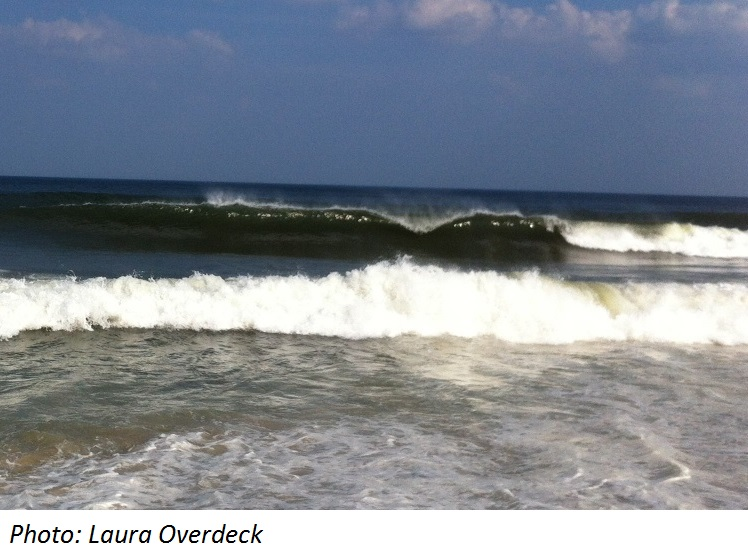
If you've ever been to the ocean and played in the waves, you know how strong they are and how much splash they can make. What makes those waves in the first place? They're caused by wind blowing over large areas of the open ocean, which gives the waves lots of power. As they come to shore, the shallower water slows them down (but their power has to stay the same, so as waves get taller, they slow down by that amount squared: if a wave becomes twice as tall, that means it's now traveling only 1/4 as fast). This is also why waves "break": the bottom of the wave slows down more than the top, so the top ends up falling over the front and the wave gets all white and frothy. By the way, people can also make waves in wave pools by pumping lots of water into the pool at once, kind of like a big toilet (although hopefully cleaner). But there's nothing quite as exciting as the real thing at the beach.
Wee ones: If you're 3 feet tall and a 4-foot wave is coming towards you, who's taller? Will the wave splash over the top of your head?
Find out what's happening in Summitfor free with the latest updates from Patch.
Little kids: If the water is 3 feet deep and the waves are rising 5 feet above the water, how tall are the waves above the ocean floor? Bonus: If you're paddling at 3 miles per hour on a buggy board and a 10-mile-per-hour wave picks you up and you ride it, how much faster are you going now?
Find out what's happening in Summitfor free with the latest updates from Patch.
Big kids: When a wave comes and you jump over it, you'd better keep watching because there's probably another wave coming. If the waves are coming every 10 seconds, how many waves do you jump over in 1 minute? (Reminder: a minute has 60 seconds.) Bonus: If they speed up to once every 4 seconds, now how many waves do you have to jump over every minute?
Answers:
Wee ones: Yes! The wave is taller than you are.
Little kids: 8 feet in total. Bonus: 7 miles per hour faster.
Big kids: 6 waves. Bonus: 15 waves.