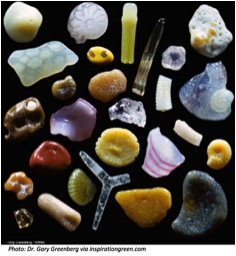
We just can't get enough of this photo. Are you wondering what all those tiny, colorful objects are? Unbelievably, they're grains of sand. The picture is "magnified" - made bigger than real life - by a factor of 250 times, because the photographer took this picture through a microscope. If you take any plain old white sand from the beach or a nearby sandbox and look at it through a strong lens, you'll see the same incredible designs. In fact, even if you study sand just through a magnifying glass, that's enough to show that grains of sand are very different sizes and shapes from each other. You can see that this mixture has everything from tiny sea creatures to the tips of bigger shells (the spirals) to smoothly polished chunks of rock. And with the picture blown up like this, it makes grains of sand a lot easier to count.
Now here's today's math~
Find out what's happening in Summitfor free with the latest updates from Patch.
Wee ones: How many purple stripes can you count on the purple and white stone (near the lower right corner)?
Little kids: If you take a pinch of sand that has 5 seashells and 6 teeny pebbles, how many grains did you pick up? Bonus: How many grains of sand are there in the picture?
Find out what's happening in Summitfor free with the latest updates from Patch.
Big kids: If you find that in a pinch of your backyard sandbox, 1/4 of the grains are seashells, how many should you find in a pinch of 36 grains? Bonus: When you line up grains of sand in a row, you can fit about 500 per inch. If you then magnify the photo 250 times, how wide is each grain in your new photo?
Answers:
Wee ones: 3 stripes.
Little kids: 11 grains. Bonus: 27 grains.
Big kids: 9 teeny seashells. Bonus: Half an inch. If magnified 500 times the grains would each be 1 inch wide, so magnifying 1/2 as much as that will yield 1/2 that width.