Business & Tech
Tomato Trouble at the Summit Market?
Wet weather and a plant disease mean fewer heirlooms at the market this year.
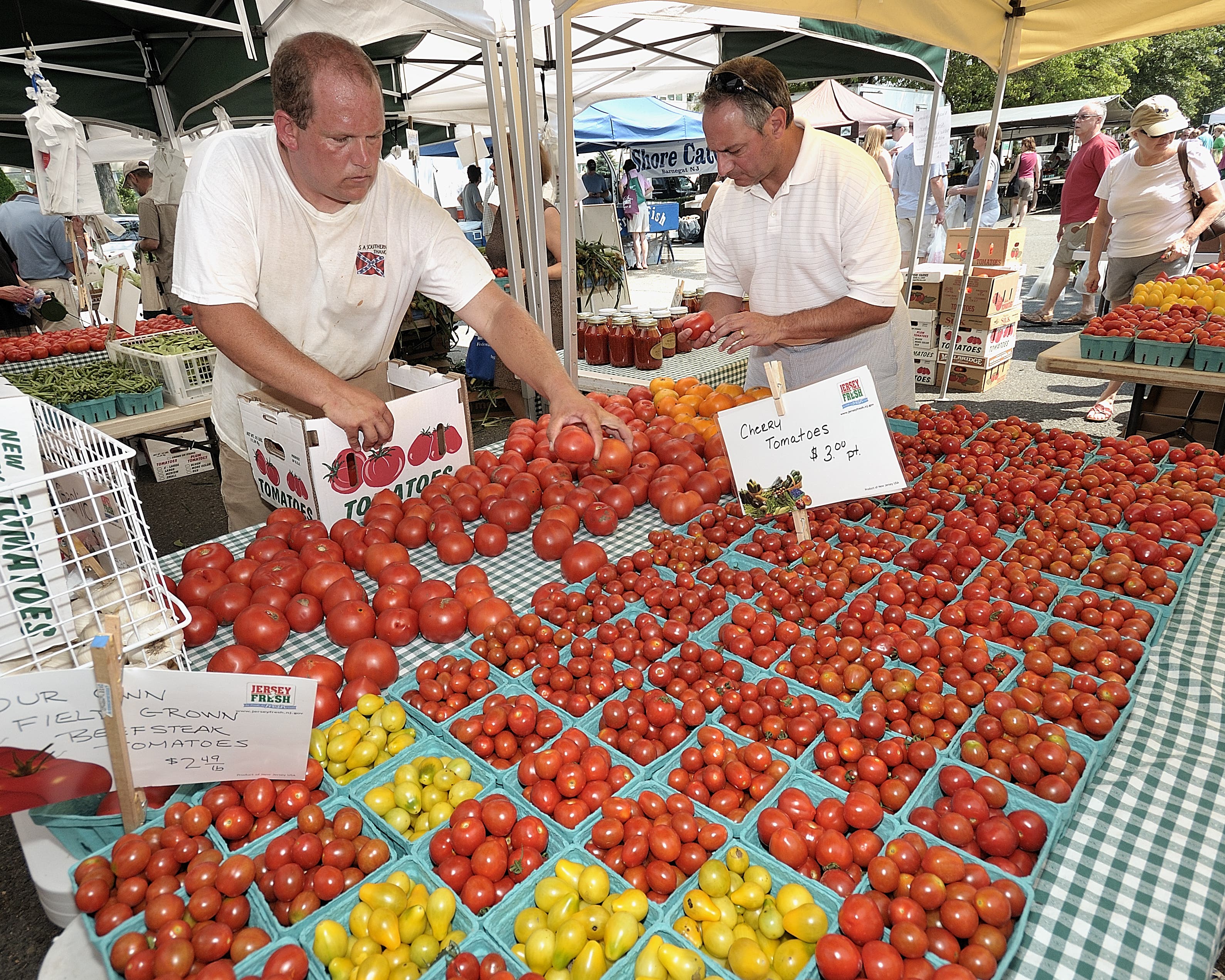


Cherry Grove Organic Farm sold tomatoes at the Summit Farmer’s Market Sunday, but its flat green crates held a humble harvest. A stand whose mid-August bounty typically includes more than 30 varieties of heirlooms offered only smallish round versions of the basic Jersey red, none as big as a tennis ball. At the height of tomato season, a hand-lettered sign above the crates read “Could be the last.”
Three weeks ago, Cherry Grove’s tomato plants were hit with late blight, a crop-destroying fungus that affects tomato and potato plants and is best known for its devastating role in the mid-19th century Irish potato famine. When an employee approached him to report that their tomato plants “were black and smelled funny,” recalled Cherry Grove farmer Matt Conver, “I was at the counter and my hands were shaking, because I knew what it was and I knew what it meant for us.” Ninety percent of the farm’s tomato crop—five thousand plants that would have produced some 40,000 pounds of tomatoes, accounting for the vast majority of the farm’s income—was ruined, Conver said. The tomatoes for sale this week were what could be salvaged.
As Conver and the handful of farmers at the Summit Market can attest, it’s been a tough year for the tomato. The ruby trophy of the Garden State grows best in hot, dry weather but instead got a very cool and rainy June. And late blight, which thrives in such weather, spread its spores up and down the eastern seaboard, killing the crops of some farmers and home gardeners. Depending on which of the five produce stands they buy their tomatoes at, shoppers at the Summit Farmer’s Market have been seeing the impact of these two developments on availability and price, with the two organic producers most affected.
Find out what's happening in Summitfor free with the latest updates from Patch.
Poor tomato weather has made for a later and smaller harvest at North Slope Farm, of Lambertville, NJ, which offered its first tomatoes just two weeks ago, said farmer Michael Rassweiler. The organic farm raised the price of its heirloom tomatoes to $4 a pound, up fifty cents from last year, in part to make up for the low yields of rain-stressed plants, he said.
Prices at Corner-Copia of East Windsor, NJ, fluctuated earlier in the summer due to the weather but have stabilized at $2.49 a pound, said farm manager Lou Mercantini.
Find out what's happening in Summitfor free with the latest updates from Patch.
Doug Race, co-owner of Race Farm in Blairstown, N.J., said that while his price, $2.50 a pound, is the same as last year, his production costs have increased as he has spent more on fungicide spraying in an effort to prevent late blight. Still, despite the season’s wet start, he was optimistic about the remaining harvest.
“We’re picking good right now,” said Race, adding that with “hopefully a very late frost, I think the supply will be fine.”
Race said he has monitored his fields for late blight several times a week with the help of employees of Rutgers Cooperative Extension’s Integrated Pest Management Program, who scout for pests and disease.
Kris Holstrum, a research project coordinator with the program, said of the roughly 40 growers he works with in northern New Jersey—none of them organic producers—half a dozen had late blight on their plants, but for only two was the disease widespread enough to require crop destruction. South Jersey farms were more affected, he said. The blight, which is present in small quantities every year, is believed to have spread rapidly through the sale of infected tomato seedlings from big-box retail stores to home gardeners; from there, the airborne disease has traveled to farms and other home gardens, said Holstrum.
“Most of the commercial growers, we’ve caught it early enough and notified them that the organism is in the region, so they immediately began using fungicides to combat it,” Holstrum said. “As far as the markets go, I can’t imagine that quantity has been limited by the disease as much as it has been by the fact that the weather has been bloody awful.”
Conver, of Cherry Grove, said that many organic growers use an approved copper fungicide to try to prevent late blight, but that he had not done so in part because “it is really expensive and time-consuming,” and because “late blight is such a potent disease,” and “organically there’s not a lot you can do about it.” Throughout the Northeast, other organic farmers have also lost tomato crops to blight.
With his crop being “absolutely disastrous,” Conver said he saw no point in raising his price of $3.25 a pound—or in charging more for other goods—in an attempt to recoup his losses.
“Tomatoes is it for us,” he said. “It’s pretty much a lost year.”
Conver said he got a lot of questions from customers on Sunday wondering about the absence of heirloom tomatoes at his stand, inquiries that soon turned to sympathy.
“I was actually touched by people’s concern about the financial well-being of the farm,” he said. “It was nice to see that people care.”
Conver, who said he has had time “to process” since the initial devastating “kick in the gut” of the blight diagnosis (confirmed by Rutgers Cooperative Extension), said it comes after seven “really good years” of farming, and that occasional crop failure comes with the job.
“We’ve always been frugal about saving our money specifically with this in mind,” he said. “If it’s not this, it could be drought, it could be a hailstorm. You never know what the year is going to bring.”
Next year he expects to feel more wary, and he is looking into crop insurance, but this year’s outcome “is what it is,” he said.
Rassweiler, of North Slope Farm, encouraged Summit consumers to continue to support farmers at the Sunday market, noting that the poor tomato weather was nevertheless good for greens, and that Conver, who worked at North Slope for several years before starting Cherry Grove, has excellent watermelons this year.
“If people want to have food grown in their surrounding region, then where it stands right now is that they really need to shop at farmer’s markets, and it’s a challenge when there’s a major crop failure,” Rassweiler said. “The way that local communities deal with that is the same way that farmers have to… you focus on another crop.”