Health & Fitness
Rare Dugout Canoe Found in Bergen County
Its ancient origins are shrouded in mystery. Was it made by early settlers or Hackensack Indians?

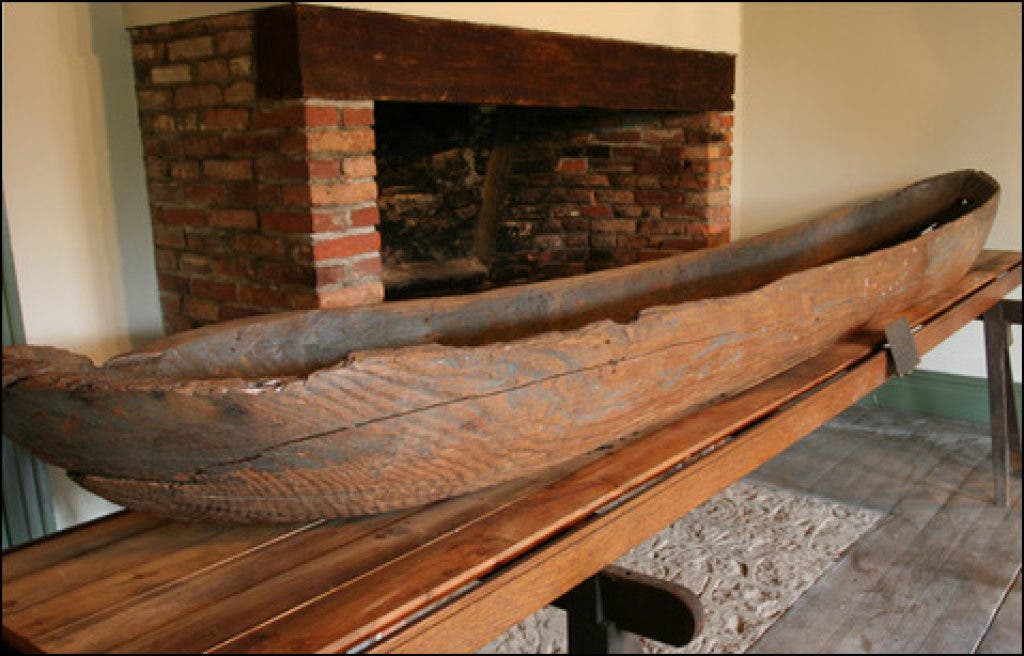


The dugout canoe in the Bergen County Historical Society (BCHS) collection is probably one of the most extraordinary artifacts to ever be found in Bergen County but its ancient origins are shrouded in mystery.
BCHS was only a year old in 1904 when the 15 foot long (!!) white oak canoe was donated for the collections.
I'm amazed how many objects survive from the past, consider the perilous voyage the canoe took. The late Reginald McMahon's research describes its discovery in 1868 during excavation for a cellar where Col. Garret C. Ackerman was constructing a house, now the location of the County Administration Building in Hackensack.
Find out what's happening in Teaneckfor free with the latest updates from Patch.
Col. Ackerman made good use of the hollowed out tree; his workmen nailed it to the side of his barn and used it for a trough for cattle until it was taken down 25 years later in 1893 and donated to BCHS by his grandsons.
BCHS President Frances Westervelt began an effort in 1915 to determine its age by sending a wood sample to the Peabody Museum at Harvard and Director C.C. Willowby responded that the wood fragment "seems to show the marks of steel tools which would place it in the historic period." He concluded that it was "of Indian origin, although perhaps not prehistoric."
Find out what's happening in Teaneckfor free with the latest updates from Patch.
It has not yet been examined with any modern methodology. I reached out to the Smithsonian a few years ago for their advice on determining its age. It was suggested to compare dated tree ring samples with the canoe tree rings. I eventually left off with a NJ college professor of dendrochronology who didn't want to move his delicate equipment to our location and we didn't want to move the canoe.
Curiously, the canoe was reportedly found with not only Indian artifacts but also a Halberd (a combined spear and battle-ax, see photo) which was thought by State Museum curators in 1971 as British influenced and from the 1700s. Halberds were also found at Plymouth and Jamestown, unfortunately the "Hackensack Halberd" didn't make it into our collections, its whereabouts are unknown.
Directly across the river on the east side was the Achter Col settlement, the location is noted by a BCHS Blue Marker:
…Johannes Winckelman built near here a ninety-foot long fur trading post and farmhouse – a building which sheltered both settlers and cattle. During the 1643 Indian war it was protected by five Dutch soldiers but on the night of September 17, 1643, it was attacked and burned to the ground by the Hackensack and Tappan Indians. This section of Bogota was known as “Winkelman” for many years.
Could the canoe have been used during this event or is it from another time period?
As early as 3,000 BCE, Indians were settled along the Hackensack River; the Hackensacks' village stood near Kips Bend in Teaneck, Tantaqua's Plain was further north at New Bridge, River Edge and Tappan Indians lived on the river plains in what is now New Milford. From: 1609: A Country that was Never Lost by Kevin Wright.
We have a fundraising drive to build a Bergen County history museum for the BCHS collections (over 4,000 objects, not including our extensive rare book and document library) -- most of which is in storage -- including the canoe. BCHS owns the land at New Bridge, we just need your help fundraising.
For more information about the canoe, see The Hackensack Indian Dugout Canoe by Reginald McMahon which is available at the Campbell-Christie House gift shop at Historic New Bridge Landing.
Achter Col Colony – BCHS Blue Marker:
http://www.hmdb.org/marker.asp?marker=7128&Result=1
The Blue Marker Program was begun by BCHS President Lewis Owen in 1959. BCHS historic markers are now found throughout the county.
The Bergen County Historical Society, a non-profit, 501(c)(3) volunteer organization, was founded in 1902 to develop public appreciation for Bergen County's remarkable history, especially through the preservation and study of its material culture. We are the only historical association to focus on Bergen County as a whole, from its prehistory to the present day. Our museum collections are presently on display in a limited basis at Historic New Bridge Landing. Public programs include educational events, placement of Blue informative roadside historical markers, museum exhibits, monthly lectures, library collection, website and message board. We are the largest landowner at HNBL. We are not a government agency and have never received regular or significant public funding, we rely on private donations and membership.
www.bergencountyhistory.org