Politics & Government
Protesters Jeer Sweeney At Mayors' Meeting In Toms River
Chants from opponents of a vaccine bill and school funding cuts were heard inside as the NJ Senate president spoke to Ocean County mayors.




TOMS RIVER, NJ — New Jersey Senate President Stephen Sweeney stopped in Toms River on Tuesday morning to deliver a speech to the Ocean County Mayors Association.
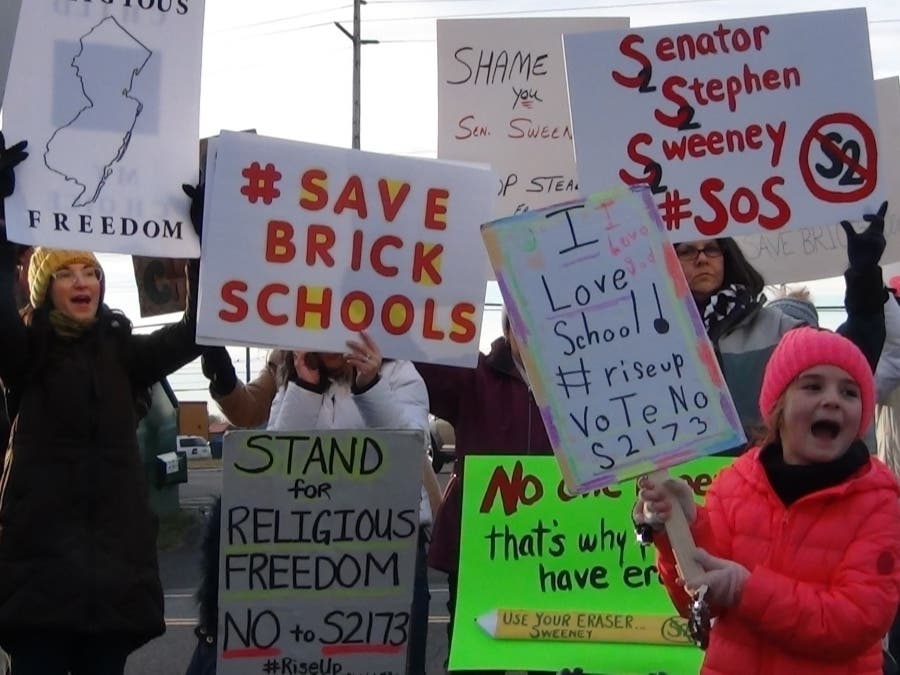
While Sweeney never faced the protesters who awaited him outside The Grove restaurant at the Howard Johnson on Hooper Avenue, they made sure he heard them, chanting so loudly it could be heard inside the meeting.
The group of about 100 people, which gradually grew as parents arrived after getting children off to school, alternated between "Our bodies, our choice, fair funding now," and "Parents Know, Sweeney's gotta go" after they got confirmation from meeting attendees that the New Jersey Senate president was inside the restaurant.
Find out what's happening in Toms Riverfor free with the latest updates from Patch.
Sweeney arrived at the Howard Johnson about 8:45 a.m. and while his staffers walked past the group of protesters who were on the strip of grass between the parking lot and Cedar Grove Road, the senate president was whisked in the back door of the facility.
The back-door manuever only irritated the protesters, some of whom had arrived at 7:30 a.m., sparking them to chant louder.
Find out what's happening in Toms Riverfor free with the latest updates from Patch.
The volume was enough that it forced Sweeney, who was closest to the window, to speak louder, meeting attendees said.
The group was a mix of interests. The initial plan for the protest was circulated by the group New Jersey for Medical Freedom, which is opposed to the vaccinations bill, S2173/A3818, which would remove religious exemptions as a reason to decline vaccines for school-age children. That bill was passed by the state Assembly in December but has stalled in the Senate since because of heated opposition from parents across the state. Sweeney has said the Senate will revisit the bill this month.
Joining that group were parents from Toms River and Brick, where the school districts are faced with significant cuts in their state funding. The cuts, mandated under the Sweeney-pushed legislation known as S2, amended the School Funding Reform Act of 2008 to remove so-called adjustment aid from certain school districts.
Sweeney has contended those districts — more than 100 are affected by S2 cuts — are not taxing their property owners sufficiently to support their school districts. In Brick and Toms River — as well as several others who have joined a lawsuit against the state — officials contend their districts are being punished for being efficient. Both Toms River and Brick spend below the state average per pupil.
The lack of interaction with Sweeney was a frustration to many of the protesters.
Rachel Remelgado, who was among hundreds of Toms River parents and students who rallied in Trenton in December over the funding cuts, said Sweeney's maneuver reminded her of the way state legislators treated the Toms River students who rallied outside their offices.
Instead of coming out and speaking with the students, state legislators and their staffers took photos from their windows of the scene in the courtyard at the December rally.
"And then they dropped their blinds," Remelgado said. "It was a great opportunity to say to the kids, hey, good job getting involved and speaking out, but they missed it."
That's one reason it was important to her to be outside the mayors association meeting on Tuesday.
"In Toms River, we have manners. We greet our visitors," she said.
Kate Moreno of Brick, who has children in Emma Havens Young Elementary and Lake Riviera Middle School, said the realities of what the Brick schools are facing have finally hit home with parents.
Moreno and PTA officers from Lake Riviera, Emma Havens, Veterans Memorial and Osbornville schools said the announcement that Herbertsville School will close finally drove home the seriousness of the cuts facing Brick.
"Twenty-two million (dollars) is a lot of money," another mother said.
There is a bill proposed by the legislators from the 10th District, which covers Brick and Toms River, that would provide relief for those towns and others whose property tax bases were severely impacted by Superstorm Sandy. The bill, S2803 sponsored by Sen. Jim Holzapfel, continues to languish.
In the meantime, Sweeney is trying to push through a bill that would grant districts like Toms River and Brick the ability to raise property tax levies to make up for the cuts. School district officials in Brick and Toms River have repeatedly said that's not a realistic solution.
Brick schools business administrator James Edwards has said the property tax levy would need to rise 19 percent to cover the $22 million in state aid cuts, and wouldn't take into account rising costs of health care, utilities and other costs that typically rise every year in schools. A property tax increase of that size would cripple the town and drive businesses out, Brick Township Mayor John G. Ducey has said.
The assertion that the Toms River and Brick school districts are receiving more than their fair share of funding is based in the formula the state Department of Education uses to calculate each district's "local fair share." Local fair share is the amount the state says each district should should be taxing its property owners.
However, the Department of Education has refused to release the formula it uses to come up with the local fair share, including the wealth multiplier, despite a multitude of Open Public Records Act requests from school districts, the media and residents. Read more: Toms River, Brick Seek 'Secret' Math Equation In School Aid Fight
School business administrator William Doering has said that the funding information it has gotten from the state says Toms River property values have risen 48 percent since 2008 — despite the fact that Toms River lost $2 billion in ratables and still has not recovered $600 million.
Ducey, after the meeting, said Sweeney told the mayors association that even he does not have the formula, that the Department of Education has refused to provide it to him.
Sweeney, however, said his staff had "reconstructed" the formula based on past years' funding and would give that to Ducey.
Sweeney also told the attendees that he is looking to reexamine the funding formula and revise it as needed. No timetable for that possibility has been announced, however.
Though the group opposing the vaccine bill loudly demanded the bill be killed, Sweeney told the mayors' association that he still intends to put the bill up for a vote in the state Senate.
There are two more voting sessions in this legislative session: on Thursday and on Monday. If the bill does not pass the Senate, those seeking to eliminate the religious exemption for vaccines for schoolchildren will have to start from scratch after the new Legislature is sworn in later this month. If the state Senate does approve the bill, it would have to go back to the state Assembly for another vote for procedural reasons. That, however, would appear to be a formality because the Assembly passed the bill 45-25 in December.
Have a news tip? Email karen.wall@patch.com Follow Toms River Patch on Facebook
Get more local news delivered straight to your inbox. Sign up for free Patch newsletters and alerts.