Schools
Toms River Regional Schools Budget 2022-23: What To Know
The Board of Education is set to hold its public hearing on the budget Wednesday evening. Here's a breakdown of what is in it.


TOMS RIVER, NJ — The Toms River Regional Board of Education is set to hold its public hearing on the 2022-23 school budget on Wednesday.
The Toms River Regional Schools administration presented the breakdown at the March 30 Citizens Budget Advisory Meeting annually and it usually is well-attended. This year's edition had just two residents in attendance to ask questions.
One board member was absent as well.
Find out what's happening in Toms Riverfor free with the latest updates from Patch.
The $229.5 million general fund budget — the part that pays for the day-to-day operations of the district — does not include any staff cuts for the 2022-23 school year.
That lack of staff cuts is thanks in part to $6 million the district received in coronavirus pandemic relief funds from the federal government, which are being used to offset special education tuition, allowing the district to protect 90 staff positions, interim Superintendent Stephen Genco said during the March 30 meeting.
Find out what's happening in Toms Riverfor free with the latest updates from Patch.
The budget includes a 1.9 percent increase in the tax levy — 2 percent on the general fund, as required by S2, the law that also is cutting the district's state aid, and 0.1 percent on the debt service.
The district is more than $41.5 million under adequacy according to the state Department of Education, which is why the district must raise the tax levy. Genco said district Business Administrator William Doering said the number is closer to $47 million.
"When you're under adequacy, the state is saying your taxpayers aren't paying their fair share so you need to raise it the highest," Genco said.
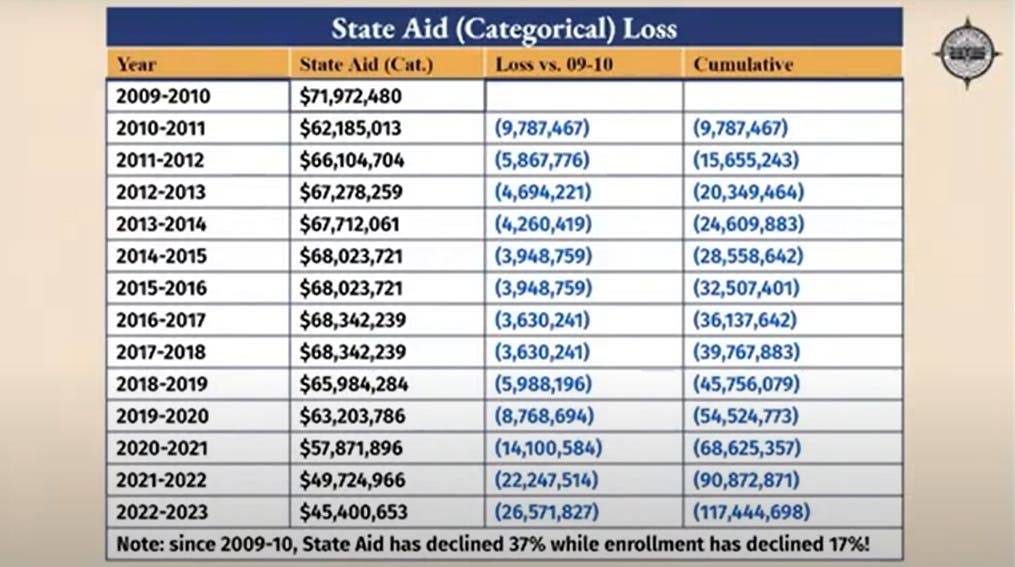
Toms River Regional received a $4.3 million cut in state aid for the 2022-23 school year, as part of S2. A lawsuit to force the Department of Education to turn over the school funding formula and the data that is needed to see if the state aid figures are correct is ongoing, as the state is continuing to drag its heels on supplying the data, Genco said.
The 2022-23 budget is the fifth year of the aid cuts; Genco said the district is facing a fiscal cliff with the potential for catastrophic cuts over the next two years unless something changes.
Here is a breakdown of key areas of the 2022-23 budget:
Curriculum and instruction: $86,424,339, up $3,907,634. This includes salaries, professional development, supplemental resources, substitute teachers. It includes funding for a JROTC Academy to start. The last three years of cuts continue to put a tremendous strain on staffing, buildings and facilities, the district said.
The American Rescue Plan funds for 2022-23, of $8.73 million, will be spent on extended-day and summer programs, the K-5 reading program, K-8 social studies text, tech device updates, the iReady program for K-8, social workers to support students, and more.
Co-Curricular: $3,980,583, down $20,674. The decrease is because the district replaced the Toms River High School North band uniforms this year. The budget includes stipends for coaches, advisers, fees for referees, chaperones, membership dues, equipment, royalty fees (for plays and musicals), and uniforms. There are no cuts to sports or co-curriculars.
The pandemic "magnified the importance of student involvement in these programs," Assistant Superintendent James Ricotta said.
At its high schools, the district offers 10 fall sports, 12 in the winter and nine in the spring. High School South and East each have 50 clubs year-round, while North has 44 in the fall and 43 in the spring. The intermediate schools have five fall sports, three in the winter and four in the spring. There are 24 clubs at Intermediate East, 18 at Intermediate North and 22 at Intermediate South.
Benefits: $51,237,275, up $613,638. The district is self-insured; costs are up for 2022-23 because of increased health care needs and lower employee contributions that are the result that requires the offer of the Educators Health Plan to new employees. That health insurance plan costs employees less but has increased the burden on school districts. The district's plan has been less expensive than the state-operated plan. Pension contributions are part of this figure and that cost is volatile.
Administrative: $5,255,428, up $63,916. This includes not only the superintendent, business administrator, principals and other administrators, but legal services, engineering services, the auditor and other staff in the business office.
The Toms River Regional District has among the fewest number of administrators per pupil, Genco said. According to the state Department of Education's Taxpayers Guide to Education Spending, ranking 15th lowest out of 92 districts with more than 3,500 students.
The state Education Adequacy Report, which defines what a district is expected to spend to educate students, says a district with 5,240 students — just over a third of the enrollment of the Toms River Regional district — should have a superintendent, two assistant superintendents, four directors, one supervisor, and nine academic coaches, along with a principal at each school, an assistant principal for a middle school with 600 students and three assistant principals in the high school, with 1,600 students.
Toms River Regional, with about 14,600 students, has about 1,100 students each in Intermediate North and South, and 1,400 in Intermediate East. High School North has more than 2,000 students, while East and South each have about 1,400 students. The district has three assistant superintendents and four directors. Each elementary school has a principal and the intermediate schools have a principal and two assistants each. High School East and South each have three assistant principals, while North, with more than 2,000 students, has four.
Utilities: $4,491,882, up $54,750 due to anticipated increases in natural gas costs and water/sewer costs. Doering estimates the district has saved $8.59 million through its energy education program since 2012, costs that would have made the district's budget crunch worse.
Insurance (not including health insurance): $3,864,889, up $202,486. Insurance costs are rising across the board, from property to various forms of liability insurance. Cyber liability insurance has been growing rapidly, but Doering said it is a necessity -- along with increased security measures like multifactor authentication -- because of the spread of hacking schemes where cyber-pirates take over an entity's data network.
Operations and Maintenance: $13,001,449, up $46,333. This includes the district's share of salaries for the police officers who are stationed in the district's schools. $1 million was pulled from the district's maintenance reserve to pay for maintenance needs at its 18 schools and five support facilities, such as central registration, the health center at 54 Washington St. and the school bus yard. There is a total of 2.55 million square feet of school buildings to be maintained, officials said.
The $13 million is separate from the $8 million set aside to make repairs to stop water intrusion at Toms River Intermediate South. It also is separate from the money being spent on renovations through the 2019 bond referendum.
Student and special services: $39,943,501. The amount is lower in 2022-23 because the district is paying special education tuition through federal COVID-19 pandemic relief funding. The district has increased its special education programs and has been able to provide services for more students within the district instead of having to pay outside tuition, but there are still increasing needs for service. This portion of the budget includes vocational school tuition for students, both those who attend the partial-day programs and the academy programs such as MATES and the Performing Arts Academy. It also includes the child study teams, related services, and health services, as well as homebound instruction for students with long-term health issues.
The number of students receiving special education services has risen 15 percent from June 2021, and that trend is anticipated to continue into 2022-23, said Joy Forrest, the district's director of special services.
Transportation: $17,729,029, up $2,737,635, an 18 percent increase. The increase reflects the rise in fuel prices, the rise in salary costs for drivers, the jump in the cost of contracted routes and the number of students receiving aid-in-lieu for transportation to schools outside the district (within a 25-mile radius).
The district has seen the number of students eligible for aid-in-lieu rise from 702 to 2,406 over the last six years, with an expected cost of $2.2 million in 2022-23. The state reimburses about 80 percent of that cost, but not until the following school year. About $3 million is for contracted transportation. The district has 162 buses -- 112 large, and 50 small, all equipped with video surveillance, and 91 buses transport students four tiers per day. The district will be replacing 12 54-passenger buses and 1 small bus through its rolling lease purchase program, at $1.4 million.
Doering said the district is using its buses to maximum efficiency, more than twice the state's recommendation.
Technology: $3,606,371, down $15,902. This covers the district's IT personnel, its computers, phone system, projectors, wireless internet, and all of its software licensing, including Microsoft, Adobe, Genesis and other programs. The district has a rolling lease program, budgeted at $700,000, for replacement of outdated Chromebooks for students and teachers.
Revenues: The district's tax levy for 2022-23 is $168 million and it is set to receive $49.3 million in state aid. The district also has more than $12 million in other revenues, including pandemic relief funds, grants, and income from the Bubble and the RWJ Barnabas Health Arena.
Doering noted that in regard to S2 and the district's local fair share, one of the continuing problems is the local fair share continues to change — it is $219 million in the 2022-23 budget -- but the district cannot possibly close the gap in short order. Under the 2 percent cap on tax levy increases, it would take 15 years for Toms River Regional to reach the current fair share amount.
Here is the tax impact of the 2022-23 school budget for each town:
- South Toms River, $1.0228 per $100 of assessed value, or $1,719.03, up from $1,717.57, for a home assessed at the median of $168,076. The increase amounts to $1.46 for the year or 12 cents a month.
- Beachwood, $1.1580 per $100 of assessed value, or $2,386.74, up from $2,303.79, for a home assessed at the median of $206,100. The increase amounts to $82.95 for the year or $6.91 a month.
- Pine Beach, $1.2053 per $100 of assessed value, or $3,263.85, up from $3,225.35, for a home assessed at the median of $270,800. The increase amounts to $38.50 for the year or $3.21 a month.
- The tax rate for Toms River Township is 81.1 cents per $100 of assessed value. Because the township underwent a revaluation, the comparison to the 2021-22 tax rate isn't straightforward. As with the municipal taxes, some homeowners will see an increase, others will see a decrease, and some will stay the same.
Sign up for Patch alerts and daily newsletters here, or download our app to have breaking news alerts sent right to your phone. Have a news tip? Email karen.wall@patch.com Follow Toms River Patch on Facebook.
Get more local news delivered straight to your inbox. Sign up for free Patch newsletters and alerts.