Traffic & Transit
4 NJ Toll Increases In Almost 15 Years. Are NJ Roads Any Better?
Patch took a look at some of the data on tolls, roads and drive times, and asked several state agencies about them.


NEW JERSEY — Bruce Black of West Deptford is one of more than 1 million people who frequently use either the New Jersey Turnpike or Garden State Parkway to get to work.
He told Patch the area around Exit 5 is “terrible” and called the tolls “very high.”
While Gregory Harcum of Cinnaminson said the New Jersey Turnpike Authority “does a pretty good job maintaining” its namesake, he felt the state’s other highways and interstates “need the most work and are not very well maintained.”
Find out what's happening in West Deptfordfor free with the latest updates from Patch.
With several tolls increases in New Jersey within the past 15 years and road improvements frequently cited as one of the reasons for justifying them, Patch examined the Garden State’s recent track record of toll increases and road improvements.
After Years Of No Toll Increases, Multiple Increases
Find out what's happening in West Deptfordfor free with the latest updates from Patch.
The New Jersey Turnpike opened in 1951 and Garden State Parkway in 1957, according to the New Jersey Turnpike Authority.
The same year the Parkway opened, it cost 25 cents to get through a toll plaza on the main highway and stayed that way for nearly 40 years, until the toll rose to 35 cents in 1989, according to The New York Times.
Toll increases in 2008 and 2012 followed, followed by a few more in 2020 and 2021, and now, that once 25-cent toll has skyrocketed to $1.96 or $2 (depending on whether a person has an EZ-Pass or not), roughly a 700 percent increase since the highway first opened.
As for the New Jersey Turnpike, its drivers also experienced decades of limited changes to toll collections, then saw increases in 2008, 2012, 2020 and 2021.
Perhaps not coincidentally, recent reports on thenewswheel.com, budgetdirect.com and caranddriver.com gave the New Jersey Turnpike or some NJ bridges the dubious distinction of being some of the “most expensive” roads or tolls in America.
Thomas Feeney, a New Jersey Turnpike Authority spokesperson, scoffed at the first report when contacted by Patch.
“If you drive across the PA Turnpike right now from the New Jersey state line to the Ohio state line (360 miles), you would pay 13.7 cents per mile ($49.30 total) as an E-ZPass customer and 26.4 cents a mile ($95.20 total) as a non-E-ZPass customer,” he said. If you drive on the NJ Turnpike right now from the Delaware Memorial Bridge to the George Washington Bridge (122 miles), you would pay 11.9 cents per mile ($14.57 total) as an NJ E-ZPass customer and 15.9 cents per mile ($19.45) as a non-NJ-E-ZPass customer.
Feeney continued, “And yet somehow newswheel.com has the New Jersey Turnpike ranked higher in their most expensive toll roads list?
Tolls are not the only driving-related item that has seen increases in recent decades.
Commuters in New York City metropolitan area took about an average of 34.9 minutes to get to work in 2010, making their drive to work the longest average travel time in the U.S., according to an analysis of that year’s U.S. Census data that appeared on nj.com.
That number had risen to 37.7 minutes, and the New York City metropolitan area still claimed the top spot when it comes to longest commutes, by the time the next census rolled around.
Outside Analysis Of NJ Roads
When it comes to the quality of New Jersey roads, several analyses not conducted by the state of New Jersey suggest there is room for improvement.
The transportation research nonprofit known as TRIP released data this past January of this year that indicated 34 percent of New Jersey’s major roads are in “poor condition,” down from 37 percent in 2016.
“What that means to the motorists of those are roads where you can feel that the road surface you're driving on isn't smooth,” Rocky Moretti, director of policy and research at TRIP, told Patch. “You're feeling more vibrations, and certainly you're seeing the physical signs of that from cracking the potholes.”
In addition, the American Society of Civil Engineers’ most recent infrastructure report said 37 percent of New Jersey roads are in poor condition.
Also, citing “severe potholes and uneven and unfinished pavement,” New Jersey residents also tended to give their state’s roads a thumbs-down, according to a 2021 survey published by consumeraffairs.com ranked the Garden State’s roads seventh worst of all 50 states.
“The challenge with pavements is long term,” Moretti said. “The deterioration occurs over a number of years. It takes a long-term investment program that's reliable so that you can begin to rebuild the system.”
He continued, “ultimately, it's cheaper to rebuild a system and keep it in condition than to let it deteriorate to the point where you're patching up your worst sections of roads, which is actually far more costly.”
State Making Changes Over Time
New Jersey has taken steps, such as ensuring $12 billion in total bonding authorization to financially support transportation projects from Fiscal Year 2017 through Fiscal Year 2024, according to New Jersey’s Transportation Trust Fund Authority website.
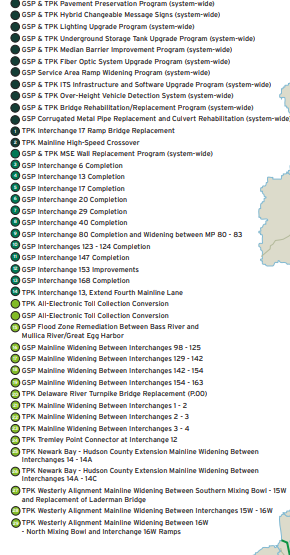
A review of the New Jersey Turnpike Authority’s Long Range Capital Plan indicates that a substantial majority of that money will not go to resurfacing or repaving roads that have potholes that could potentially cause costly care repairs.
Rather, it will go to widening either the New Jersey Turnpike or Garden State Parkway or making infrastructure improvements. In addition, depending on where in New Jersey one lives, it could take years for some of the new road widenings and infrastructure improvements to occur.
Feeney, the New Jersey Turnpike Authority spokesperson, told Patch it could be 2042 until some of the projects in the capital plan are completed.
For roads such as State Highway 3 in North Jersey, State Highway 33 near Trenton and State Highway 70 in South Jersey near Cherry Hill, the state uses a pavement management system to assess current pavement conditions, New Jersey Department of Transportation Spokesperson Stephen Schapiro told Patch.
This system, uses multiple criteria, including rut depth and percent of a road that is cracking, to ascertain the order in which roads should be repaired, according to New Jersey’s Department of Transportation website and Schapiro.
Federal Money Will Also Help Fix NJ Roads
As a longtime traveler of New Jersey roads, Congressman Donald Norcross, who represents the state’s first Congressional District, told Patch he sympathizes with those who think Garden State’s roads need improvement.
“I drove to work at 5 a.m. every morning as an electrician, sometimes driving across the state to reach job sites,” he said. “We’ve had chronic underinvestment in our roads for decades. That’s why I fought so hard to pass the Infrastructure Investment and Jobs Act, which is delivering billions of dollars to New Jersey. The money will create jobs, decrease wear and tear on our vehicles” and make roads less dangerous.
Specifically, “the bill will provide $12.61 billion in state funds for highway, bridge and transit investments in New Jersey over the next 5 years, including a 41% funding increase in [Fiscal Year] 2022, according to Schapiro.
A press release from U.S. Senators Cory Booker and Bob Menendez of New Jersey indicated nearly $7 billion of that federal allocation is expected to go highways and roads. aThe exact projects the federal funds will go to remained uncertain at the time of this story’s posting.
Gloucester Township resident Marilyn Foy hoped the funds stayed in her part of the state.
“Most of South Jersey taxes go to North Jersey,” she told Patch.
Moretti, the TRIP analyst, said that the federal funding, in tandem with initiatives at the state level, provide “hope” that substantial improvements can be made to New Jersey’s roads.
“We also recognize how heavily traveled the state's transportation system is, and in a very high level of deterioration, and it takes a significant effort to turn that ship around.”
---
Readers: Is there a stretch of road in New Jersey that you know you think is in bad shape? Email me – janel.miller@patch.com – specific details regarding the name of the road; whether it is the north-, south-, east- or westbound side; the approximate mile marker; and a description of why you feel the road is in such bad shape. Note that your observations and comments may appear in a future Patch article.
Get more local news delivered straight to your inbox. Sign up for free Patch newsletters and alerts.