Politics & Government
Committee Race Blows Away West Deptford Spending Records
The campaigns more than doubled the 2010 total.


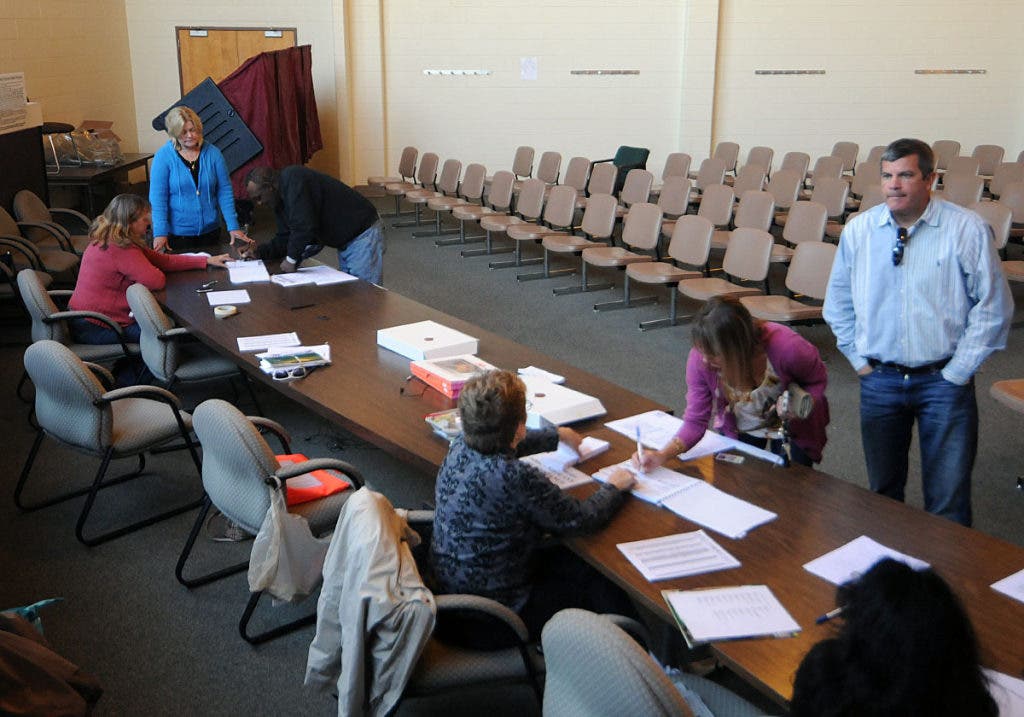
West Deptford’s 2011 township committee race wasn’t just historic because of the first third-party candidate ever, or the fact that it gave Republicans control for the first time in 25 years.
It was also the most expensive election in history, as the parties combined to spend more money this year than the previous two most expensive elections combined.
Democrats Hunter Kintzing and Denice DiCarlo and Republicans Sam Cianfarini and Ray Chintall dropped a total of $168,662.51 in total campaign spending through the course of the year, according to post-election Election Law Enforcement Commission (ELEC) filings.
Find out what's happening in West Deptfordfor free with the latest updates from Patch.
The Democrats made up the bulk of that total, spending $144,822.97, about $67,000 more than in 2010, while the Republicans more than tripled their spending from a year ago, putting out $23,839.54 this year, in comparison to $7,658.79 in 2010.
Add in the primary spending from Republicans Loran Oglesby and Matt Mahon, and the total spending by independent Len Daws, who spent less than $4,000 and wasn’t required to detail his totals, and the 2011 total climbs to at least $176,387.51.
Find out what's happening in West Deptfordfor free with the latest updates from Patch.
By comparison, the two most expensive campaigns previously were the 2010 race, which saw $84,948.69 spent through the year, and 2002, when spending hit $83,434.82.
John Weingart, associate director of the nonpartisan Eagleton Institute of Politics at Rutgers University in New Brunswick, said campaigns spending as they did in West Deptford this year is outside the norm, but not completely unheard of.
“I think they’ll occur from time to time,” he said. “I don’t think there’s the money or the appetite for that on a large scale at the municipal level.”
Weingart said a number of factors contribute to spending spikes at the local level, but it’s more common when either strong local candidates or strong local issues emerge to drive spending higher than is typical.
Bruce Caswell, associate professor of political science at Rowan University, and a specialist in elections and political participation, said increased spending isn’t necessarily a bad thing, since it typically leads to increased turnout and voters making more informed decisions at the ballot box.
“If you think politics is important, you could argue we under-spend on campaigns,” he said. “These little forests of campaign posters that pop up at corners–that’s the way people know about an election.”
Caswell said the evidence he’s seen points directly to higher spending leading to more voters showing up at the polls.
“We do know when there’s a lot of advertising, when campaigns are highly visible, it increases turnout,” he said.
While West Deptford’s turnout this year was about 1,000 voters lower than in 2010, the township’s turnout rate–just a hair under 40 percent–was significantly higher than the statewide, record-low average of 26 percent.
Though the positive effects on turnout are a benefit, both men said increased spending becomes a concern when, whether by perception or reality, a few large donors can be seen to skew the election.
Caswell said a surge in fundraising and spending can effectively be a form of influence-peddling.
“That’s what disturbs people,” he said.
One way to rein that in, at least to a degree, is to have competitive bidding for professional contracts, Weingart said, though the law still allows professionals seeking those contracts to pour cash into campaigns.
He also pointed out that skyrocketing campaign spending can mean people are less likely to get involved in politics; Weingart particularly noted the Second District state Senate race between Jim Whelan and Vince Polistina, where the candidates went through $2.6 million, as a potentially chilling situation.
Caswell, though, said even seemingly-extravagant spending like that aren’t necessarily a problem.
“I wouldn’t mind spending more money on campaigns, as long it doesn’t distort outcomes and influence,” he said.
Republicans Democrats 2011 $23,839.54 $144,822.97 2010 $7,658.79 $77,289.90 2009 less than $4,000* $54,791.09 2008 less than $6,700* $42,835.01 2007 less than $6,700* $45,282.27 2006 less than $3,500* $50,654.16 2005 $7,001.64 $61,624.68 2004 less than $3,000* $53,991.98 2003 $10,594.53 $57,072.59 2002 $15,314.56 $68,120.26 2001 less than $5,800* $38,159.06 2000 less than $4,700* $37,265.78 1999 less than $2,400* $36,980
*did not make the ELEC threshold for a breakdown of spending.
Get more local news delivered straight to your inbox. Sign up for free Patch newsletters and alerts.