Community Corner
Novel Destinations Visited Through the Peace Corps
Ellen Rhudy's story of 22 months serving Macedonia.
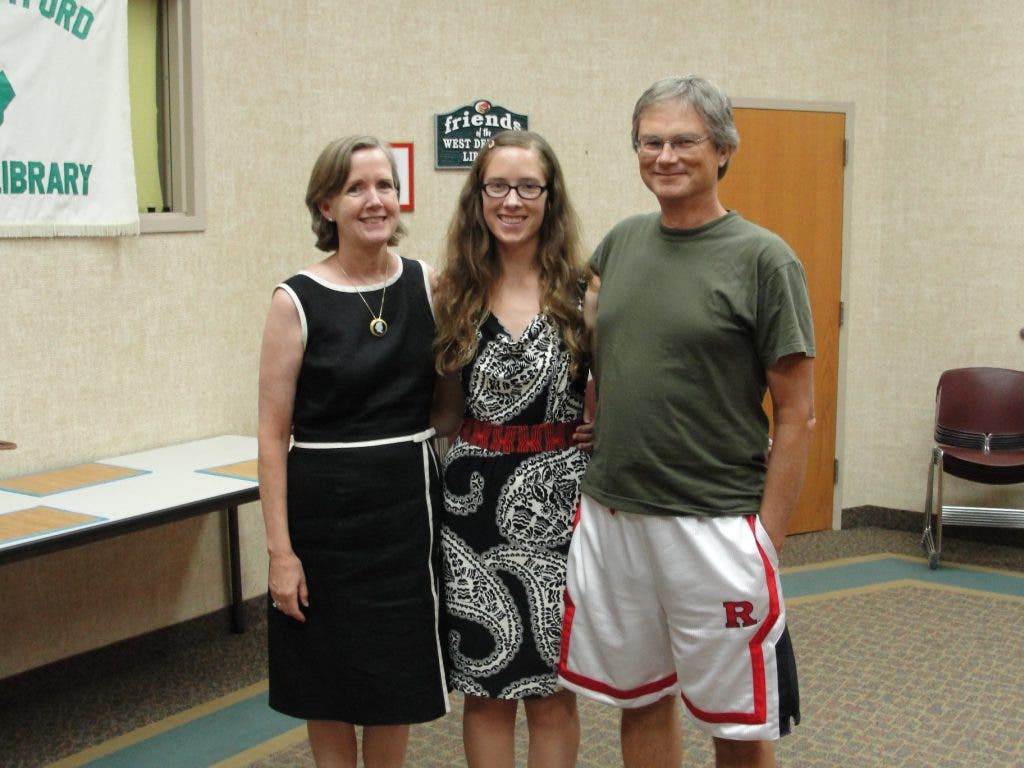

“I wanted to, rather than just talking about making the world a better place, actually try.”
Ellen Rhudy, a native of Mullica Hill, has been living in Macedonia as a volunteer for the United States Peace Corps for the past 22 months, but took a brief break on her vacation to speak at the about her experience there.
“This is actually my first time back in the States in 22 months, so coming home was strange–especially going to a grocery store…seeing how much stuff there is,” she said.
Find out what's happening in West Deptfordfor free with the latest updates from Patch.
Rhudy grappled with the idea of joining the Peace Corps for four years before she applied.
“I wanted to learn another language and live in a different country and experience a different culture,” she said.
Find out what's happening in West Deptfordfor free with the latest updates from Patch.
After she graduated from Rutgers with an English and History double-major in 2008, Rhudy began three months of training in a designated Peace Corps “training community” within Macedonia before she moved to her home in Debar, near the Albanian border.
“I felt overwhelmed by the different ideas of personal space and by how much more formal the culture can be,” Rhudy said. “Elders are respected, so they have to be greeted first when you enter a room; trying to work out things like this had me feeling like a bumbling idiot my first few months.”
“And I found it hard to adjust to the different (and more subordinate) roles women often play,” she added. Unlike many volunteers who live on their own, Rhudy lives with a 14-person host family of Macedonian Muslims.
One of her host sisters married last summer at the age of 16. As is customary for the culture, the marriage was arranged. The couple had even been married “on paper” six months prior to the ceremony, Rhudy said.
“It’s one thing to say that it’s wrong for a 16-year-old girl to have an arranged marriage; it’s much harder to say that after spending two years living with a kind, welcoming family whose daughters are married when they’re 16, especially when they are so accepting of my (very different) lifestyle,” Rhudy said.
Women’s rights are an important issue, especially in the western, more Muslim parts of the country, but Rhudy said things are “in the process of changing.”
“Most Albanians actually marry when they’re older, about the same age that we tend to marry in America,” she continued.
However, Macedonian girls sometimes discontinue school after completing eighth grade. Rhudy explained it is the law for all children to continue into high school, and the majority do, but instead, some girls will stay home to cook and clean.
Another of Rhudy’s host sisters is a registered high school student, but does not attend school, based on tradition and her family's culture.
Rhudy works as a teaching assistant in an all-Albanian school, where she has just one Macedonian coworker. Her training included a practicum with local school teachers to learn their curriculum and then to learn to collaborate on lesson plans.
She assisted a third-grade class this past year but moves through the school “based on need and teacher/student requests.” Her primary responsibility is to introduce new teaching methods.
“They just go down the page and they go right from the book,” Rhudy said of the teachers. “Even if they’ll have exercises that need a CD, if they don’t have the CD, they’ll still try and do the exercise.”
“Teaching is not a respected profession in Macedonia,” she said, adding that teachers do not receive much training and only make about 300 euros–or $424–per month.
“They’re not going to get any more money if they’re really good teachers,” Rhudy said. “In fact, they’re more at-risk of getting fired if they’re doing something that is a little strange than…if they go right out of the book.”
Rhudy helped students make alphabet books, inspired by Dr. Seuss, so they can learn the alphabet and not recite the phonetics, she said. She also started an English Club for the sixth-grade class and set up a school-wide spelling bee.
“For about a year and a half, I worked with an NGO in my town to run an adult English class,” she added.
“The basic idea [of the Peace Corps] is that volunteers spend their first year learning the language, getting to know people in their communities and learning to recognize the needs of the community, and the second year acting on what they’ve learned in the first,” Rhudy explained.
When her service is up in October, Rhudy will move to Albania to research the country’s culture for nine months as a Fulbright fellow. She does not have plans for what she will do afterward.
Rhudy blogs about her experiences in the Peace Corps at erhudy.wordpress.com.
Editor's note: several passages have been clarified in this article. While accurate that Rhudy's host sister doesn't attend high school despite being registered, she does so because of her family's traditions, rather than any other reason. Also, a paragraph was editing to reflect that the fact that the majority of girls do attend high school, though some drop out after eighth grade.