February, 2010.
On Sunday as we prepared to step out into the stands of Sun Life Stadium, I grabbed my friend’s arm and stopped him in his tracks. “Let’s savor this,” I said. “We're about to enter the modern Coliseum. We are today’s Roman citizen.” Now, I admit it’s a cliché observation. But just because it’s oft repeated, doesn’t make it any less true…perhaps the opposite. I was impressing upon him that attending a Super Bowl made us a part of history. That we were about to join the epicenter of that new Rome. The pomp. The pageantry. The overwhelming sense of the circus of antiquity come to life once again in a modern age. As a testament to United States’ hard power our eyes were drawn skyward by the ear-splitting banshee screech of F-15s in “finger four” formation slicing through the clear twilight above us. Later, as I watched the coin toss commence in mid-field, I was half-expecting the Colts and Saints players to turn towards some unseen central figure and call out in unison “those who are about to die salute you!”
Before I took my seat to enjoy the first of many $12+ beers, I couldn’t help but look all around at the teeming mass of which I was a part and ask: is this what it was like for the Romans of old? They say history may not repeat, but it does rhyme. When we look back on the rise and fall of Rome and note the timeline of its decline, one doubts that those hooting for blood in the stands in the great gladiatorial contests in their day realized that they were citizens of an empire that was unraveling in decay. That, although in their own lives things may have seemed quite intact, something underneath supporting it all was rotting away. That their great nation was sinking under the weight of political mismanagement and shameless cronyism, the unsustainable burden of profligate government spending at home while maintaining a military presence to guard porous imperial frontiers far too widespread for any one nation to control. In its cultural body, the deterioration of core values that make a society viable was well underway. Deviancy was being continually defined down (as the late Sen. Daniel Patrick Moynihan would say) and taking the once great Republic with it.
A record 106 million Americans watched the last Super Bowl that I attended. SB XLVI between the Giants and Patriots drew a record 111.3 million. There is a certain feverish “bread and circuses” aspect of the weekend. Granted, this is not an event put on by the government to placate and distract a restless mob. The NFL is very much a for-profit enterprise. And with anywhere from 10 to 15 million Americans unemployed depending on how you measure it, the need for a distraction from hard times that the Super Bowl product provides may be more in demand than usual, hence the stellar ratings. Caesar provided amusement to his subjects and they in turn remained loyal and acquiescent. The NFL provided this year’s diversion from the day-to-day. [FYI: 50 million of us watched the playoff games yesterday.]
Perhaps I can take comfort in the notion that our social mores are still far apart from those of Rome in a very significant way. Our mainstream society's tenets are fundamentally grounded in respect for the rights of the individual, which we see as God-given or the inheritance of natural law that no emperor or governing body can deny us at a whim; indeed, we place a higher celestial value on humanity than any society in recorded history. As such, the day-to-day grind of a citizen in even supposedly civilized Roman times was a far more brutal affair, life was cheap, short and often painful in ways we cannot fathom. It was also a society filled with slaves who were, to a free Roman, the walking dead whose value expired when they could no longer work or, in the case of their amphitheater, entertain the mob with their blood.
Find out what's happening in Westfieldfor free with the latest updates from Patch.
Our culture, on the other hand, idolizes our modern gladiators, showering them with incredible riches and affection—some would argue too much so. Drew Brees, the league’s highest paid player, earns $51 million a year ($11 million in endorsements). But even the lowest paid bench-warming scrub is paid a minimum $477,000 annually. Unlike their Roman counterparts, our gladiators are free men who live the best of lives our material society can offer. All so that the circus can go on for the rest of us in the gallery.
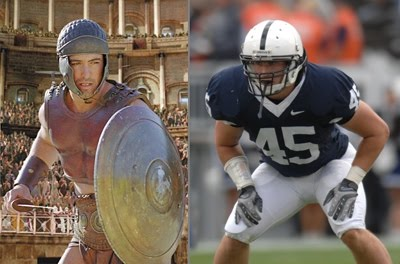
In the 2000 movie Gladiator, director Ridley Scott used the modern football stadium as his model to capture the experience of the Coliseum in all its glory. I hope that the parallels between ancient Rome and the present day United States end there. But on Super Bowl weekend, with the central expression of who we are as a people revealed in all its sensory overload, I could not help but reflect on that Roman slave who whispers in the conqueror’s ear as he stands erect in his flower-adorned chariot at the height of his triumphal ride through the city: “All glory is fleeting.”
Find out what's happening in Westfieldfor free with the latest updates from Patch.
[Addendum: January, 2014…]
Do not get me wrong. I am an avid football fan and think the NFL is one of the best run organizations in the world. I adore the game, in fact, and believe that its lessons of teamwork, of mental and physical fitness, alertness, learning to take a hit and get back up, and even enduring some physical pain, prepares a youngster for life maybe more than any other sport. Participation in organized sports is an essential ingredient to anyone’s development as a person of character.
But the Super Bowl is so much more than just four quarters of football. It is the event of the year in the United States. A week long party culminating in a national mass migration via the television screen to whatever corporate arena is playing the part of de facto Coliseum for the day. It is not the NFL’s offering that makes me wonder about who we are as a people and where we are as a country, but rather our reception of the product itself. A man who tortures dogs, for example, was still cheered by an adoring throng because he can throw a wicked spiral. A forthright and extremely respectful and polite young man who prays on his knees and gives thanks to God is viciously ridiculed for his faith by some of the more acerbic commentators, both inside and outside of sports, simply because, though a Heisman quarterback, his NFL future was in doubt. There is something wrong with that.
And yet...I look at an inspiration like Peyton Manning, a man who two years ago couldn’t throw a football and is now one game away from completing the most stunning season of any football player in any position and in any era, and I am filled with hope that this game, this whole event, brings out all aspects of the American character… including the best in us.
When the Constitutional Convention was in session 133 years before the genesis of the NFL, George Washington was seated up high at the front of the room to oversee the discussions. Into the wooden back of his chair was carved a semi-circle of the sun peeking over the horizon. Good old Ben Franklin, in his typical insatiable optimism, offered that after what he saw that summer in Philadelphia, he came to the conclusion that it was a rising, not setting, sun. Only time will tell whether the Super Bowl, and our embracing of all it implies about how far we are into our country’s long day, will be looked back on by future historians as a symbol of our continuing sunrise as a great and vibrant nation, or emblematic of the long sunset of another decaying empire.
Either way, it should be a heck of a game. Broncos in 10 … the cold won’t mean a thing to Peyton. You heard it here.
Senatus Populusque Americanus!