Community Corner
West Orange Teacher Shares Personal Stories Of The Holocaust With Students
Social studies teacher Pamela Romanchuk is on a mission to teach students about the Holocaust through a very personal lens: her family.


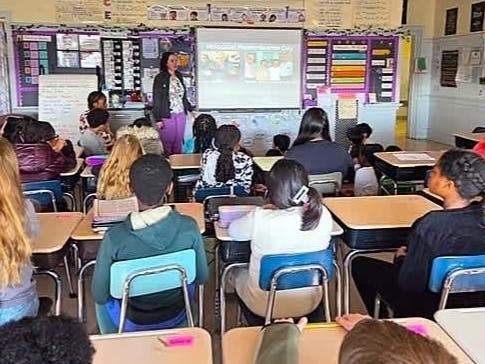


WEST ORANGE, NJ — The following news release comes courtesy of the West Orange Public School District. Find out how to post announcements or events to your local Patch site.
Seventh grade Social Studies teacher Pamela Romanchuk is on a mission to teach students about the Holocaust through a very personal lens: her family.
“As the granddaughter of four Holocaust Survivors, and 7th grade Social Studies teacher at Edison Middle School, I have been sharing their stories in honor of Yom HaShoah since 2023. As of the end of April, I will have spoken at Hazel, Gregory, and Redwood Elementary schools, and Liberty, Roosevelt and Edison Middle Schools,” Romanchuk said.
Find out what's happening in West Orangefor free with the latest updates from Patch.
Yom HaShoah, or Holocaust Remembrance Day, usually falls in April—on the 27th of Nisan in the Hebrew calendar—marking the anniversary of the 1943 Warsaw Ghetto Uprising. The uprising, considered the largest single revolt by Jews against the Nazis during WWII, occurred between April 19 – May 16, 1943, when Jewish resistance forces fought against the final deportation of 50,000 residents.
The story of Romanchuk’s family begins on Kristallnacht, or Night of Broken Glass. On November 9-10, 1938, Nazi forces destroyed Jewish businesses, hospitals, buildings, and synagogues in Germany due to the purported assassination of German diplomat Ernst vom Rath by 17-year-old German-born Polish Jew Herschel Grynszpan.
Find out what's happening in West Orangefor free with the latest updates from Patch.
“Grandpa Eric and his twin brother Uncle Harvey were 18 years old when Kristallnacht, Night of the Broken Glass happened throughout Germany,” Romanchuk began.
“Rather than be arrested, they fled Germany on foot for over a year and travelled over 300 miles to France. When they arrived in France, they were immediately arrested and put into a “re-education center,” being tagged as German ‘enemies of the state’ by France. They eventually escaped the re-education center and made their way to the United States, where they enlisted as medics in the US army and were sent back to Europe as American citizens fighting for their new homeland.
“Grandma Frances was born and raised in Austria. Once Germany took over Austria in 1938, her parents sent her, alone aboard a ship at the age of 13, to a family in the United States. She had never met the family and did not speak English. While there, she received a letter saying her parents were on their way to the USA. On the day the ship arrived, their luggage came off the boat, but her parents never did. They were killed in a concentration camp during the war. Gram made a living working in various factories until she married Grandpa,” she explained.
“Frances and Eric met at a party in New York and were married shortly thereafter. Grandpa Eric and Uncle Harvey both continued their careers in the medical field in the United States after the war. They bought a duplex in Queens and the brothers and their wives lived together until they passed away. Grandpa Eric and Grandma Frances’ legacy is two children, seven grandchildren and four great-grandchildren.“
Romanchuk continued, “Grandpa Henry was born and raised in Germany. His father was a German patriot who fought for Germany in WWI and loved his country, raising his family to be good German citizens. They were very wealthy and owned a furrier factory. After Kristallnacht, Night of the Broken Glass, Henry's father was arrested for being Jewish and sent to Buchenwald for three weeks. When he returned, he tried desperately to get his family out of Germany but was unable to do so. The family dealt with the Nuremberg Laws (laws passed on September 15, 1935, by a Reichstag session at the annual Nuremberg Rally that were the basis for antisemitic and racist legislation in Nazi Germany), were forced to wear Jewish stars, and were deported to Theresinstadt Ghetto in 1943. Grandpa was 19 years old. The whole family was deported to Auschwitz in 1944, and only Grandpa Henry survived. His parents and sister all perished. Grandpa Henry was eventually transported to Gross-Rosen, another concentration camp, and was there until Liberation until 1945. After liberation, he stayed on the American side of Germany until he was able to arrange passage to the United States and in November 1949, he took his first steps on American soil.”
Students were able to ask questions during the assemblies.
“Romanchuk concluded, “It's not about making sure the Holocaust against Jews does not happen again. I tell their stories to say anything, even remotely like that, can happen to anyone. It's about sharing history so if something like this starts again, people can raise the alarm bells earlier, fight earlier, to protect themselves and their neighbors. I try to teach my students that what makes us different is also what makes the world a better place. We should celebrate and learn about those differences. The world would be a very boring place without them.
Send local news tips and correction requests to eric.kiefer@patch.com. Learn more about advertising on Patch here.
Get more local news delivered straight to your inbox. Sign up for free Patch newsletters and alerts.