Politics & Government
Librarian Unearths Copy of Woodbridge's Original 1669 Land Deed
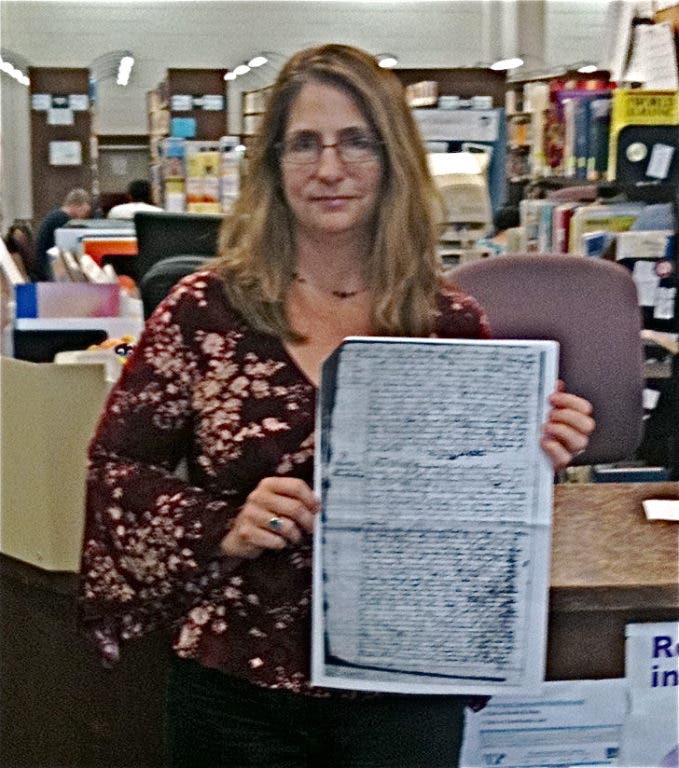
Librarian Wendy Rottweiler dug and discovered a copy of a 1669 document that first laid out the physical boundaries of Woodbridge before it was even a township.



New Jersey was the crossroads of the American Revolution. The landscape of New Jersey is dotted with the efforts of towns like Cranford, Westfield, and Clark that lovingly cherish their heritage through the preservation of antique structures and artifacts that show off what like was like at the dawn of the new nation.
Woodbridge may be the oldest township in New Jersey, but even with all that history, there's precious little in the municipality that hasn't fallen to the wrecking ball.
Even much of the original ephemera that established the township has been lost to the ages - or so it was thought.
Find out what's happening in Woodbridgefor free with the latest updates from Patch.
A copy of the original charter of Woodbridge, dating from 1669, was unearthed by a diligent township librarian.
Wendy Rottweiler, who serves as the , senior reference librarian since 1995, was digging around, trying to find a copy of the original document that established the physical boundaries of Woodbridge before it was incorporated into a township.
Find out what's happening in Woodbridgefor free with the latest updates from Patch.
"It's a fascinating historic record," said Rottweiler, who had discovered that the paper existed as she went through old papers that the main library currently houses.
She knew the charter existed somewhere, and she finally found a description of Woodbridge, signed by Philip Carteret, the first royal governor of the province of New Caesaria, or New Jersey.
Woodbridge was incorporated as a township later in 1693.
"It was a private charter, not a royal charter," Rottweiler said, to distinguish the document from royal decrees signed by the two original Proprietors, John Berkeley and George Carteret (a cousin of Philip), who were given the royal province as a land grant by King Charles II.
Rottweiler tracked down the deed establishing Woodbridge's boundaries in the archives of the New Jersey State Museum in Trenton.
Getting a copy was as mundane as paying a small fee and waiting for a photocopy to be mailed of the deed as entered in the Lord Proprietor's book held by the state archives.
"This charter laid out the geographical area known as Woodbridge, how the land would be allotted and how it would be settled," she said. "The deed sets out the boundaries. It's page upon page of physical description of the area described as Woodbridge."
The 11 by 17 inch photocopy is "hard to read," Rottweiler said, with the lavish calligraphy of the 17th century.
At this point, the copies Rottweiler obtained are part of the Woodbridge Main Library's historical collection, and she intends to make them accessible for viewing by the public. "We will possibly display them. It's interesting to see the original writing," she said. "But it's a lot easier to read the transcription of the deed."
While Woodbridge has had two historic societies in its existence, it has never had a museum as towns much less ancient have had. There has been no place to store historic records for posterity, so the library has become a repository by default.
Rottweiler, with her interest in history, has been a careful guardian of the documents that have come her way.
There's no rhyme or reason to what bounty the public has bestowed on the library.
"People come up with things that have been in their families, or they find things in their attics or stuffed under floorboards. It all winds up here," she said.
Some of the treasures the library holds include a 17th century Bible belonging to the Olstens, a family with historic roots in the township, Rotteweiler said. Other important artifacts include an antique diary written by the cousin of Jonathan Dally, a historian who wrote a much prized history of Woodbridge.
The library also fell heir to the photography collection of the late Ruth Wolk, a township journalist and historian who wrote her own history of the township in the 1960s.
The library has also digitized much of historic Woodbridge newspapers, many long out of business. Many of them are accessible online. Other ephemera has been turned into digital records and can also be read online.
"I'm proud of what we've done with limited resources," she said. "We're played an important part in the preservation and dissemination of these documents. Researchers around the world contact us for information."
Because of the township's long history, the library is often the first resource for genealogists, Rottweiler said.
A long held goal has been for the library to construct a room to archive township historic records - a room, Rottweiler said, that could be used by the public to conduct historic research.
Get more local news delivered straight to your inbox. Sign up for free Patch newsletters and alerts.