Politics & Government
NJ Army Veteran Grateful for Service Dog
Sgt. Shaun O'Brien suffered a traumatic brain injury after a rocket blast in Afghanistan. Now, a service dog helps him get through each day.


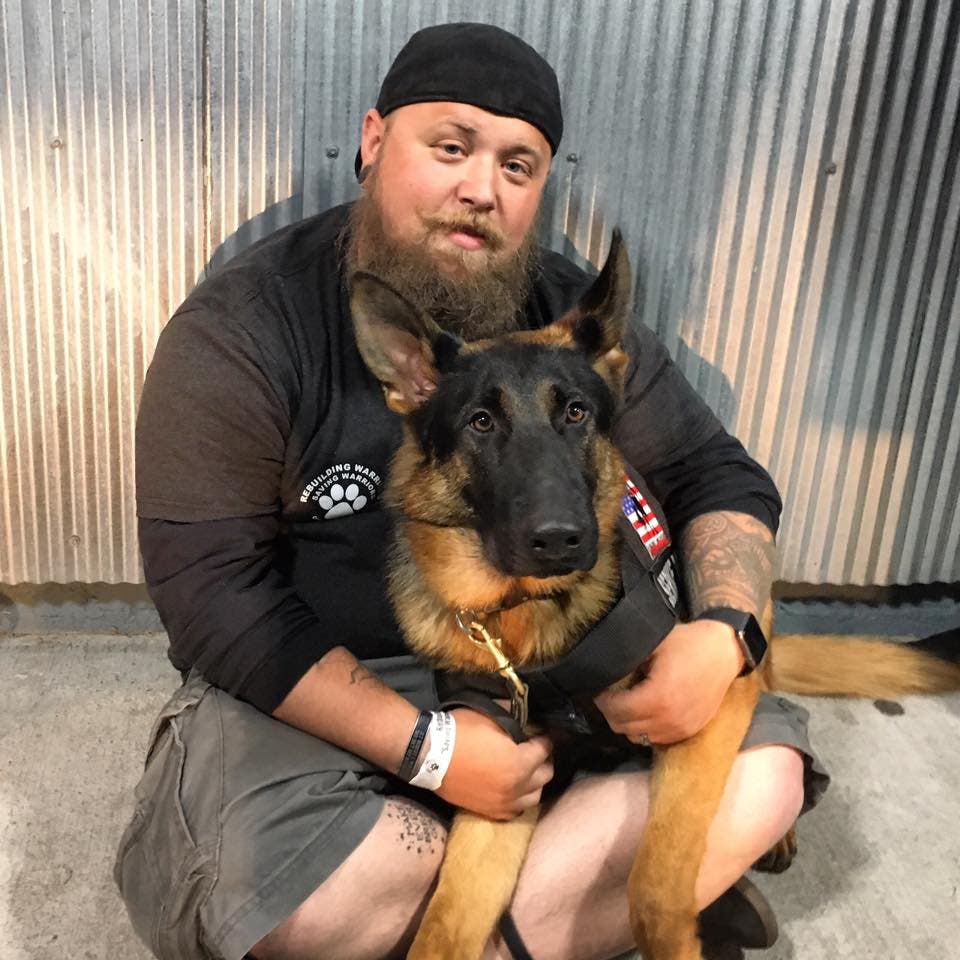


Woodbridge, NJ - Lee, a one-year-old German Shepherd, has only been Shaun O'Brien's dog since Sunday. But this former U.S. Army sergeant already cannot imagine life without him.
O'Brien, 35, lives in the tiny town of Winfield, NJ, sandwiched between Rahway and Clark. In 2011, he served in Afghanistan, where he suffered a mortar shell attack and was diagnosed with traumatic brain injury and post-traumatic stress disorder. He was given the highly-trained service dog Sunday through an organization called Rebuilding Warriors, partly based in Woodbridge. Here is his story:
An attack on the base
Find out what's happening in Woodbridgefor free with the latest updates from Patch.
O'Brien, working as a graphic designer at the time, volunteered to serve in the U.S. Army in 2009. He was deployed to Afghanistan in January 2011, where he worked as a convoy medic. He escorted supply missions to remote areas, bringing food, water and supplies.
"Those missions were usually pretty smooth, actually," he said. "But our base was nicknamed Rocket City. We took mortar fire daily, sometimes several times a day."
Find out what's happening in Woodbridgefor free with the latest updates from Patch.
To this day, he's still not sure who was firing at them — the Taliban or another insurgent group, but the rocket fire all seemed to come from a nearby mountain range.
"They aimed anywhere inside the camp and tried to cause as much damage as possible," he said. "The alarms would go off and you would hear the shells landing."
Sept. 18, 2011. He was actually scheduled to fly home the next day for R&R. O'Brien was outside, part of a team sweeping the base for signs of anything unusual. The alarms went off. The first round of mortar shells landed a couple hundred yards away. The team ran towards a nearby bunker, and that's when they collided headfirst with the second round of shells coming down.
"I remember going down and the next thing I remember is waking up in a pile of people inside the bunker," he said. He felt his head and body: Everything was intact. Immediately, he went into medic mode and began checking the others. There were a lot of dazed soldiers and fractured bones, but everyone seemed mostly OK.
It wasn't until a few hours later, in a different building, that a friend noticed O'Brien "wasn't acting right."
"I kept trying to lock a door, this really simple lock, and the door wouldn't lock. I just kept doing it over and over, like a broken record," he recalled.
He saw a doctor on base and got a diagnosis right away: traumatic brain injury.
"A lot of it is the same as a concussion at first: Sensitivity to light, dizziness, nauseous, a headache and confusion," he said. "It's not until later that you see the true extent of the damage."
The army told him to call his wife, Jesyka, and tell her he had been injured. Throughout the whole conversation, he called her Jason, his brother's name. He has no memory of that call.
Back in the U.S. harder than being in Afghanistan
O'Brien was given a Purple Heart for the injuries he received in the mortar attack. He could have gone home, but wanted to finish out the year. He left Afghanistan in January 2012 and returned to Fort Knox, Kentucky. That was when things "got really bad."
"I started forgetting a lot of stuff. I mean, my short-term memory was just shot," he said. "I would get so frustrated that I couldn't remember anything that I would get really angry."
He started fighting with Jesyka, really bad fights. He became scared to leave the house and talk to strangers. He would startle easily; loud noises scared him. He had terrible anxiety, and depression set in.
"I didn't know what was happening to me — I had never had depression or anxiety before," he said. "I started to give up. I stopped going to doctors' appointments and I stopped leaving the house."
And then, Jesyka told him something: She was pregnant with their first child. He had to find help.
His active duty was almost coming to an end, and soon he would be discharged. That's when O'Brien made a decision: He would re-enlist, as a medic again, and insist that the Army send him to work in Walter Reed National Military Medical Center, outside Washington, D.C.
"I just knew I had to get there," he said. "The people who know the most in the world about traumatic brain injury are there, and I wanted to see if they could fix what had happened to me. I had to take matters into my own hands."
The Army agreed. O'Brien started working at the hospital, but soon after he started talking to some of the doctors there, they all agreed: He needed to be a patient.
What followed was three years of treatment at Walter Reed. Doctors found the blast had also damaged his lumbar spine, so O'Brien needed to have several spinal surgeries and physical therapy. He met with psychiatrists and occupational therapists, all the while learning what had happened to his brain that day.
"As opposed to a car crash or a football concussion, the blast from a bomb does different things to the brain; the shock waves do something to the brain," he said.
For a while, he wanted to become a surgeon himself, to try and help people who had been injured like him.
"I tried to take some college courses. But the way my brain works is so different now. It was very hard," he said.
22 veterans a day ...
In August of 2015, he medically retired from the Army. O'Brien is from Hackettstown and his wife was raised in Winfield. They moved there to be closer to her family.
Once here, he found an organization called Rebuilding Warriors, which connects trained service/companion dogs with veterans. Its vice president of operations, Jeff Mullins, is based in Woodbridge.
Dogs are given to soldiers who have lost limbs, as well as those with PTSD and traumatic brain injury. Their dogs come from private breeders, and even include rescue dogs from local animal shelters, if they have the right temperament. Lee, short for "Shillelagh," was funded by an Old Bridge and Belmar-based Irish civic association called Friends of the Shillelagh.
On Sunday, in a ceremony in Neptune, he was given the dog.
"It's been incredible. He's very attentive and he's always by my side," said O'Brien. "Due to my spinal injuries, I can't always bend over to pick things off the ground. Lee gets them for me."
"Lee goes out with me in public and he can tell right away if I'm upset or nervous about something. He leans into me or looks up at me, like 'Hey, I'm right here for you,'" he said. "A lot of having him around is a confidence booster."
Actually, having Lee makes him feel like he's back in the Army, like he's part of a team again.
"I'm there for him and he's there for me. We've become a partnership and I needed that. I missed that team mentality," he said.
He still gets scared to leave his house sometimes. He still forgets things. Jesyka has to write down notes for him: Get milk at the store. Bring the laundry when you come downstairs.
The rate of suicide among military veterans is 50% higher than those who have never served, according to a 2009 study published in the Annals of Epidemiology. Those rates were highest during the first three years out of the military.
"I think about that statistic you always hear: 22 veterans a day commit suicide," he said. "I know guys I served with had it much worse than me, and they never got help. They tried to work through it."
"When I get sad, I look into Lee's eyes and I think about that number: 22 vets a day. And then I think about how Lee needs me, and my wife and my son need me."
Get more local news delivered straight to your inbox. Sign up for free Patch newsletters and alerts.