Arts & Entertainment
Return of Back-to-Nature Gardening in the Suburbs
Transforming the backyard into a self-sufficient paradise.


“The civilized man has built a coach, but has lost the use of his feet.”
--Ralph Waldo Emerson
What does Emerson, a Transcendentalist/Philosopher have to do with organic gardening and urban regeneration? What do the buzzwords permaculture and sustainability have to do with self-reliance? And how is any of that related to Wanda Knapik and her firm My Local Garden?
Find out what's happening in Wyckofffor free with the latest updates from Patch.
It appears that history is about to repeat itself and permaculture, though more sophisticated and polished, is the recycling of old ideas that grow out of man’s despair for his condition.
In this case, a very strong, very intelligent, very successful corporate type, a person who excelled in team building and spreadsheets, a woman named Wanda who preferred the outdoors to the boardroom, decided in 2007 that enough was enough.
Find out what's happening in Wyckofffor free with the latest updates from Patch.
She remembered her fondest days as a very young child making mud pies in her first garden on Forest Road in Livingston--a nursery of baby Japanese maples transplanted from underneath the mother tree to Wanda’s little garden called "Orion’s Nursery."
Knapik’s lifetime of learning, nurtured by parents, who went camping and who spent summers in her father’s native Poland, learning with generations of family members how to till the earth. (Knapik’s Polish family worked in the cities, but traveled to the countryside to grow their own food.)
There is a renaissance in living going on, perhaps as the direct result of current world economics, perhaps a natural cycle of society gravitating to and from our parents' and grandparents' ways. The resultant transition towns, rainbow regions and agro ecology movements are a rebirth of an old idea: To reduce man’s dependence on a system that is unhealthy and damaging to future generations. A kind of Hippocratic “do no harm approach” that is more community-based.
In the 1970s, this was a hippie ideal--a rejection of government control in response to the Vietnam War and a "back to nature philosophy" that resulted in communal living and organic gardening.
Gardening books written in 1929 (after the stock market crash), the 1930s and '40s years of the Great Depression (Joseph Russell Smith: Tree Crops and Permanent Agriculture, Franklin Hiram King: Farmers of Forty Centuries), and the advent of the Victory Garden during World War II all support the idea that when times are tough, we go back to our roots and as in the case of the not-so new "sustainability," society finds itself post 9/11 and in an economic slump rolling up its sleeves, ready to get to work.
Knapik’s Bernardsville firm is representative of the new and improved organic living, with its mission to bring harmony between man and his environs and restore physical and mental health by bringing the outdoors in and man out and into the garden.
These urban farmers are a new breed--highly educated (Princeton, NJIT, Ohio University, RISDE, Seton Hall); experts in literature, ecology, construction and design; they are permaculture experts dedicated to connecting people with nature and each other, growing organic food as a community of gardeners and living a healthier lifestyle.
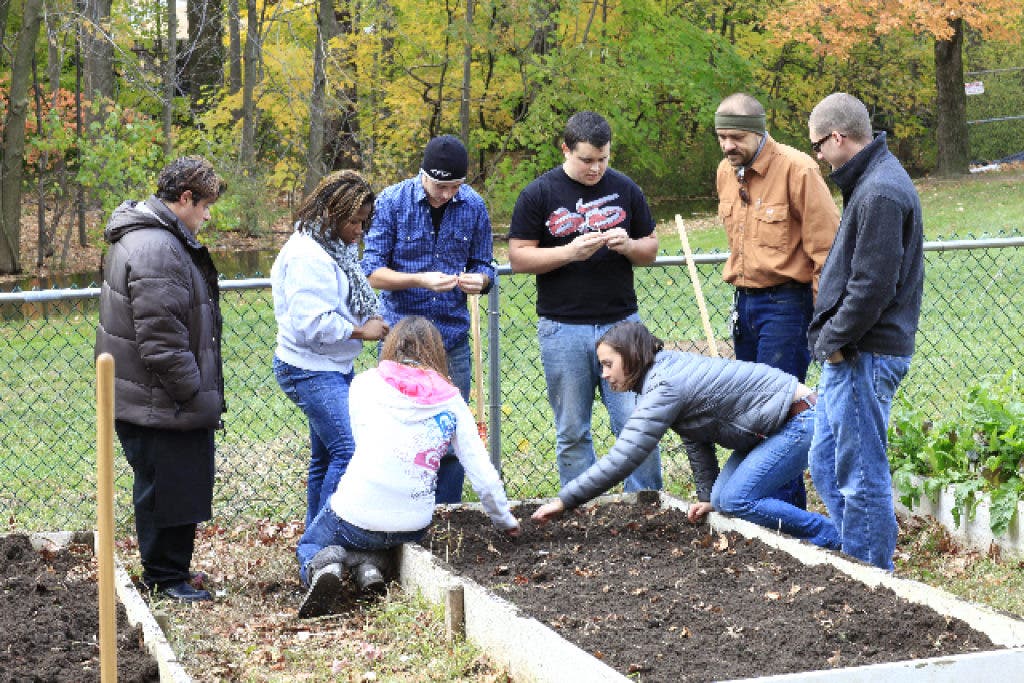
My Local Garden is the name of Knapik’s company, which is made up of professionals throughout the state. They will come to your home, interview you to determine your goals, then build anything from kitchen gardens where they belong--close to the house--to decorative custom window boxes and chicken coops on wheels--all based on the permaculture principles of building practical skills, sharing knowledge, regenerating landscapes and especially inspiring people of all ages to grow their own food.
Knapik spreads the word organic through lectures at local meetings of Master Gardeners, gardening conferences, libraries, arboretums, garden clubs and schools. (Organic means food grown naturally without the use of harsh chemicals or genetic engineering.)
Permaculture expands on the natural idea by also demanding ecological responsibility-that the act of growing leaves no impact on the earth. This is not the touchy-feely kind of hippie/earthy talk of the '60s and '70s--this movement is founded on a kind of Dr. Phil practicality that is both knowledge-based and environmentally responsible.
My Local Garden is as much about education as enthusiasm; these hard-working folks say what they mean and mean what they say. If you want a raised-bed garden for efficient after-work growing, you will not only get that but become knowledgeable enough to have a productive harvest to share with neighbors and friends. The sharing part is as equally important to these passionate garden educators/entrepreneurs as is their success in the field.
Knapik’s enthusiasm is catching. Her lectures are directed toward the beginner as well as stimulating for old green thumbs like me. She teaches many classes on organic gardening at Montclair State University and has been certified as a Permaculture Specialist through a very vigorous program. Knapik has also been involved in many community gardening efforts in the tri-state area.
This new way of returning to nature expresses an old desire: To throw off the chains of a technologically oriented society, where people spend endless hours communicating through texting and computers. It is the longing to return to the back porch for a glass of lemonade, watching fireflies and counting stars, the reminiscing of a satisfactory day of working in the garden, sharing tomatoes with your neighbor, telling stories around the archetypical campfire in the outdoors.
For information, go to Knapik’s website www.MyLocalGarden.com or sign up for classes at adultschool.org. Knapik recommends several books as well: Elliot Coleman of Maine’s “Four Season Harvest," Graham Bell’s “Permaculture Garden” and Rosemary Morrow’s “Earth Users Guide to Permaculture.” A related book not on Knapik’s List is “The Backyard Homesteader,” edited by Carleen Madigan, for suburban sustainability on one quarter of an acre.
“Make producers, not consumers,” admonishes Knapik with a winning smile.