Health & Fitness
Mosquito Pesticide Trucks Are Coming To Astoria
After trying to kill mosquitos in Queens with aerial bug spray, the city is taking an on-the-ground approach amid an active mosquito season.


ASTORIA, QUEENS — The city is taking its mosquito-killing efforts to the streets of Astoria after a spike of West Nile virus cases amid an increasingly active mosquito season.
Last month, the city found positive West Nile virus cases in 188 groups of mosquitoes across the five boroughs, which is a massive spike from the 9 positive groups that had been found at that time last year.
Since the insects breed in standing water, the Department of Health attributes the spike in mosquitos to "recent heavy rains" — a trend that experts say we can expect to continue seeing amid increasingly severe, climate change-induced weather changes.
Find out what's happening in Astoria-Long Island Cityfor free with the latest updates from Patch.
The city has been attempting to reduce citywide mosquito activity since mid-May by sending low-flying helicopters over insect hot-spots and dousing the areas in larvicide.
In the World's Borough, the DOH has done the mosquito repellent treatment four times, especially in areas of northeast Queens, which appears to be one of the city's West Nile virus hotspots, according to a city map.
Find out what's happening in Astoria-Long Island Cityfor free with the latest updates from Patch.
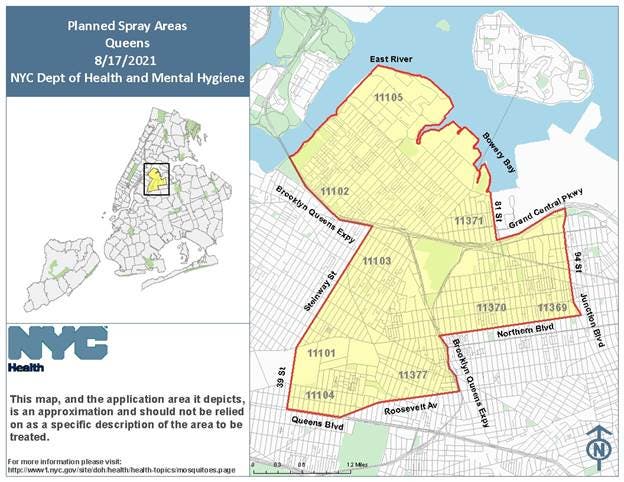
For the first time this season, the agency is bringing an on-the-ground approach to parts of northwest Queens, with plans to drive around parts of Astoria, Ditmars, East Elmhurst, Jackson Heights, Steinway, Sunnyside, Sunnyside Gardens, and Woodside spraying a mosquito adulticide on city streets.
The city previously used this approach in parts of northeast and southeast Queens, as well as the Bronx.
The city's mosquito-killing trucks will drive around those sections of northwest Queens on Tuesday, Aug. 17 between the hours of 8:30 p.m. and 6:00 a.m. the following morning, weather permitting.
Whereas the aerial treatment uses the chemical VectoMax® GS, the trucks will deploy "very low concentrations of Anvil®, Duet®, or DeltaGard®," according to the DOH.
The agency describes the risks of this pesticide as "low" to people and pets, but says that people who are sensitive to spray ingredients could feel short-term eye or throat irritation or get a rash.
In order to avoid symptoms, the DOH recommends staying indoors during spraying, and washing any skin or clothing that's been exposed to the pesticide with soap and water.
The treatment helps ensure that people stay better protected from mosquito-borne diseases, specifically including West Nile virus.
So far, cases of West Nile virus have just remained in mosquitos this season, although the DOH is still investigating one person in the Bronx who was recently diagnosed with meningitis, which can be caused by West Nile virus.
The best way to control mosquitoes at home is to replace containers of standing water — including vases and pet bowls— weekly, to prevent breeding.
Other options include wearing long sleeves and pants, and using air-conditioning or window and door screens.
To prevent mosquito bites, the Centers for Disease Control suggests using insect repellent that contain DEET, picaridin, ir3535, lemon eucalyptus oil, para-menthane-diol or 2-undecanone.
Here's where the trucks will drive around and spray for mosquitos in northwest Queens:
Get more local news delivered straight to your inbox. Sign up for free Patch newsletters and alerts.