Business & Tech
Atlantic Avenue Business Owners Frustrated With LIRR Construction
MTA Says They've Met And Communicated With Business Owners
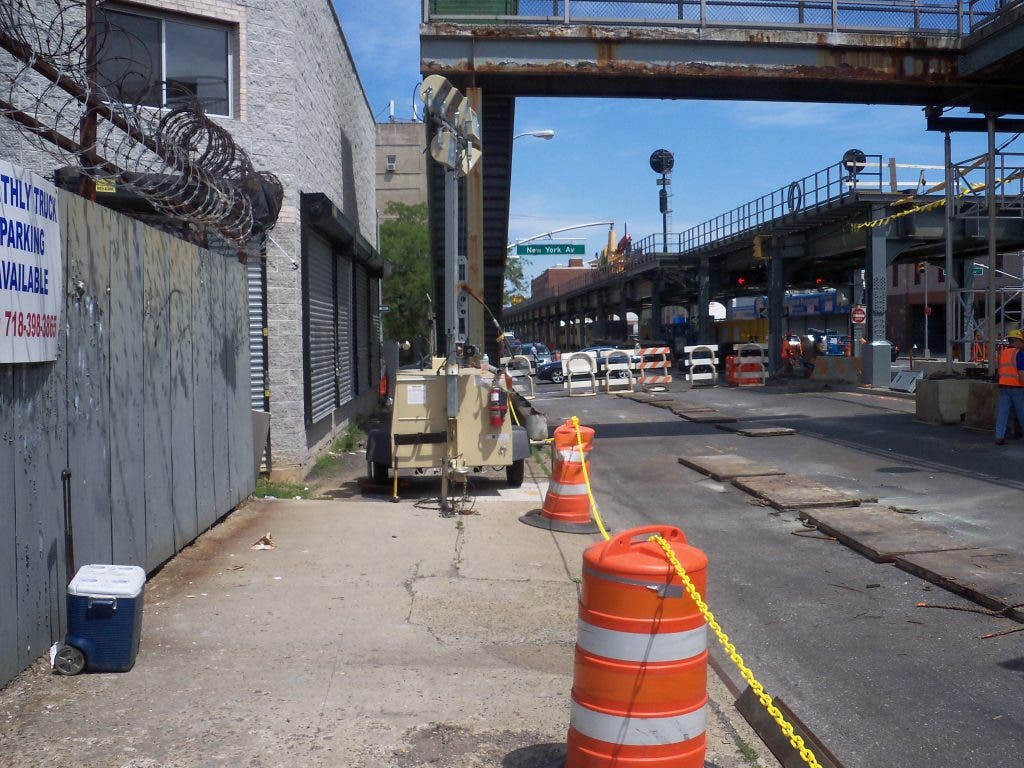


Business owners along a stretch of Atlantic Avenue, between Nostrand and New York Avenue, are hot and bothered by an MTA construction project that has had a crippling effect on foot traffic into their businesses.
Construction is underway to complete the third phase of the Atlantic Avenue Viaduct Rehabilitation-- a $237 million project that began in 2008 to improve and repair a section of the Long Island Rail Road that carries LIRR customers between Jamaica, Queens and downtown Brooklyn.
The work along the Atlantic Avenue section, which began in April, will replace girders, beams, and bracing, as well as the upper portion of street columns supporting the LIRR’s Nostrand Avenue station.
Find out what's happening in Bed-Stuyfor free with the latest updates from Patch.
The project will continue through August with closures to eastbound and westbound rotating every weekend.
However, it's a not a pretty picture for business owners on the block already coping with a tepid economy, as the need for construction crew members to work virtually shuts down the ability of customers to access their stores.
Find out what's happening in Bed-Stuyfor free with the latest updates from Patch.
“A lot of drivers can’t come through now because there’s one lane open,” said Ray Mendoza, owner of Rush Auto Tire Shop on Atlantic. “So a lot of people, even if they have a flat tire, they’ll keep going straight down rather than stop here.”
As Mendoza spoke in front of his store, several yards away dust is flying, garbage is piling up along the block and heavy construction machinery is being moved by construction crews.
The westbound side of Atlantic that houses Mendoza’s business is totally shut down to vehicular traffic with barely any room for pedestrians to walk, while on the eastbound side, only one lane is open for cars, leaving little room to park.
Mendoza, who has run his business on Atlantic for 12 years, says that since the construction work began, it has cut his business by 75 percent. He feels even more angry by what he says is the lack of communication between the MTA and business owners on the block.
“I just got a flyer about this a couple of days ago, and not too long a guy from the MTA visited and told me that this work might last longer than what they’re saying,” said Mendoza.
Down the block, Adam Reisner, a designer at the Atlantic Design Center, had a couple of customers in his store when Patch stopped by. But he agreed with Mendoza that overall, the construction project has hurt business.
“A lot of our customers that would usually drive up here can’t make it today because of what’s going on outside,” said Reisner. “And the Long Island Rail Road does not give enough notice or preparations when they decide to do this phase of the train station.”
Sal Arena, a spokesman for the MTA said that “whatever inconvenience there is, relatively speaking it’s short-term.”
“The work is scheduled to be completed some time in September. We’ve publicly announced and let the local businesses and civic groups know about that, provided that everything goes according to plan and there are no interruptions,” said Arena.
Arena insisted that the MTA has been working closely with the Bed-Stuy Business Improvement District to alert business owners in the area of upcoming road work.
However, while Bed-Stuy Business Improvement District Deputy Director Lisa Thompson, acknowledged that the LIRR has held bi-weekly meetings on the viaduct project with her group and business owners around Bed-Stuy since January, the block on Atlantic between Nostrand and New York Avenues “is out of our boundaries.”
Thompson advises business owners to read the materials they’re given and to participate in local townhall meetings.
Despite the construction work affecting his business “significantly," Edmon Braithwaite, owner of Nostrand Wines and Liquors on the corner of Atlantic and Nostrand, is doing his best to ride out the long construction project.
Unlike other business owners on the stretch, Braithwaite feels that the LIRR has done a good job in reaching out to him, especially when it came to his concerns regarding parking sign changes.
“I’ve had three meetings with their senior staff, they’ve given me community updates and I even met with a contractor two hours ago right on the street outside, so I’m comfortable with the communication," said Braithwaite. "They’ve been very proactive.”
