Schools
4 John Jay Seniors Earn Top Science Awards At WESEF
Research on crops, ticks, possible treatments for disease and better understanding of how trauma affects physiology made an impression.


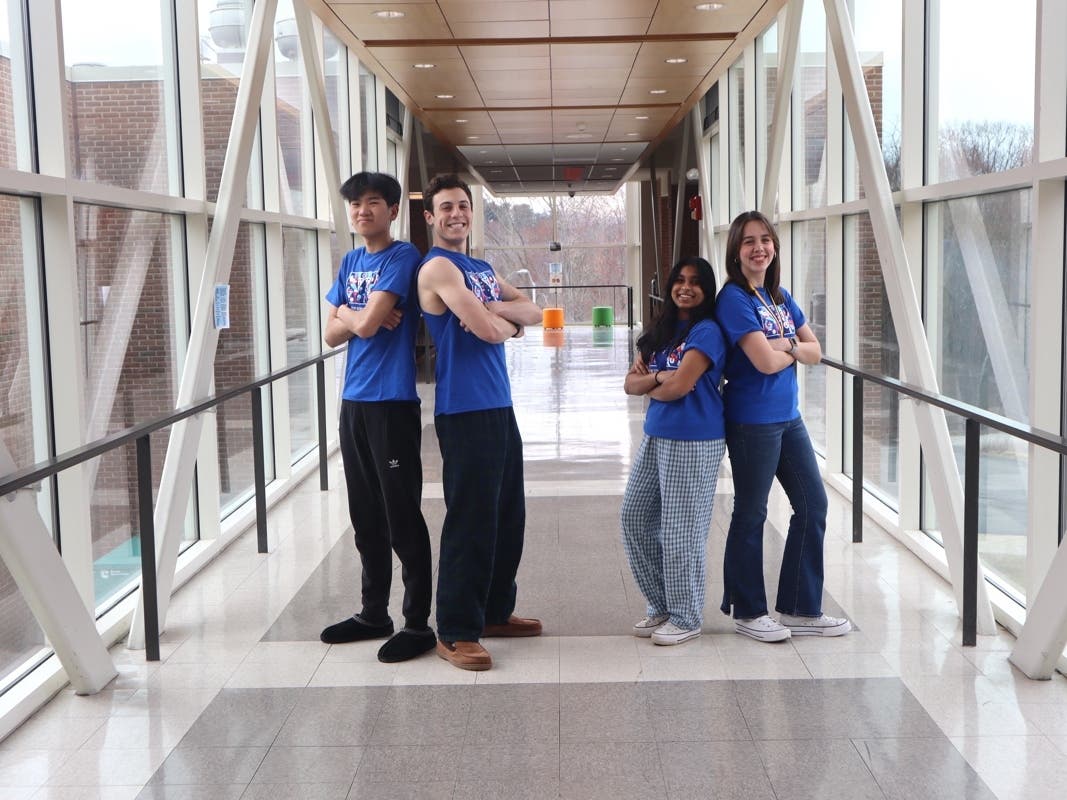
CROSS RIVER, NY — Four local high school scientists are being honored for doing their part to help us to better understand the world we live in.
The Katonah-Lewisboro School District announced that four seniors in John Jay High School’s Science Research program were recognized at the Regeneron Westchester Science and Engineering Fair (WESEF) Awards Ceremony on March 23.
- Caleb Lee placed 4th in Environmental Science for his research on the influence of soils on crop yield.
- Sophia Lind was awarded the Office of Naval Research Award for her research on how childhood trauma affects the structural brain.
- Maya Nitta was awarded 1st place in Medicine and Health and earned a spot as a WESEF Finalist. Maya will be going to Dallas to present her research at the International Science and Engineering Fair along with 19 other top projects from WESEF. Her research is on the efficacy of hyperbaric oxygen therapy as a preventative treatment against engraftment syndrome.
- Byron Wilson was honored with the NASA Earth System Science Award for his research on tick populations at Ward Pound Ridge Reservation.
"I am so happy for the students, and appreciative of the hard work and support of teachers Krista Munger and Dr. Linda Burke," science research teacher Ann Marie Lipinski said.
Find out what's happening in Bedford-Katonahfor free with the latest updates from Patch.
John Jay’s Science Research students will present their work at the school’s Science Research Symposium on April 20, at 7 p.m. The event will take place at John Jay High School and is open to the public. It will feature speaker sessions at which all seniors will present a 12-minute PowerPoint, and then move to a poster session in the cafeteria where seniors, juniors and sophomores will present their research.
"This is such an exciting accomplishment for our students, and such a great tribute to all the support and guidance offered by their teachers," Superintendent Andrew Selesnick said.
Find out what's happening in Bedford-Katonahfor free with the latest updates from Patch.
The following details about the winners were provided by the Katonah-Lewisboro School District:
Caleb Lee
A chance online internship the summer after his freshman year introduced Science Research senior Caleb Lee to soil research. He became fascinated by the connection between soil, plant health and human health. "It’s a cycle that most people take for granted," he said. That interest informed his Science Research project: Influence of Soils on Crop Yield and Food Security. He worked alongside mentor Richard Huh who manages an organic farm at the Hemato Institute in Bedford.
"My project looks at how a combination of a cover crop treatment and a microorganism solution can affect the health of New York soil," said Caleb. He took core samples from four plots of soil treated with a combination of cover crops, cash crops and microorganism solution. The results show that the use of cover crops have a more significant positive impact on the soil health compared to the microorganism solution.
Caleb plays basketball, is the President of the Videography Club, and the Treasurer of the Junior State of America. He sees himself pursuing agricultural sciences in college and beyond.
"Science Research has taught me how to research through journals, how to learn from other people and how to do my own research," said Caleb. "I’ve also learned a lot about public speaking. This class has set me up for the future!"
Sophia Lind
Science Research senior Sophia Lind is fascinated by what shapes us. Her interest in epigenetics—environmental factors’ effect on the way our genes are expressed, which can be perpetuating across generations—led her to study how childhood trauma affects the structural brain.
Her Science Research topic: Adult Brain Volume Changes Related to Childhood Maltreatment, Polygenic Risk, and Neighborhood Socioeconomic Status. She worked with Dr. Ashley Huggins, Ph.D. in The Morey PTSD and TBI Neuroimaging and Analysis Lab at Duke University.
"Participants of my analysis experienced a traumatic injury, leading to an ER visit with a risk of future PTSD," said Sophia. She taught herself to code in R-Studio and analyzed data collected on the subjects’ brain volumes and information provided by their Childhood Trauma Questionnaire among other mechanisms.
Sophia found working with her mentor, Dr. Huggins, an invaluable experience. Last summer Sophia spent a week in The Morey Lab, shadowing researchers, analyzing MRI scans and seeing how a professional research lab functions.
Although Sophia has many literary and artistic interests and talents, she said that John Jay’s SciRe program reconnected her to her early interest in brain science. She’s President of the Art Club and an editor of the school newspaper, The John Jay Focus, and Reflections, the school’s literary journal. Her short story related to mental health was published in a book titled “Collecting Dust.” She also wrote "School’s Effect on Mental Health" for the The Katonah-Lewisboro Times.
Maya Nitta
Science Research senior Maya Nitta lights up when she talks about her experience working in a medical research lab. "I worked with 72 different plasma samples," said Maya. "They were frozen; one of my jobs was to bring them to room temperature them each morning. I observed experiments and prepared for my own research."
Maya’s Science Research project topic: Investigating the Efficacy of Hyperbaric Oxygen Therapy in Modulating IL-6 and Treating Engraftment Syndrome in Post-Stem Cell Transplant Patients. Her mentor is Dr. Omar Aljitawi at The Hematology and Transplantation Lab at UR Medicine.
Tenacity is one of Maya’s strengths. It was difficult for her to find a lab internship as she was not yet 18 years old the summer before her senior year. "I reached out to fifty labs," said Maya, "and was rejected by 49 of them." She’s also adaptable. Maya initially thought she would research diabetes, then shifted to traumatic brain injuries, then glioblastoma brain tumors. When she found her mentor, she also found a research topic: transplant rejection.
"My research focuses on evaluating the efficacy of hyperbaric oxygen therapy as a preventative treatment against engraftment syndrome which is an inflammatory complication that occurs in many patients who have undergone allogeneic stem cell transplants," said Maya.
"Because of COVID, my grade missed out on a lot of hands-on learning in school," said Maya. "I loved getting to be hands-on in the lab."
Maya is Captain of John Jay’s Varsity field hockey team, Captain of the Science Olympiad team, and Secretary of the Amnesty International club as well as a member of the District’s Equity and Racial Justice Committee. She looks forward to studying biomedical engineering in college.
Byron Wilson
Science Research senior Byron Wilson is co-captain of John Jay's cross-country team, captain of John Jay’s Fishing Club and a mechanic at Ridgefield Bicycle Company. When it came time to pick a research topic, he thought of the ticks that he was always wary of while running, fishing and mountain biking. "I recognize ticks as a local threat," said Byron. He decided to learn more.
Byron’s Science Research topic: Habitat Vegetation and Tick Population Densities. His mentors are Dan Aitchison, curator of wildlife at Ward Pound Ridge Reservation; Dr. Linda Burke, a palynologist, ecologist and taxonomist—and former Science Research teacher at John Jay; and Dr. Richard Ostfeld, who studies the ecology of tick-borne diseases at the Cary Institute of Ecosystem Studies.
Data collection looked like this: Wearing long pants, long sleeves and boots, Byron dragged a 1 x 1 meter square of white muslin attached to wooden dowels and a rope through specific sections of Ward Pound Ridge Reservation. He stopped every 15 meters, collected the ticks from the muslin using forceps and put them into vials.
He specifically compared the ticks found in the ecotone, or border, between mowed fields and deciduous forest and the ecotone between unmowed fields and deciduous forest. Byron found that the ecotone between unmowed fields and deciduous forest supported a denser tick population.
Documenting temperature humidity, and precipitation proved crucial to data interpretation. “Last summer was a uniquely hot and dry summer,” said Byron. "I saw a desiccated—dried up—tick population."
"Science Research affirmed my interest in field biology," said Byron.
Get more local news delivered straight to your inbox. Sign up for free Patch newsletters and alerts.